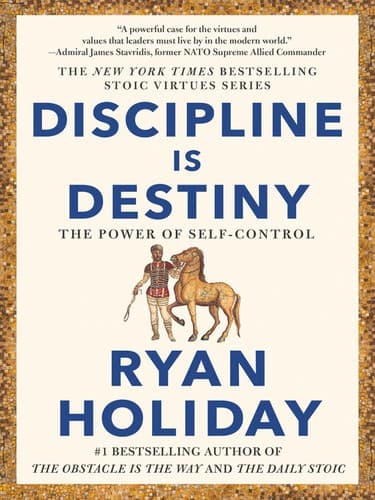
Core Idea
- Temperance, or self-discipline, is the book’s central virtue: the power to govern appetite, impulse, habit, and ambition so the higher self—not the lower one—runs a life.
- Holiday argues that freedom is not license but self-rule; without restraint, liberty, success, technology, and plenty become forms of bondage.
- The real contest is the ancient one of akrasia: what is easy, immediate, and indulgent versus what is best, durable, and worthy.
What Discipline Looks Like
- Holiday treats discipline as physical, mental, and spiritual command, with the body as a training ground for character.
- Lou Gehrig embodies this at the body level: he played through pain and discomfort, never missing 2,130 consecutive games, and refused to make excuses.
- Early rising, clean spaces, and routine matter because they protect the best hours and reduce friction; a tidy desk, made bed, and orderly environment support clear thinking.
- “Just show up” is a recurring rule: genius depends less on inspiration than on repeated, ordinary labor, whether Edison in the lab or writers advancing a book page by page.
- Practice creates second nature; Musashi, Casals, and the idea that we fall to our training all reinforce that performance under pressure comes from repetition.
- Discipline also includes rest, sleep, and recovery; overwork can be a false economy, while proper sleep and load management preserve judgment and longevity.
- Holiday extends discipline to appearance, simplicity, and frugality: need less, own less, and other people have less leverage over you.
Managing Desire, Pain, and Temperament
- A major section of the book warns that pain and pleasure both distort judgment if temperament is not in control.
- Kennedy’s pain is used as a cautionary example: self-medication, doctor-shopping, and relief-seeking worsened his condition, while real improvement came from exercise, stretching, breathing, and strengthening.
- Holiday is not against help; he explicitly allows treatment, but rejects “Dr. Feelgoods” and any promised shortcut that offers escape without real work.
- Pleasure is treated in the Epicurean sense as absence of pain, not indulgence; the test of a pleasure is what it costs you the next morning in shame, fog, or damage.
- Abstinence means avoidance, but restraint means knowing the right limit and stopping there; this applies to food, drink, sex, work, and attention.
- He broadens self-discipline into protection from every kind of addiction or dependency—including approval, ambition, social media, and busyness.
- Temperance also means not getting baited by insults, gossip, provocation, or anger; the discipline is to keep the main thing the main thing.
- Silence is part of this: speak less, keep secrets, and prefer the power of quiet competence over verbal release.
Self-Control as Leadership and Character
- The book repeatedly ties self-discipline to leadership under pressure: Eisenhower, Washington, Churchill, Elizabeth II, and others model restraint rather than impulse.
- Queen Elizabeth II is the clearest example of rulerly temperance: calm, dutiful, adaptable, and able to listen, pause, and choose “better not” over reflex.
- George Washington and Abraham Lincoln show the discipline of pause, revision, and not acting from anger; the space between stimulus and response is where character lives.
- Churchill’s patience was strategic, not timid: he resisted pressure to squander strength early and waited for the decisive moment to act.
- Holiday admires people who carry burdens, share power, and know when to step back; resignation, retreat, or withdrawal can be higher forms of strength than clinging to office.
- Discipline is not coldness; it should make a person kinder, steadier, and more useful to others, raising the standard around them.
The Hard-Won Balance Holiday Defends
- The book’s definition of greatness is not trophies or wealth but human flourishing; self-control protects a person from laziness, excess, and their own ambition.
- Holiday is wary of ambition as a fever: socially rewarded striving can hollow people out and make them tyrannical or unhappy.
- Money is presented as a tool, not an endpoint; there is no magical state of being beyond discipline, only the chance to use resources to say no and stay faithful to the main work.
- Time is the nonrenewable resource; discipline means boundaries, delegation, and refusing distractions so the essential work and the essential people get what they deserve.
- Holiday’s own writing process becomes part of the argument: he nearly failed the manuscript until he recommitted to trusting the process, doing the cards, and writing anyway.
- His final standard is that hard things are good when pursued with temperance and sustainability; discipline is what turns talent into destiny.
What To Take Away
- Self-discipline is not austerity for its own sake; it is the condition of freedom, dignity, and reliable performance.
- Temperament matters as much as talent because the body’s cravings, pain, and passions can wreck judgment unless they are governed.
- The best discipline is steady, unglamorous, and repeatable: show up, do the work, rest properly, and keep the main thing the main thing.
- Destiny belongs to the disciplined not because outcomes are guaranteed, but because a self-mastered life is the only secure foundation for success, service, and character.
Generated with GPT-5.4 Mini · prompt 2026-05-11-v6