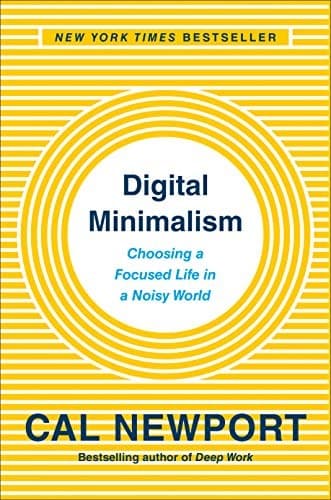
Core Idea
- Digital minimalism is Newport’s answer to the feeling that modern internet tools are not just distracting, but draining autonomy, mood, and meaning from nonwork life.
- His claim is not that technology is bad, but that most people need a full philosophy of tech use grounded in values, not a few hygiene hacks like turning off notifications.
- The practical entry point is the digital declutter: a 30-day break from optional digital technologies, followed by a selective reintroduction of only the tools that clearly earn their place.
Why the Problem Exists
- Newport argues that tools like Facebook and the iPhone moved from peripheral conveniences into the core of daily life so fast that people never had a serious chance to decide what role they wanted them to play.
- The deeper issue is a lopsided arms race: platforms are designed to exploit psychological vulnerabilities while users experience them as harmless fun.
- He leans on Tristan Harris and Adam Alter to show how behavioral addiction works through intermittent positive reinforcement and the drive for social approval.
- The Facebook Like button is his signature example of a slot-machine-like feedback loop, while hearts, tags, streaks, and instant replies all exploit our tribal sensitivity to approval.
- Newport’s three principles are clutter is costly, optimization is important, and intentionality is satisfying.
- Clutter is costly means even “useful” tools can cost too much in life terms once you count the attention and time they consume, not just the money they save or value they provide.
- Optimization is important means digital tools often have diminishing returns, so careful rules and workflows can recover a lot of value without unrestricted use.
- Intentionality is satisfying means the act of deliberately choosing what belongs in your life matters, as illustrated by the Amish and liberal Mennonites evaluating technology through core values rather than convenience.
The Main Arguments: Solitude, Conversation, and Leisure
- Newport argues that modern life has become solitude deprived: people spend very little time alone with their own thoughts, free from input from other minds.
- He defines solitude as a subjective state, not physical isolation; you can be solitary in a coffee shop if you are not consuming other minds through books, podcasts, or a phone.
- He treats solitude as a source of new ideas, self-understanding, emotional balance, and stronger relationships, and worries smartphones plus “always-on” audio have nearly erased the quiet needed for it.
- He flags rising anxiety, depression, and suicide among iGen as a possible warning sign, citing Jean Twenge’s timing around 2012 when teen mental-health trends worsened sharply.
- His recommended solitude practices are simple but pointed: leave the phone behind sometimes, take long walks alone, and write letters to yourself to think by writing.
- On social life, Newport argues that only conversation really counts; texts, emails, IMs, and social media are mostly logistical tools, not substitutes for rich interaction.
- He uses Sherry Turkle’s contrast between connection and conversation to argue that low-bandwidth digital interaction can displace the face-to-face or voice-based exchanges that actually maintain relationships.
- He also notes a trade-off: digital communication can expand networks and offer small benefits, but heavier use often correlates with loneliness and worse well-being because it displaces offline contact.
- His concrete social rules include not clicking Like, reducing low-value comments, consolidating texting, and using conversation office hours so calls and in-person talk happen deliberately.
- Newport’s leisure argument is that a good life needs more than problem-solving and passive consumption; it needs high-quality leisure that is valuable for its own sake.
- He favors demanding activity over passive entertainment, drawing on the Bennett Principle that strenuous pursuits can leave you more energized, not less.
- He praises craft and hands-on work because physical reality gives “infallible judgment,” making skill, effort, and tangible results more satisfying than screen-based self-presentation.
- He also values structured social leisure—board games, CrossFit, F3, social fitness, clubs—because shared rules and rituals create lively in-person community.
- The broader goal is a leisure renaissance in which digital tools support analog life, rather than colonize all free time.
The Digital Declutter and Reentry
- The digital declutter is not a permanent purge but a 30-day reset designed to break default habits and reveal which tools actually deserve reentry.
- Newport defines optional technologies as screen-based tools you could remove without seriously harming work or personal life, and recommends giving borderline tools operating procedures instead of open-ended access.
- Examples of operating procedures include checking texts only from a spouse, email only on desktop, podcasts only on a commute, or capping Netflix to a set number of episodes.
- The first part of the declutter is usually uncomfortable, but Newport says the urge to check typically fades after one or two weeks.
- The point is not just detox; it is to force rediscovery of analog replacements like reading, journaling, organizing, hobbies, face-to-face conversations, and family time.
- Reintroduction requires a three-part screen: the tool must support something deeply valued, be the best way to support it, and have a specific operating procedure.
- Many participants, Newport reports, abandoned social media entirely or kept it only under strict limits, sometimes discovering they no longer even liked the service after the break.
- The book treats this selective reentry as the real mechanism by which digital minimalism becomes sustainable rather than merely aspirational.
What To Take Away
- The book’s central move is to stop asking whether a tool is useful in isolation and instead ask what life cost it imposes once attention, autonomy, and habit are counted.
- Newport’s philosophy is less about abstinence than about intentional scarcity: keep only a few carefully chosen digital uses that clearly serve your values.
- His strongest recurring warning is that shallow digital “connection” can quietly crowd out solitude, conversation, and embodied leisure—the very things that make life feel rich.
- Digital minimalism is ultimately a claim that less technology, used more deliberately, can produce more meaning than constant access ever will.
Generated with GPT-5.4 Mini · prompt 2026-05-11-v6