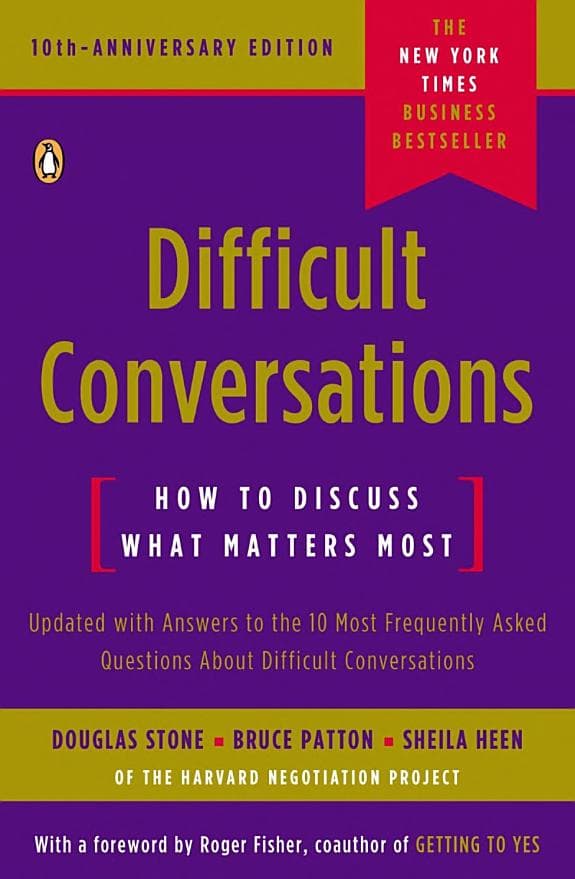
Core Idea
- Difficult conversations are normal, not signs of failure; the aim is to handle them better, not eliminate them.
- The book’s central move is from message delivery to a learning conversation: a shared inquiry into what happened, what is felt, and what is at stake for identity.
- Most hard talks are derailed not by the topic itself, but by the three hidden conversations inside them: What Happened?, Feelings, and Identity.
The Three Conversations
- In What Happened?, people fight over facts, intent, and blame, but the authors argue these are usually clashes of perception, interpretation, values, and incomplete information.
- The truth assumption makes each side treat its story as reality and the other’s as wrong; the remedy is curiosity and the And Stance, which holds both stories as potentially valid.
- The intention invention error is assuming we know what motives produced an action; intent is invisible and should be treated as a hypothesis, not a verdict.
- The book’s alternative to blame is contribution: ask how each person, and the surrounding system, helped create the problem and how to prevent it next time.
- Contribution is often missed in recurring patterns such as being too late to raise concerns, being unapproachable, mismatched assumptions at an intersection, or hidden role assumptions that keep a cycle going.
- The point of contribution is not confession; it is to understand enough to move forward constructively.
- In the Feelings Conversation, emotions are not side issues but “at the very core” of difficult conversations, even when the surface topic is money, work, or logistics.
- Unspoken feelings leak through tone, body language, sarcasm, withdrawal, or defensiveness, and burying them also makes it harder to listen.
- People often mistake judgments or accusations for feelings; the book insists on naming the actual emotion beneath the label.
- Before sharing feelings, it helps to negotiate with them: perceptions can change, and so can emotions, once the story is better understood.
- In the Identity Conversation, the danger is what the issue seems to say about whether we are competent, good, or worthy of love.
- Identity threat creates all-or-nothing thinking, panic, denial, or overreaction; the goal is not to avoid the threat but to regain balance and complexity.
How to Have the Conversation
- Start with the Third Story: a neutral, outside-observer account of the difference between the two stories, not an argument from inside your own.
- The useful sequence is Third Story → Their Story → Your Story → problem-solving.
- Open by inviting partnership, not compliance: ask the other person to help you understand, rather than framing them as villain, obstacle, or judge.
- When bad news is unavoidable, be direct and humane; do not trick the other person into saying it first or hide the point behind hints.
- Listening is mainly a stance of curiosity: “Help me understand” is the target, not performance of active-listening formulas.
- Good listening requires noticing your internal commentator so you are not just waiting to reply while pretending to hear.
- Helpful tools are inquiry, paraphrasing, and acknowledgment; inquiry is for learning, paraphrase shows understanding, and acknowledgment answers the emotional question of whether the other person feels heard.
- Acknowledgment is not agreement, but it must usually come before problem-solving.
- Questions should be open, concrete, and safe to decline; cross-examination or questions that are really statements only harden the fight.
- If you are flooded, say so and pause rather than fake attention; sometimes the right move is to ask for a better time.
Speaking Clearly and Staying Whole
- To speak well, you need entitlement: the conviction that your views and feelings are as legitimate as the other person’s.
- Silence does not protect you; the book uses Audre Lorde’s warning to argue that what matters most should be spoken even at the risk of being misunderstood.
- Self-sabotage often looks like “trying” but actually preserves the safety of failure; hesitation, forgetting, and vagueness can reflect identity doubt.
- If speaking feels sickening, the book recommends a STOP sign: ask why you feel unentitled, whose voice you hear, and what would restore enough confidence to speak.
- Say the heart of the matter directly, rather than hiding it in subtext, hints, jokes, or leading questions.
- Use the Me-Me And to name your own mixed thoughts honestly instead of flattening them into one polished position.
- Distinguish fact, opinion, and conclusion; explain the experiences and reasons behind your view instead of presenting it as absolute truth.
- Avoid “always” and “never,” which invite counterargument and make change feel impossible; speak in specifics, impacts, and possibilities.
- The book repeatedly stresses that you are the authority on your own experience, but not on the other person’s intent or the full truth of the situation.
What To Take Away
- The book’s practical optimism is modest: you will not prevent all conflict, but you can reduce fear, improve outcomes, and preserve self-respect.
- Most breakthroughs come from shifting stance, not from finding the perfect wording: curiosity, humility, and balance matter more than cleverness.
- The hardest conversations become workable when you separate story, feelings, and identity instead of collapsing everything into blame.
- The deepest goal is not agreement in every case, but a conversation that lets both people understand more, decide more clearly, and move forward without unnecessary damage.
Generated with GPT-5.4 Mini · prompt 2026-05-11-v6