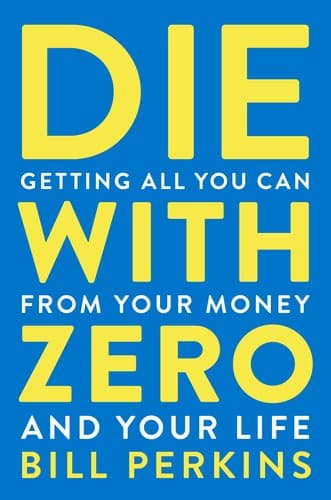
Core Idea
- Die With Zero argues that money is a tool for maximizing lived experience, not an end in itself.
- The central mistake is saving too long or too much and missing the age-sensitive windows when experiences, relationships, and health can actually be enjoyed.
- The goal is not literal zero in your bank account at death, but a life structured to convert money into meaningful experience at the right times.
The Book’s Main Logic
- Perkins treats life as an optimization problem: use finite life energy and finite time to maximize fulfillment, not net worth.
- Money is valuable because it buys experiences, but experiences create a memory dividend through recollection, photos, stories, and nostalgia.
- Because the memory dividend compounds over time, earlier experiences often have more total value than identical experiences purchased late.
- Some opportunities are age-dependent or health-dependent, so “I’ll do it later” is often false even when money can be earned back.
- The book rejects living on autopilot, where people follow defaults, routines, and social scripts instead of deliberately choosing what to spend time and money on.
- A recurring warning is that small recurring choices, like the “latte factor,” matter mainly because they reveal opportunity cost, not because frugality is the highest virtue.
- Perkins uses the idea of life energy from Your Money or Your Life: every dollar represents hours of life spent earning it.
- He notes that a higher salary can be misleading if commuting, clothing, and extra work hours make the true hourly value lower than it appears.
How to Think About Spending, Saving, and Timing
- The book rejects fixed rules like “save 10%” or the 50-30-20 rule because the right spend/save balance changes with age, health, income, and stage of life.
- Young people often have time and health but little money, so it can be rational to borrow or save very little if income is likely to rise later.
- But the opposite error is also real: spending more just because one can, without getting much memory dividend, is waste rather than fulfillment.
- Perkins argues that the best period for many people is the overlap of health and wealth in midlife, when money can still buy meaningful experiences and time pressure is manageable.
- He makes a strong case that health is the biggest multiplier, because health expands what money can actually do.
- Small health declines can snowball, so preventive care and maintenance are framed as investments in future experience points.
- Time-saving purchases can be rational when they buy back hours that matter more than the cash spent, especially when money is more abundant than time.
- He cites research suggesting people who spend on time-saving services report higher life satisfaction because time pressure falls.
- A useful test is the “Would I rather?” question: would I rather have this experience now or wait for a bigger version later?
- Perkins’ personal interest rate is the implicit rate at which delaying an experience would have to compensate you; it rises as you get older or sicker.
- The book also introduces time bucketing, which means assigning experiences to the life stage when they are most feasible instead of keeping them on a vague bucket list.
- Physical, adventure-heavy, or energy-intensive experiences belong earlier; some experiences like reading or cruising remain flexible later.
Peak Wealth, Risk, Giving, and Mortality
- Rule No. 8 says your net worth should have a peak point, after which you should start spending down rather than trying to grow wealth forever.
- That peak should be a date or life stage, not an arbitrary target number, because numerical goals tend to shift and delay action.
- The author uses simulations and a rough survival threshold idea: keep enough to cover expected remaining living costs, then spend the rest on life.
- He argues that many people oversave for longevity risk, acting as if they were bad insurance agents who self-insure by hoarding too much.
- To manage risk, the book favors tools like life expectancy calculators, life insurance for mortality risk, and annuities for longevity risk.
- An annuity is presented mainly as insurance, not as an investment, because it pools the risk of outliving savings.
- Perkins repeatedly stresses that retirement is partly “retiring on your memories,” since later-life enjoyment depends increasingly on accumulated experiences.
- For this reason, he thinks the best age to create memories is earlier, when they can generate decades of dividends.
- On children and inheritance, he argues that leaving money at death is often inefficient because it arrives too late for maximum usefulness.
- He favors in vivo transfers—giving money while alive—because you can time gifts when recipients are most able to use them, often around ages 26–35.
- The same logic applies to charity: giving while living beats posthumous bequests because the recipients can use the money immediately.
- He praises examples like Robert F. Smith’s Morehouse support and Chuck Feeney’s lifetime philanthropy as models of timely generosity.
- The recurring moral is that if you care about the people or causes you want to support, you should not wait until death makes the transfer automatic.
What To Take Away
- Spend with intention, not by inertia: the right question is what life value a dollar buys at this moment, not whether saving is virtuous in the abstract.
- Time matters more than people admit: many experiences, gifts, and opportunities have a best-before date.
- Protect health and buy back time when it genuinely expands experience, because money is only useful insofar as you can still use it.
- Die with zero is a direction, not a literal account balance target: convert wealth into a fuller life, and don’t leave meaningful living deferred until it is too late.
Generated with GPT-5.4 Mini · prompt 2026-05-11-v6