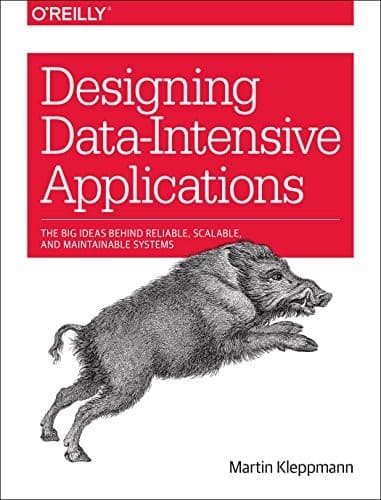
Core Idea
- The book’s central claim is that data-intensive applications are defined by data as the main challenge: volume, complexity, change rate, and distribution matter more than raw CPU.
- Its goal is not to teach one database or framework, but to explain the design trade-offs behind reliable, scalable, and maintainable systems built from multiple data tools.
- Real systems are usually compositions of databases, caches, queues, search indexes, batch engines, and stream processors, so architecture matters more than any single component.
Designing Reliable, Scalable, Maintainable Systems
- Reliability means the system keeps working correctly at the desired performance level despite hardware faults, software bugs, and human error; faults are inevitable, so the goal is to stop them becoming failures.
- The book emphasizes common failure sources: disk and machine faults at scale, correlated software bugs, and operator mistakes; remedies include redundancy, isolation, monitoring, rollback, testing, and deliberate fault injection like Chaos Monkey.
- Scalability is not a binary label but a question of how a system behaves as load grows; the right load parameters might be requests/sec, fan-out, read/write ratio, or active users.
- Performance must be measured carefully: response time is a distribution, not a single number, and tail latencies like p95/p99/p999 matter because queueing and slow outliers dominate user experience.
- The book argues there is no universal scaling recipe; good designs depend on the workload, whether the system is read-heavy or write-heavy, and whether vertical scaling, horizontal scaling, or a hybrid is appropriate.
- Maintainability is framed as minimizing long-term cost of operations, debugging, adaptation, and feature work, with three principles: operability, simplicity, and evolvability.
- The book treats abstraction as the main tool for reducing accidental complexity, but notes that finding good abstractions is especially hard in distributed systems.
Data Models, Storage Engines, and Distributed Consistency
- Data models shape both software structure and how engineers think; the book compares relational, document, and graph models and argues that no single model fits all use cases.
- Relational databases win on powerful querying, normalization, joins, and declarative SQL; document databases fit tree-like, self-contained data with better locality; graph databases fit highly interconnected data and many-to-many relationships.
- The book stresses that “schemaless” document stores are misleading: the schema is just pushed into application code, so the real choice is schema-on-write versus schema-on-read.
- It also contrasts declarative languages with imperative ones: SQL hides access paths and lets the system optimize, while graph query languages like Cypher and SPARQL expose pattern matching over vertices and edges.
- Storage engines are presented as a choice between log-structured designs and B-trees; LSM trees favor sequential writes and compaction, while B-trees favor more predictable reads and direct in-place access.
- For analytics, the book distinguishes OLTP from OLAP and explains why column-oriented storage, compression, and materialized views make warehouses fast for scans and aggregates.
- Replication, partitioning, and transactions are treated as the core distributed-data problems; replication gives availability and read scaling, but introduces lag, failover risk, and consistency anomalies.
- The book compares single-leader, multi-leader, and leaderless replication, showing how each trades off availability, latency, conflict handling, and operational complexity.
- It highlights anomalies from replication lag—read-your-writes, monotonic reads, and consistent prefix reads—and shows why stronger guarantees often require transactions or coordination.
- Transactions are presented as a programming convenience that hides partial failure and concurrency, but the book is precise about what ACID means: atomicity, consistency as application invariants, isolation, and durability.
- Isolation is where much of the subtlety lies: snapshot isolation helps with consistent reads, but it still allows write skew and phantom-driven bugs unless serializability is enforced.
- The strongest forms discussed are serial execution, two-phase locking, and serializable snapshot isolation (SSI); each has different costs, especially under contention.
Distributed Systems, Consensus, and the “Inside-Out” Database
- The distributed-systems chapter treats partial failure as the norm: in asynchronous networks, a missing response is ambiguous, clocks are imperfect, pauses happen, and the system model is always an approximation.
- Timeouts, failure detectors, leases, and quorums are shown to be necessary but imperfect; the book repeatedly warns that slow nodes, network partitions, and GC pauses can all look like failure.
- The author distinguishes safety from liveness and uses this to explain why eventual consistency is a liveness property, not a strong guarantee about when convergence happens.
- Linearizability is presented as the key recency guarantee, while causal consistency preserves happens-before relations without paying the full coordination cost of total order.
- The book ties together linearizable CAS/registers, total order broadcast, consensus, atomic commit, locks/leases, and membership services as closely related abstractions.
- It also explains why 2PC is blocking and operationally dangerous, even though it can provide atomic commit across nodes.
- Consensus is framed against the FLP impossibility result: deterministic consensus cannot be guaranteed in a fully asynchronous crash model, so real systems rely on timeouts, failure detectors, or randomness.
- The later chapters shift from “one database” to systems of record plus many derived data systems: indexes, caches, search, warehouses, and materialized views are all derivations that can be rebuilt from the source.
- This leads to the book’s strongest architectural message: prefer logs, CDC, event streams, replay, and idempotent processing over dual writes and distributed transactions when integrating heterogeneous systems.
- Batch processing, MapReduce, dataflow engines, and stream processing are all presented as ways to transform immutable input into derived views; the main difference is latency, materialization strategy, and fault recovery.
- In streams, the book emphasizes event time versus processing time, windowing, joins, state recovery, and exactly-once semantics; correctness depends on how state, offsets, checkpoints, and side effects are coordinated.
- The final synthesis is that modern data systems are best understood as an ecosystem of specialized tools held together by well-defined dataflows, not as a single database doing everything.
What To Take Away
- Design around dataflow, not just storage: decide which system is authoritative, which outputs are derived, and how updates propagate.
- Choose consistency deliberately: linearizability, serializability, causal consistency, and eventual consistency solve different problems and come with different costs.
- Optimize for the real workload: storage engine choice, replication strategy, and batch/stream architecture should match the access pattern, tail-latency requirements, and failure tolerance you actually need.
- The book’s enduring lesson is that reliable, scalable systems come from understanding the trade-offs between correctness, latency, availability, and maintainability, not from chasing a single “best” database.
Generated with GPT-5.4 Mini · prompt 2026-05-11-v6