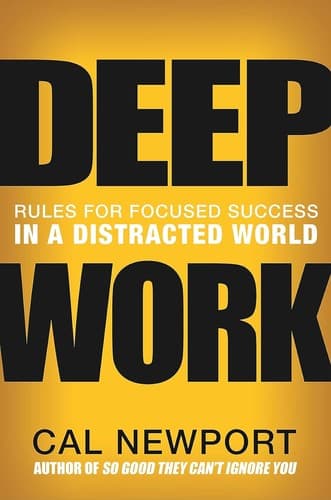
Core Idea
- Deep work is distraction-free concentration that pushes your cognitive abilities to their limit, creates new value, and is hard to replicate.
- Newport’s central claim is the Deep Work Hypothesis: deep work is becoming rarer at the same time it is becoming more valuable, so people who cultivate it will have a major advantage.
- The book contrasts deep work with shallow work: logistics, email, and other low-cognitive tasks that are easy to replicate and often dominate knowledge work.
Why Deep Work Matters
- Newport argues the modern economy rewards two scarce abilities: quickly mastering hard things and producing at an elite level in quality and speed.
- Both abilities depend on deep work because learning hard systems requires intense attention, and elite output requires uninterrupted time to turn skill into finished value.
- He ties this to deliberate practice and argues that focused repetition strengthens the relevant neural circuits, while distracted effort weakens them.
- Attention residue explains why task switching is costly: part of your mind remains stuck on the previous task, so even brief email checks can reduce performance on the next task.
- Deep work is also meaningful: it supports flow, restores a craft-like relationship to work, and helps shape a more satisfying inner life.
- Newport uses Carl Jung’s Bollingen Tower, J.K. Rowling’s hotel retreat, Bill Gates’s Think Weeks, and Jason Benn’s career change as examples of depth enabling exceptional output.
- Benn’s story is especially important: after replacing distracted consulting work with isolated study, he learned programming fast, graduated top of Dev Bootcamp, and doubled his salary.
Why It Is Hard to Do
- Newport says deep work is rare because business culture rewards distraction through open offices, constant messaging, and mandatory online presence.
- He calls the resulting dynamic the Principle of Least Resistance: when feedback is unclear, people choose the easiest behavior in the moment.
- He also describes Busyness as Proxy for Productivity, where visible activity substitutes for real results in knowledge work.
- The Cult of the Internet and Neil Postman’s technopoly make networked activity seem inherently good, even when it undermines craftsmanship and serious output.
- Because the costs of distraction are hard to measure, organizations often normalize shallow habits like rapid email reply, frequent meetings, and superficial visibility.
- Newport’s point is not that the Internet is bad in itself, but that the modern default systematically disadvantages depth.
How Newport Thinks You Can Protect Depth
- A useful deep-work life starts with rituals, not just willpower, because willpower is finite and concentration is easy to break.
- The Eudaimonia Machine illustrates an ideal environment: spaces progress from inspiration and support to isolated deep-work chambers designed for total focus.
- Grand gestures can also help by raising the stakes of a task and making procrastination harder, as in Rowling’s hotel suite or Gates’s Think Weeks.
- He recommends hub-and-spoke thinking about workspaces: keep collaboration and serendipity separate from the places where deep work happens.
- The 4DX framework is adapted to personal productivity: focus on a few important goals, track the right lead measures, keep a visible scoreboard, and review progress regularly.
- Newport is skeptical of constant connectivity, so he urges fixed-schedule productivity: set a hard end to the workday so scarcity forces better prioritization.
- He also recommends becoming hard to reach with email by using filters, clearer reply habits, or even non-response when appropriate.
- On email, his broader principle is to do more work when you send or reply so you reduce back-and-forth and close loops faster.
Training the Capacity for Focus
- Newport treats focus as a trainable skill, not a personality trait.
- Schedule Every Minute of Your Day to prevent attention from dissolving into default shallow work, while remaining flexible enough to revise the plan when needed.
- Be Lazy means ending the day with a real shutdown ritual so work does not leak into the evening; he links this to recovery, unconscious thought, and attention restoration.
- Don’t Take Breaks from Distraction: instead, schedule Internet use in blocks and stay offline outside them so you practice resisting the urge to switch.
- Work Like Teddy Roosevelt uses compressed deadlines and intense bursts to force concentrated effort on a high-priority task.
- Meditate Productively turns walking, showering, or commuting into a single-threaded problem-solving session by repeatedly returning attention to one defined issue.
- Memorize a Deck of Cards is presented as concentration training because elite memorization depends on attentional control and vivid mental structure.
- Newport also argues for a stricter attitude toward social media and entertainment: use a craftsman approach, keep only tools that materially advance core goals, and avoid wasting leisure on endless web consumption.
What To Take Away
- Deep work is Newport’s answer to a knowledge economy that rewards learning fast and producing well while making sustained attention harder to maintain.
- The book’s recurring claim is that concentration is both an economic advantage and a source of meaning, not just a productivity hack.
- Newport’s practices are aimed at reshaping the environment and habits around depth, because discipline alone loses to distraction.
- The final message is blunt: if you want to do rare, valuable, and satisfying work, you have to build a life that makes deep work normal.
Generated with GPT-5.4 Mini · prompt 2026-05-11-v6