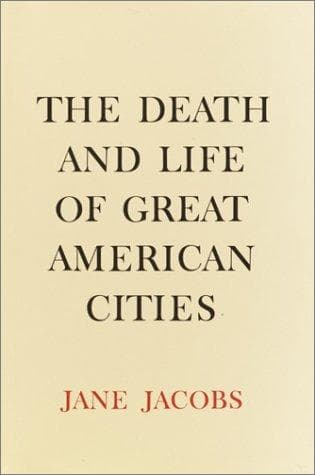
Core Idea
- Jacobs attacks orthodox urban planning for trying to impose tidy order from above, arguing instead that real city vitality emerges from the messy, close-grained interaction of uses, people, and time.
- Her case is built from observation of ordinary streets, parks, neighborhoods, and districts; the central question is not how cities should look, but what conditions make them work.
- Cities fail when planners sort functions apart, clear away old fabric, and replace organic diversity with projects, monuments, super-blocks, and “radiant” open space.
How Cities Stay Safe, Social, and Legible
- The sidewalk is the city’s main social organ: public peace depends less on police than on an “intricate, almost unconscious, network of voluntary controls and standards” among residents and users.
- Safe streets require three things: a clear public/private boundary, eyes upon the street from natural proprietors, and continuous sidewalk use by people with different reasons to be there.
- Stores, bars, restaurants, and other public places matter because they generate traffic, watchers, and casual encounters; empty or inward-looking environments do not self-police.
- Jacobs’s North End of Boston example shows that a dense, mixed, old district can be safer and healthier than it looks, because street life itself deters crime and disorder.
- She extends this to children: streets are usually safer and more formative than playgrounds or isolated project greens, because adults already on the street provide supervision and civic training.
- Public contact on sidewalks builds trust through countless tiny exchanges—greetings, errands, gossip, advice, favors—and that informal trust underlies formal civic life.
- By contrast, planned “togetherness” often produces either intrusive sharing or defensive isolation, especially in homogeneous model neighborhoods that cannot support real urban privacy.
The Conditions for Diversity
- Jacobs’s central economic claim is that cities need diversity of primary uses so that people are present at different times of day and support one another economically and socially.
- She identifies four conditions for vibrant diversity: multiple primary uses, short blocks, mixed building ages, and sufficient density of people.
- Primary-use mixtures matter most when they spread activity across mornings, afternoons, evenings, and weekends; a district with only one dominant time rhythm becomes thin and vulnerable.
- Lower Manhattan illustrates this: huge daytime employment without enough after-hours life leaves shops, services, and streets weak at the wrong times.
- Old buildings are essential because they lower the economic threshold for experimentation; “old ideas can sometimes use new buildings, but new ideas must use old buildings.”
- A district made only of new buildings tends to favor chain stores, banks, and standardized enterprises; old buildings shelter bookstores, bars, studios, pawn shops, foreign restaurants, and other low-overhead uses.
- Density is necessary but not enough: high dwelling densities can support healthy districts, but only when paired with the other conditions, and overcrowding is not the same thing as density.
- She rejects the common planning habit of treating mixed use as ugliness; when diversity works, it can be visually serene, while homogeneous use often produces the ugliest monotony.
- Successful diversity can also destroy itself: when one mixed district becomes too profitable, duplication and specialization crowd out the very variety that made it vital.
Borders, Slums, Money, and Traffic
- Large single-use borders—campuses, parks, tracks, expressways, civic centers, waterfront walls—often create border vacuums where foot traffic drops and surrounding streets weaken.
- Jacobs prefers borders that become seams, with uses at the edge that connect the special place to ordinary city life; otherwise the border drains vitality outward.
- She argues that slums are usually not caused first by race, old buildings, or lack of playgrounds, but by stagnation, dullness, and selective out-migration that make a place lose its capable residents too fast.
- A slum can unslum if enough people stay by choice, improvements happen gradually, and discrimination outside the area does not force all mobility to become displacement.
- Public housing and slum clearance often worsen the problem by uprooting social networks and hiding the real cost of condemnation; they also create involuntary subsidies from displaced people.
- Jacobs distinguishes gradual money from cataclysmic money: cities need continual, small-scale investment and repair, not huge flood-like injections that trigger clearance and replacement.
- She shows how mortgage blacklisting, redevelopment finance, and suburban credit systems divert capital away from city neighborhoods and toward low-density dispersal.
- Her alternative is gradual subsidy and guaranteed-rent style support for private building and rehabilitation, so neighborhoods can add diversity without being rebuilt all at once.
- On traffic, she insists that automobiles are not the root cause of city destruction; they become destructive when cities are already being shaped for dispersal, wide roads, and low intensity.
- The real choice is not cars versus pedestrians in the abstract, but whether cities remain dense enough that people can walk, use transit, and choose not to rely on cars.
- She favors attrition of automobiles by cities—short blocks, narrow and lively streets, dead ends, and selective traffic controls that make city use richer and car dependence less attractive.
What To Take Away
- Jacobs’s deepest claim is that city order is an organized complexity, not a simple design problem, so planners should study living examples instead of imposing abstract schemes.
- The basic unit of urban health is not the isolated building or the self-contained neighborhood, but the interdependent street-district-city system.
- Good city planning protects the conditions that let diversity arise on its own: mixed uses, mixed ages, dense and walkable streets, and institutions that support gradual change.
- Her book is both a critique of modern planning and a defense of the city as a humane, self-renewing form of social life.
Generated with GPT-5.4 Mini · prompt 2026-05-11-v6