Core Idea
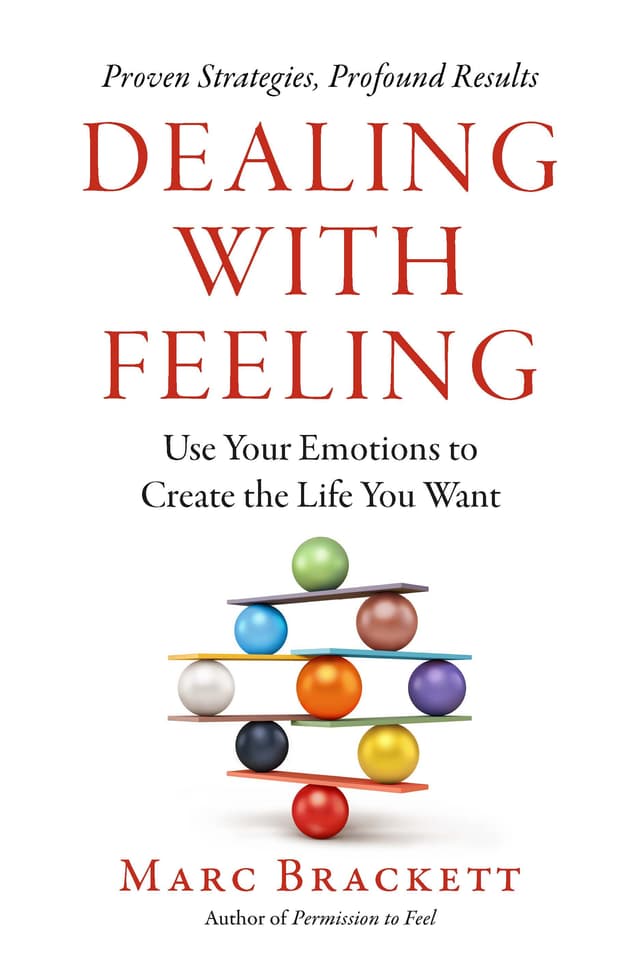
- Dealing with feeling is the life skill at the center of the book: emotions shape attention, relationships, health, work, and judgment, and the key is not suppressing feelings but choosing helpful responses to them.
- Brackett’s core claim is that emotion regulation is learnable, teachable, and preventive; people and institutions fail when they treat emotions as bad, fixed, or too private to name.
- The book argues that better emotional skill would reduce damage in families, schools, workplaces, health care, and society, while improving learning, resilience, and connection.
How Regulation Works
- Regulation begins with accepting all emotions without judgment, then deciding what to do next; emotions are information, not moral categories.
- Brackett distinguishes affect, emotion, feeling, mood, and disposition, and uses that precision to show that different states require different responses.
- His general model moves from deactivation to response: pause, breathe, and create space before acting, then identify the emotion, determine the goal, choose a strategy, and evaluate whether it worked.
- He emphasizes hot processing versus cool processing: hot reactions are impulsive and sometimes useful, but cool processing supports thoughtful self-regulation.
- Regulation is context-dependent and often requires polyregulation, a mix of strategies rather than one universal fix.
Naming, Mindset, and the Social Side of Feeling
- “You have to label it to regulate it” is a central principle; vague labels like “stressed” or “fine” hide important differences in what is actually happening.
- He gives precise distinctions such as anxiety = uncertainty, fear = immediate danger, stress = too many demands and too few resources, pressure = something important depends on what happens next, and overwhelmed = emotionally flooded.
- Emotional granularity matters because people who can name feelings more precisely regulate better, spiral less, and show better psychological outcomes.
- Accurate labeling can reveal the real emotion beneath the surface, as in cases where “anger” is actually disappointment, resentment is actually envy, or “anxiety” is really stress plus overwhelm.
- Brackett ties regulation to growth mindset: if emotions are seen as fixed and uncontrollable, regulation feels impossible; if they are seen as malleable, they become workable.
- Childhood messages, performance praise, cultural stoicism, and shame all shape whether people think feelings are manageable or dangerous.
- He warns that emotion language is socially shaped by family, power, gender, race, economics, and culture, so labeling should be precise but not simplistic.
Co-Regulation: How Other People Shape Our Feelings
- A major theme is co-regulation: people regulate one another constantly through tone, facial expression, listening, empathy, and presence.
- Brackett argues that self-regulation and co-regulation are interdependent; adults who cannot regulate themselves cannot reliably help children regulate.
- Healthy co-regulation means being a calm, curious, nonjudgmental “wiser one” who helps the other person feel understood and then move forward.
- The opposite is harmful co-regulation: ignoring, minimizing, shaming, venting without purpose, tough love, gaslighting, or reflexive fixing.
- He uses the phrase “Never worry alone” to capture the value of seeking a good co-regulator when emotion feels too large to handle solo.
- Good co-regulation does not stop at comfort; it can include problem-solving, repair, perspective-taking, kindness, and helping someone align with long-term goals.
- The book draws on attachment and infant research, including the still-face effect and Romanian orphanage studies, to show that regulation begins in early relationships.
Body, Practice, and Classroom Application
- Brackett treats physiology as part of emotion regulation: movement, nutrition, and sleep form an emotion regulation budget that powers the brain’s ability to cope.
- Exercise is presented as both preventive and immediate intervention, with even short bouts improving mood and reducing stress; identity change matters, because becoming “a person who works out” sustains the habit.
- Nutrition affects regulation through blood sugar, healthy fats, hydration, gut health, and emotional eating; the brain needs stable fuel to use higher-level strategies.
- Sleep is indispensable because sleep loss heightens reactivity, worsens judgment, and undermines strategies like reappraisal; he argues sleep should be valued rather than treated as weakness.
- In practice, the book favors a toolbox: breathing, mindfulness, cognitive reframing, distanced self-talk, visualization, relationship-based support, and sometimes just doing nothing until the nervous system settles.
- Breath work and mindfulness are useful, but Brackett cautions they are not sufficient by themselves and can become avoidance if used to bypass necessary action.
- In schools, he uses RULER—recognize, understand, label, express, regulate—to make emotions teachable, with students learning to identify feelings, diagnose causes, and select strategies.
- School examples show that students can handle regulation better when adults replace punishment with support, norms, and strategy-building; the goal is to make regulation part of identity, not just behavior.
What To Take Away
- Emotions are not the enemy; unskillful reactions are, and the book’s answer is to build better habits for noticing, naming, and responding.
- Precision beats vagueness: the more accurately you identify what you feel and why, the more likely you are to choose the right response.
- Relationships are regulatory tools: calm, empathetic people can help others recover, and repair matters when co-regulation goes wrong.
- The deepest message is that emotional skill is not a luxury or personality trait but a core human capacity that can be taught, practiced, and institutionalized.
Generated with GPT-5.4 Mini · prompt 2026-05-11-v6