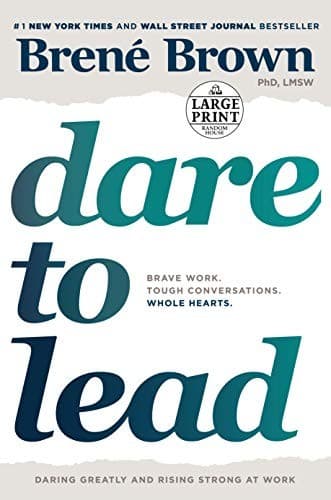
Core Idea
- Brown argues that courageous leadership is a set of learnable skills, not a personality trait, and that the foundation of all brave work is vulnerability.
- Her central claim is that organizations fail less from lack of talent than from armor, shame, fear, and disconnection; the remedy is leaders who can stay human in uncertainty.
- The book is a research-based playbook for building cultures where people can do brave work, tough conversations, and whole hearts without hiding behind perfectionism or power.
What Daring Leadership Requires
- Brown defines a leader as anyone responsible for recognizing and developing potential in people and processes.
- The core capabilities of daring leadership are rumbling with vulnerability, living into our values, braving trust, and learning to rise.
- A rumble is a conversation committed to staying curious, generous, accountable, and open-hearted instead of defensive or outcome-controlled.
- Vulnerability is not oversharing or emotional dumping; it is uncertainty, risk, and emotional exposure handled with boundaries and purpose.
- Brown rejects the myths that vulnerability is weakness, that competent people “don’t do vulnerability,” that trust must come first, or that leaders can simply engineer vulnerability out of life and work.
- Trust and vulnerability are interdependent: people need enough trust to risk openness, and trust is built through repeated acts of openness and reliability.
- Her marble jar metaphor shows that trust grows through small, consistent moments of care, confidentiality, reliability, and attention; a few violations can remove many marbles.
- Psychological safety matters because teams must be able to ask for help, admit mistakes, and offer ideas without fear of humiliation.
- Brown distinguishes relational vulnerability from systemic safety: systems can reduce unnecessary exposure, but leadership can never eliminate the human risk of being seen, judged, or disappointed.
- She repeatedly frames courage as contagious, and argues that cultures should make brave work and whole hearts the expectation, not armor.
Shame, Empathy, and the Vulnerability Armory
- Brown treats shame as the master emotion: the feeling of “I am bad” and “I don’t belong,” which makes people avoid exposure at all costs.
- Guilt is different because it says “I did something bad,” so it can support change without attacking identity.
- Shame in organizations shows up as perfectionism, favoritism, gossip, comparison, bullying, blame, public humiliation, power over, cover-ups, and productivity-as-worth.
- Her point is not that shame disappears, but that shame resilience can be built through recognizing triggers, checking beliefs, reaching out, and speaking shame aloud.
- Empathy is Brown’s main antidote to shame: it means connecting with the emotion under someone’s experience, not fixing them or comparing pain.
- She gives empathy five skills: perspective taking, nonjudgment, emotional understanding, communicating understanding, and mindfulness.
- Common empathy failures include sympathy, gasp-and-awe, one-upmanship, and fixing, all of which can increase isolation rather than connection.
- Self-compassion also matters, but Brown insists shame is social, so it heals best in relationship.
- Brown’s “square squad” idea narrows feedback to a tiny circle of trusted people whose opinions matter because they care about you and can be honest.
- Her vulnerability armory names the protective patterns leaders use when shame is driving: perfectionism, numbing, victim-or-viking thinking, cynicism, criticism, power over, hustling for worthiness, compliance/control, weaponizing fear, exhaustion as status, fitting in, gold-star collecting, zigzagging, and leading from hurt.
- Each armored pattern is presented as self-protection that may work briefly but ultimately destroys trust, creativity, and connection.
Values, Trust, and Learning to Rise
- Brown argues that values only matter when translated into observable behaviors; otherwise they are just aspirational language on posters.
- Her own organizing idea is that integrity means choosing courage over comfort and what is right over what is fun, fast, or easy.
- Trust is framed through the BRAVING inventory: Boundaries, Reliability, Accountability, Vault, Integrity, Nonjudgment, and Generosity.
- Vault means not only keeping confidences, but also not casually sharing information that is not yours to share.
- Brown emphasizes that asking for help is a power move, because it requires vulnerability and nonjudgment.
- Self-trust is built with the same BRAVING logic through small promises, repeatable reliability, and honest repair.
- The “learning to rise” section says people must be taught how to recover before they fail, not after; resilience is a skill, not a slogan.
- Her model has three parts: the reckoning, the rumble, and the revolution.
- The reckoning starts by noticing bodily cues and emotional activation, then pausing before projecting the feeling outward.
- Brown warns against chandeliering (buried hurt exploding), bouncing hurt (turning pain into anger or blame), stockpiling hurt (burying it until the body forces a stop), and false cheerfulness that hides pain.
- She recommends box breathing and curiosity as tools for staying calm enough to think clearly; calm is defined as creating perspective while managing reactivity.
- In the rumble, people test the stories they make up in the absence of data; the first draft is often a SFD—a shitty first draft shaped by fear and scarcity.
- The corrective question is, “What do I need to learn about the situation, about other people, and about myself?”
- Brown’s point is that the gap between the story we tell ourselves and the facts we discover is where growth, accountability, and wisdom happen.
- Living into our values means naming a few core values, defining the behaviors that prove them, and using them in real decisions and conflicts.
- Her repeated standard for good leadership is simple and hard: clear is kind, unclear is unkind.
What To Take Away
- Brown’s deepest claim is that you cannot get to courage without vulnerability, and you cannot build trust, creativity, or belonging while hiding behind armor.
- Brave leaders do not eliminate fear; they learn to rumble with it without letting it dictate behavior.
- Healthy cultures are built by people who can name shame, practice empathy, tell the truth, and make values visible in behavior.
- The book’s lasting message is that leadership is fundamentally about human connection under pressure: people, people, people.
Generated with GPT-5.4 Mini · prompt 2026-05-11-v6