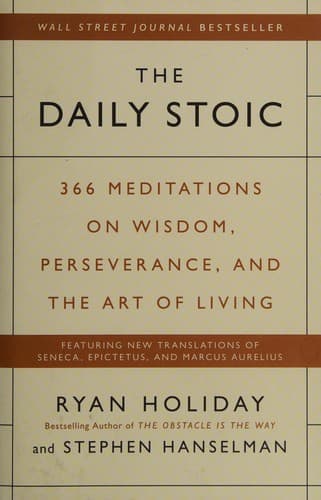
Core Idea
- The Daily Stoic presents Stoicism as a practical philosophy for ordinary life: the aim is not theory, but self-mastery, resilience, wisdom, purpose, and calm.
- Its central claim is that suffering comes mainly from judgments and perceptions, not from events themselves, so freedom begins by separating what is up to us from what is not.
- The book organizes Stoic teaching as a daily practice—morning preparation and evening reflection—using short meditations from Seneca, Epictetus, Marcus Aurelius, and earlier Stoics.
The Stoic Framework
- Stoicism is built around three disciplines: Perception (how we see things), Action (what we do), and Will (how we meet what cannot be changed).
- The only true sphere of control is the mind: judgments, choices, desires, aversions, and assent; body, property, reputation, status, family, and outcomes remain partly or wholly outside control.
- “Education” in the Stoic sense means becoming more free, fearless, and self-knowing, not merely accumulating facts or sounding intelligent.
- The book repeatedly warns against living by habit, impulse, social pressure, or common opinion, because those forms of unexamined life surrender one’s reasoned choice.
- Stoic practice requires watching impressions carefully, testing first reactions, and refusing to let anger, fear, or desire dictate response.
- Self-control is framed as the freedom to abstain: addiction and compulsion are treated as losses of sovereignty, even when the habit looks harmless.
How to Meet Difficulty
- A key technique is the reverse clause: build a backup use into your plan so that when one path fails, you can pivot without collapse.
- Stoicism favors flexible persistence: if you cannot do this, do that; if not that, do some other useful thing, even if the only thing left is “being a good human being.”
- Hardship is not evidence that life is unfair; Stoic writers treat adversity as something humans are built to face, and they urge practical action over self-pity.
- Epictetus and Marcus insist on “get active in your own rescue”: stop looking for scapegoats, and do the work available to you now.
- A recurring rule in trouble is do not make things worse—do not add resentment, flailing, or anger to the original problem.
- The book uses the military image of life as a station or campaign: the needed virtues are discipline, courage, fortitude, clearheadedness, and sacrifice.
- To manage events, the book advises “try the other handle”—reframe a situation from a different angle before deciding it is unbearable.
- Calm is contagious; in chaos, the Stoic leader’s job is to instill steadiness by example, not by force.
- The text emphasizes small sequential progress—“brick by boring brick”—and treats consistency, not dramatic transformation, as the real path to improvement.
Acceptance, Mortality, and Attachment
- Distress is repeatedly traced to judgment: an event becomes “evil” only when the mind labels it that way.
- Accepting what happens is not passivity; it is the first step toward seeing clearly and acting well.
- The book uses examples like FDR’s polio and Malcolm X’s prison to show that external setbacks can be transformed by use and interpretation.
- A major theme is that change is constant; Heraclitus’s river image and the “grabbing at the wind” metaphor warn against resenting reality for not standing still.
- The Stoics treat hope and fear as linked future-fixations; Hecato’s line—“cease to hope and you will cease to fear”—captures the effort to live more in the present.
- Attachment is presented as a primary source of unhappiness because it binds us to things outside reasoned choice: people, wealth, status, jobs, places, and lifestyles.
- The book advises pre-loss detachment: possessions are like breakable glass, loved ones are “given for now, not forever,” and the Roman triumph reminder—“remember, thou art mortal”—should curb possessiveness.
- Mortality is not meant to depress but to clarify; the imagery of the glass already broken, the Sword of Damocles, and “prepare as if at the end of life” all aim to remove illusion and sharpen present conduct.
- Death, exile, illness, and loss are used to test whether one’s values are real; the Stoic answer is that virtue is the only true good, because it cannot be taken by Fortune.
Time, Work, and Inner Freedom
- The book treats time as the most mismanaged resource: people guard money but give away days freely to interruptions, status-seeking, useless work, and distraction.
- Seneca’s warning is that life is not too short so much as wasted; the remedy is to protect solitude, reflection, and attention from noise, email, calls, and trivial demands.
- Work obsession is criticized when it becomes vanity or self-erasure; the reader is reminded that they are a human being, not a human doing.
- Philosophy is “the art of living and dying”: it is meant to shape character in real life, not to impress through rhetoric or quotation.
- Gratitude, listening more than speaking, avoiding needless quarrels, and keeping a sparing tongue are presented as signs of strength, not weakness.
- The best life is measured by good action now: handle the present task, make no excuse for inaction, and use each day as an opportunity that will not return.
- The deepest educational goal is to become someone whose own life and example are worth quoting, not someone who only repeats Stoic names.
What To Take Away
- Control your judgments first; peace depends less on events than on how you interpret and answer them.
- Train for adversity by expecting change, loss, and frustration, then practicing flexible, disciplined response instead of complaint.
- Treat mortality as a teacher; remembering that life is temporary helps strip away vanity, fear, and needless attachment.
- Spend time like the scarce resource it is: protect attention, act now, and make your philosophy visible in ordinary conduct.
Generated with GPT-5.4 Mini · prompt 2026-05-11-v6