Core Idea
- The book’s central claim is that high-tech markets do not grow smoothly; the critical break is the chasm between visionary early adopters and pragmatic early majority buyers.
- Early enthusiasm is often a mirage: companies mistake a small early-market blip for mainstream demand, overexpand, and fail when pragmatists do not follow.
- Winning the chasm is less about better technology than about creating a referenceable, whole-product beachhead in a narrowly defined market segment.
How the Technology Adoption Life Cycle Really Works
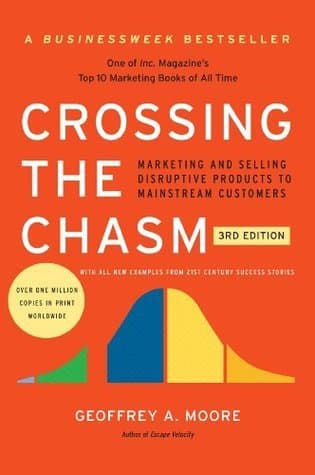
- Moore keeps the familiar adoption sequence—innovators → early adopters → early majority → late majority → laggards—but argues that the gaps between segments matter more than the smooth curve.
- Innovators / technology enthusiasts buy for the technology itself, want the truth, first access, and low prices, and are mainly useful because their endorsement validates that the product works.
- Visionary early adopters buy a strategic dream, not an incremental improvement; they are budgeted, high-visibility, and willing to fund risky projects, but they are hard to please and can demand excessive customization.
- Early-market failure often comes from selling the visionary before the product exists, producing vaporware, schedule slips, and no usable reference.
- Pragmatists in the early majority want incremental improvement, standards, infrastructure, support, and references from people like themselves; that reference requirement is why the chasm exists.
- Conservatives buy later, want packaged low-risk solutions, and prefer technology to feel like an appliance; the final skeptical tail mostly blocks purchases rather than driving them.
- The major second crack is between early majority and late majority, where products must become much easier to use or adoption stalls.
Crossing the Chasm: Beachheads, Whole Product, Positioning
- The core strategy is to pick a target segment small enough to win but important enough to matter, then become the de facto leader there before expanding outward.
- Moore rejects broad segmentation theory and numeric forecasting as a basis for chasm strategy; in low-data situations, he recommends informed intuition built from concrete customer scenarios.
- The book’s scenario method asks teams to write one-page “day in the life before/after” customer stories and run them through a checklist: target customer, compelling reason to buy, whole product, partners/allies, distribution, pricing, competition, positioning, and next target.
- A valid beachhead must pass four tests: one identifiable economic buyer, urgent economic pain, a whole product deliverable in about three months, and no competitor already occupying the space.
- The whole product is everything needed to fulfill the buying promise, not just the box; pragmatists buy the complete solution, and the vendor must often assemble it with partners.
- Examples such as Clarify and Documentum show that successful beachheads are often tiny but painful niches with strong expansion potential; the first niche matters less than its ability to open adjacent ones.
- PalmPilot is Moore’s example of success through subtraction: it stripped features until the product fit the specific use case cleanly, unlike overdesigned failures such as Newton and HP 95LX.
- SmartCards illustrate a platform problem: value depends on density and installed readers, so the best beachhead is a closed community where adoption can be imposed and made referenceable.
- Positioning is the customer-side definition of the battle; the product must be framed against a market alternative and a product alternative, with the aim of making it easier to buy than to sell.
- The position should fit in two short sentences and clearly state who it is for, what it replaces, and why the whole product is credible; this positioning then constrains the launch, channels, and messaging.
Mainstream Market Logic, Organization, and Money
- Pragmatists do not buy on product claims alone; they buy from the market leader because leadership attracts ecosystem support, standards, service, and confidence.
- That makes early dominance in a narrow segment the fastest path to broader market credibility: Moore’s “big fish, small pond” logic.
- Mainstream success depends on delivering the whole product and then protecting it; examples like Oracle, Novell, and Autodesk show that neglecting the pragmatist base can forfeit leadership.
- The late-majority market can be large, but it is won by reducing risk and effort, not by exciting customers; better out-of-box experiences and appliance-like packaging matter here.
- Moore extends the chasm problem beyond marketing: finance, organization, and R&D all have to change once the company shifts from early market to mainstream.
- Early companies often live on hockey-stick forecasts and heroic improvisation, but postchasm firms need profitability discipline, realistic commitments, and a staircase view of growth rather than fantasy inflection curves.
- Investors should focus less on abstract market size and more on how quickly the firm can assemble the whole product and become referenceable in a beachhead.
- Organizationally, the company must molt from pioneer behavior to settler behavior: pioneer technologists and visionary salespeople are essential early, but can become liabilities once mainstream routines matter.
- Moore distinguishes target market segment managers and whole product managers as bridge roles that turn visionary accounts into repeatable, supportable businesses.
- Compensation and R&D must shift too: the work that matters in the mainstream is not just core product invention, but whole-product R&D, packaging, service, and customer-success infrastructure.
What To Take Away
- Do not confuse early adopter excitement with mainstream demand; the chasm is a structural break, not a temporary slowdown.
- Choose one beachhead, not the whole market: win a tightly bounded niche where references can spread and the whole product can be delivered.
- Build the whole product before scaling: pragmatists buy complete solutions, credible partners, and visible evidence that peers already succeeded.
- Treat chasm crossing as a company-wide transition in strategy, finance, organization, and product management, not just a marketing campaign.
Generated with GPT-5.4 Mini · prompt 2026-05-11-v6