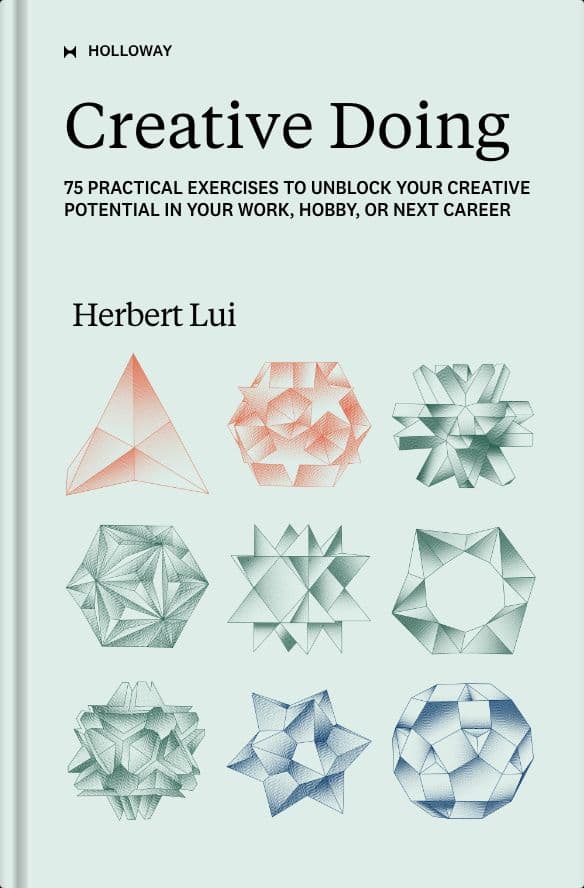
Core Idea
- Creative doing is Lui’s central thesis: creativity comes from action, repetition, and process, not waiting for inspiration or obsessing over results.
- The book argues that great ideas are made, not found, so the goal is to keep working until inspiration meets you in motion.
- Lui writes as someone who had to learn creativity through practice, not privilege, and frames the book as the guide he wished he had.
How Creative Work Actually Starts
- The book organizes creative practice around hands, head, and heart, plus three levers: quantity, quality, and purpose.
- Start from a creative operation you can actually do, then build from what is available rather than waiting for perfect tools, space, or permission.
- Early work should be treated as a draft, demo, or sketch, because modest expectations and acceptable standards reduce paralysis.
- Reusable systems for departure points—index cards, Notion, Zettelkasten, folders, layers, boxes—help capture fragments so ideas can be recombined later.
- A recurring instruction is to say yes first, let chaotic energy in, and allow the madman to work before the judge returns.
- Craft, in Richard Sennett’s sense, is an enduring impulse to do a job well for its own sake, beyond money or external approval.
- The simplest element matters first: lines in visual art, words in writing, and notes in music.
- Idle time is not wasted time; walking, showering, resting, and other forms of incubation often produce solutions that forcing cannot.
What Makes Work Better: Quantity, Constraints, and Process
- Liu repeatedly favors quantity over perfection, arguing that more attempts increase the odds of usable ideas and even of excellence.
- Exercises like write down 10 ideas, roll the dice, do the opposite, and turn problems into ideas are meant to get material flowing.
- Inspiration can be deliberately sourced from prompts, lists, newspapers, visual patterns, and daily exercises rather than left to chance.
- Constraints are productive because they lower activation energy: select one tool, set a time limit, commit to a size, do your work without your equipment, set a 10-day quota, and choose analog.
- The book treats play as serious creative input, since play creates serendipity and keeps work from becoming purely instrumental.
- Lose yourself means immersing in the making and dropping comparison, expectation, and self-consciousness.
- Enjoy the plateau argues that mastery is mostly slow, steady practice, so the practice itself has to become livable and even pleasurable.
- A major correction to perfectionism is the idea of acceptable work: complete enough to release, rather than endlessly polished.
- Remixing is legitimate growth: modify finished work by at least 3%, reduce or omit material (“greening”), and treat finality as just another state in an ongoing process.
- The book also endorses deliberate experimentation, such as making a risky version of a work or being obvious when the “obvious” idea may actually be useful or original.
Quality, Feedback, and Making the Work Legible
- Quality is something the creator must define; it is not the same as public response, algorithms, or commercial success.
- Liu recommends building a quality rubric by studying admired creators and their criteria, then using that rubric mainly in verification, not during drafting.
- To learn quality, he suggests visit the greats, study the craft, copy a classic, imitate a classic, and then remix a piece into something new.
- He warns that obsessive detail work can help the piece, but obsession can also wreck the project, so one should scope down and return to acceptable.
- Communication matters because value is often invisible; showing work-in-progress, feedback surfaces, and finished work helps people see what went into it.
- Sharing the behind-the-scenes—origin, influences, number of tries—can make the work’s value more legible.
- Creators should make people curious with a sharp, specific description of what they do instead of a vague label.
- The book also argues that artists can create their own market and opportunities, as shown by examples like Van Gogh-Bonger and Shantell Martin.
- Feedback should be sought with intention: know whether you want validation, refinement, critique, promotion, or group resonance before asking.
- Useful feedback methods include release your work, make something you won’t ever show anyone else, find new contexts, be specific, release in a lab, share your intention, and discard some feedback.
- Release in a lab means showing the same work to multiple people under controlled conditions and asking the same questions to identify patterns.
- Not all criticism should count, because some feedback is only another person’s limitation.
Purpose, Courage, and Long-Term Practice
- The final movement shifts from hands and head to heart: creative purpose is about why you make, what you stand for, and what deeper truth the work serves.
- Set an intention, set a mission, and see the vision are ways to align the work with internal purpose rather than outside validation.
- The four-stage process from Graham Wallas—preparation, incubation, illumination, verification—helps diagnose where a project is stuck.
- If work stalls, the fix depends on the bottleneck stage: more material, more rest, a breakthrough, or more energy for checking and finishing.
- Embarrass yourself is a call to tolerate looking foolish early, because taste outruns ability and only volume closes the gap.
- Archive an idea is one way to get out of your own way, letting time reveal whether an idea grows stronger or should be shelved.
- Praise your own work means noticing what is working so strengths can be repeated instead of only hunting flaws.
- Accept imperfection, via wabi sabi, frames incompleteness and flaw as part of beauty rather than as failure.
- Find your comfort balances risk with enough ease to stay consistent, while ignore the stats rejects likes, shares, and follower counts as primary measures of creative health.
- The deepest advice is simply to keep moving forward: patience, consistency, and long-term output matter more than immediate reaction.
What To Take Away
- Creativity in this book is a practice of doing, not a mood or a mystery.
- The book’s strongest recurring move is to reduce pressure with constraints, acceptable standards, and repetition.
- Quality is treated as a craft judgment, not a popularity contest.
- Purpose, courage, and patience matter because the work only becomes itself through continued making, revising, and release.
Generated with GPT-5.4 Mini · prompt 2026-05-11-v6