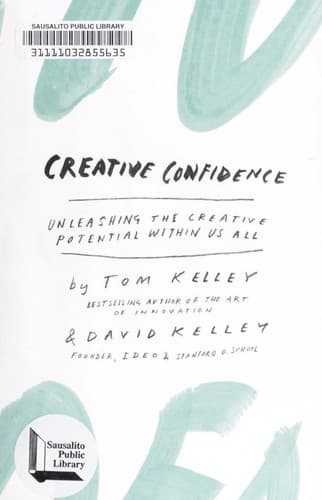
Core Idea
- Creative confidence = belief you can create change + courage to act on ideas
- Creativity is a learnable skill, not innate talent—everyone has creative potential
- Confidence builds through small wins, not IQ or natural ability
Five Mindset Shifts to Unlock Creativity
FLIP: Adopt a Growth Mindset
- Replace "I'm not creative" with "I'm learning to be creative"
- Question assumptions; see familiar situations with fresh eyes
- Treat abilities as expandable through effort and practice
DARE: Move From Fear to Action
- Reframe failure as learning, not weakness
- Start with tiny experiments; perfectionism kills creativity
- Build confidence through manageable challenges (guided mastery)
SPARK: Generate Ideas Through Empathy
- Observe real people in their actual environment
- Ask "why?" repeatedly to uncover hidden needs
- Cross-pollinate ideas across different industries
- Capture ideas immediately—they fade in 15-30 seconds
LEAP: Prototype Fast, Plan Less
- Start building rough prototypes before detailed planning
- Iterate dozens of times; quantity of attempts beats single perfect idea
- Use constraints (time, budget) to spark breakthrough thinking
SEEK: Align Work With Passion
- Find the overlap: what you're good at + what pays + what fulfills you
- Track your daily mood to identify energizing vs. draining work
- Experiment with side projects before major career moves
Build Creative Teams & Organizations
- Defer judgment during brainstorming; build on ideas instead of shutting them down
- Use "I like / I wish" feedback instead of criticism
- Make failure visible and safe—call it "experimentation"
- Design physical space with whiteboards, open layouts, and rough surfaces that signal "experiment here"
- Ban language blockers: replace "we've tried that," "that won't work," "I can't" with "How might we...?"
Practical Tools to Start Today
- Thirty Circles: 3-minute exercise—turn 30 circles into objects to build fluency
- Empathy Maps: synthesize field observations into actionable insights
- Rapid Prototyping: build multiple rough versions to test quickly
- Idea Journal: capture thoughts immediately before they disappear
Action Plan
- This week: Identify one creative fear; take one small action despite it
- This month: Observe one person/process in real environment; conduct three interviews; build three rough prototypes
- At work: Reframe one problem as "How might we...?"; run one rapid prototype cycle; give feedback using "I like / I wish"
- Ongoing: Keep an idea journal; track daily creative energy; seek out creative peers
- Longer term: Redesign your role/career toward the overlap of skill, market value, and fulfillment
Generated with Claude Sonnet 4.6 · prompt legacy-pre-v6 · model inferred from repository history