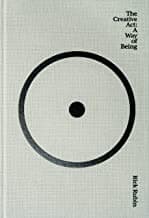
Core Idea
- Creativity is a way of being, not a talent reserved for artists: everyone already filters reality, makes choices, and shapes experience, so everyone is continually “living as an artist.”
- Rubin treats art as a translation of Source—an ongoing, larger-than-individual flow of energy, intuition, and ideas that the artist receives, filters, and re-presents in form.
- The book’s central stakes are spiritual and practical at once: to make better work, the artist must cultivate awareness, receptivity, and trust rather than anxiety, control, or fixed identity.
How Creativity Works
- Awareness is the root practice: look deeply, notice what is happening without immediate analysis, and expand perception so more of the world becomes available.
- The artist should look for clues everywhere—conversation, nature, chance, dreams, books, repetitions, coincidences, and odd moments that may carry guidance.
- Rubin treats the inner life as valid material: sensations, emotions, memories, dreams, trance states, and randomness can bypass habit and reach a deeper reservoir.
- Inspiration is a brief “download” or lightning bolt, but the important work is the preparation before it arrives and the discipline after it arrives to capture it fully.
- Great art often comes from experimentation, not from pre-knowing; the artist works forward in the dark, testing possibilities and learning from failed attempts.
- The process moves through named stages: Seed, Experimentation, Crafting, Completion.
- In Seed, gather many starting points without judging them too early, because value may appear only later.
- In Experimentation, combine and test ideas physically and playfully; the heart’s excitement is a key signal before the mind starts rationalizing.
- In Crafting, narrow the work, prune what does not serve the essence, and avoid getting trapped in an early draft or “demo-itis.”
- In Completion, release the work when it has become as good as it can be; finishing matters because it clears room for the next cycle.
- Technical skill matters because it expands expression, but skill alone does not create emotional power; point of view and energy are what make the work matter.
The Artist’s Mindset
- Rubin argues that minds seek rules, labels, and limits to reduce uncertainty, but artists must resist shrinking their world to what already feels safe or possible.
- Curiosity is the corrective to fixed beliefs: it stays porous, explores multiple perspectives, and remains open to contradiction.
- The artist should practice open-mindedness and “connected detachment,” staying engaged without assuming any setback is the whole story.
- Self-doubt is normal and not proof of failure, but Rubin distinguishes doubting the work from doubting the self; the former can improve the piece, the latter can shut the system down.
- He rejects the myth of the tortured genius: art does not require suffering, and sensitivity can be healing rather than destructive.
- Innocence and beginner’s mind can be creative advantages, because people who do not know the “proper” way sometimes make the breakthrough move.
- The artist should not over-attach to purpose or social messaging; meaning often emerges after the work is made, and art’s responsibility is to the work itself.
- “Sincerity” is not something to force; it is a by-product that can appear indirectly, even through contradiction or irrationality.
- The self is not a fixed unit but a shifting prism: different contexts reveal different aspects, and no single work can capture the whole person.
Craft, Collaboration, and Judgment
- Rubin values practice as habit: small rituals, repeated work, note-taking, and daily showing up keep the artist available for insight.
- He stresses that creativity is also collaborative—with previous art, future art, the audience, tools, the world, and other people.
- In collaboration, “let it be” can mean first do no harm; the best contribution is sometimes restraint, not intervention.
- Good collaboration requires specific, work-focused communication; feedback should be clinical and clear rather than personal or ego-driven.
- The editor/gatekeeper must be detached and ruthless, cutting until only what the work cannot live without remains.
- Rubin prefers testing, comparison, and fresh perception: A/B choices, blind tests, first instincts, and clean-slate re-listening help bypass bias.
- Context changes meaning, so if a piece feels wrong, the fix may lie in surroundings, pacing, contrast, scale, sequence, or environment rather than the core idea itself.
- He treats accidents, mistakes, and detours as potentially intelligent: the subconscious may be solving problems through what looks like disruption.
- Great art depends on essence—the irreducible “is-ness” of the work—so excess ornament, over-explanation, and unnecessary transitions can obscure it.
- The deepest success is internal: a work is successful when it is ready to be shared after the artist has done everything they can, not when it wins external approval.
What To Take Away
- Make art as a mode of attention: cultivate receptivity, notice clues, and trust that ideas arrive through a larger flow you do not control.
- Work in stages: collect seeds, test them, shape them, and let them go; do not confuse early excitement, doubt, or polish with final value.
- Protect the essence by editing ruthlessly, staying curious, and keeping the work open to surprise, context, and accidental discovery.
- Detach from status and identity: the book argues that art is not about proving yourself, but about faithfully translating what wants to emerge.
Generated with GPT-5.4 Mini · prompt 2026-05-11-v6