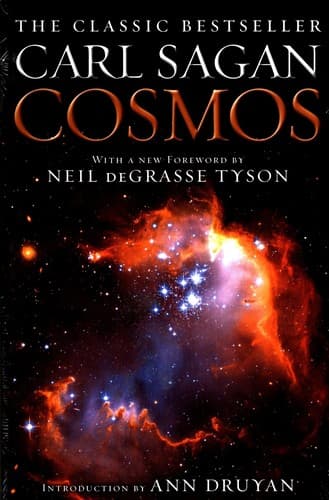
Core Idea
- Cosmos presents the universe as a single, evolving story from the Big Bang to human civilization, arguing that science is both our best method for understanding that story and a civilizational necessity.
- Sagan’s central claim is that humans are “starstuff pondering the stars”: our minds, culture, and technologies are products of cosmic evolution, and our future depends on whether we learn to use reason wisely.
- The book pairs wonder with skepticism: imagination opens possibilities, while science tests them against evidence and self-corrects when reality disagrees.
The Universe, Earth, and the Long History of Life
- The cosmos began about 15–20 billion years ago in a hot, dense Big Bang, and its expansion cooled matter into hydrogen and helium, then galaxies, stars, heavy elements, planets, and eventually life.
- Sagan emphasizes the scale of things: Earth is only a tiny shore on the “cosmic ocean,” and the observable universe contains roughly 100 billion galaxies with roughly 100 billion stars each.
- He insists Earth is not typical; empty intergalactic space is more typical, which makes the emergence of life here both fragile and rare.
- The same physical laws operate everywhere, so astronomy reveals a universe governed by mathematical regularities rather than mythic exceptions.
- Sagan traces how stars manufacture the elements of life and how supernovae recycle them, making biology a late phase of cosmic chemistry.
- Earth is presented as uniquely habitable: liquid water, a nitrogen sky, forests, oceans, and a biosphere that has turned inert matter into self-aware life.
- Life began on Earth from prebiotic chemistry, likely in a primordial organic soup; experiments by Miller and Urey showed that amino-acid-like molecules can form under early-Earth conditions.
- All known life shares a common biochemistry: DNA, RNA, proteins, and the same genetic code, supporting a single origin of life on Earth.
- Evolution is not presented as optional theory but as a fact: natural selection filters inherited variation over deep time, while extinction leaves behind many “terminated experiments.”
- Sagan uses artificial selection, from dogs and maize to crabs, to show how selection can rapidly reshape living forms.
- He stresses that evolution is powered by death and time: most organisms die, but rare useful mutations accumulate over long periods.
- Major transitions in life—photosynthesis, oxygenation, multicellularity, sex, the Cambrian explosion, land plants, animals, mammals, primates, humans—are treated as contingent milestones, not inevitable steps.
- Human traits themselves are historical accidents; if Earth restarted identically, a human-like species would be highly unlikely to reappear.
Science as a Human Tradition: From Ionia to Newton
- Sagan frames science as a cultural achievement that arose when humans began to assume the universe is intelligible and that claims should be tested by observation.
- He celebrates ancient Ionia as the birthplace of this tradition, where thinkers such as Thales, Anaximander, Democritus, and Aristarchus sought natural explanations without invoking gods.
- Aristarchus is especially important for placing the Sun at the center and treating stars as distant suns, a vision later rediscovered by modern astronomy.
- Alexandria becomes the model of a scientific civilization: a cosmopolitan research center with libraries, scholars, instruments, and cross-disciplinary inquiry.
- Sagan treats the destruction of the Alexandrian Library as a catastrophic loss, because it erased scientific and philosophical work that might have accelerated progress.
- He sharply distinguishes astronomy from astrology: astronomy seeks what the universe is really like, while astrology makes unsupported claims about planetary influence on human fate.
- Copernicus restored heliocentrism; Kepler then discovered the true geometry of planetary motion with ellipses, equal areas in equal times, and the law P² = a³.
- Newton unified Earth and sky with universal gravitation, showing that the same laws govern falling apples, the Moon, planets, and comets.
- Sagan admires this as a triumph of abstraction: simple mathematical laws can explain diverse phenomena across the universe.
- He also notes the social conditions that helped or hindered science: openness, literacy, trade, and skepticism helped it grow; censorship, priestcraft, and elite contempt for manual work slowed it.
A Fragile Planet and a Risky Species
- The solar system is not stable by default; it is the survivor of violent history, with impacts, comets, asteroids, and collisional selection shaping planetary orbits.
- The Tunguska Event becomes Sagan’s warning that a comet or asteroid can devastate a continent without warning, and could even be mistaken for a nuclear attack.
- Comets are not omens but icy bodies, historically misunderstood because humans projected fears and meanings onto them.
- Venus shows how planetary climates can become catastrophic: a runaway greenhouse produced a surface hot enough to melt lead, with crushing pressure and sulfuric-acid clouds.
- Earth is also vulnerable to climate change; Sagan warns that greenhouse gases, aerosols, and land-use changes can alter planetary conditions on human timescales.
- Mars is the key comparison planet: once imagined through Percival Lowell’s canals, it turned out to be far harsher and more ambiguous than myth or wishful thinking suggested.
- The Viking landers found no canals or obvious life, but they did show how hard it is to decide whether unfamiliar chemistry is biological or merely geochemical.
- Sagan is open to extraterrestrial life, but insists that evidence must be careful: life elsewhere may share Earth’s chemistry, yet still be radically different because evolution is contingent.
- He extends that logic to intelligence, speculating about whales, apes, and possible alien minds that might use totally different substrates, from biology to distributed radio-linked systems.
Intelligence, Communication, and Responsibility
- Sagan treats intelligence as more than information: it is judgment, memory, and the ability to build culture, language, science, and shared institutions.
- He uses the brain and the genome as layered information systems, with civilization adding libraries, writing, and eventually electronic media as external memory.
- The possibility of communication with other civilizations leads to the Drake equation, which estimates how many technical civilizations may exist but leaves the biggest uncertainty in whether such societies survive their technological adolescence.
- Sagan argues that listening is wiser than broadcasting, and that radio is the most practical medium for interstellar contact because it is fast, cheap, and physically well suited to space.
- The Voyager Golden Record is his emblem of cosmic self-description: not a data dump, but a message about who humans are, including sounds, images, and music.
- The book’s final moral argument is that humanity must “speak for Earth” by preventing nuclear war, lowering tribal violence, and widening loyalty from nation to planet.
- Nuclear weapons are the central self-made danger: Sagan details not only blast and firestorm but ozone loss, radiation, agricultural collapse, and long-term genetic damage.
- He sees hope in reason, public education, and the growing possibility of a planetary civilization, but only if humans choose stewardship over self-destruction.
What To Take Away
- Science is the best-known way to ask the right questions about the universe and correct our mistakes.
- Human beings are a late, rare product of cosmic and biological evolution, not the center of it.
- Our greatest danger is not ignorance of the stars but misuse of our own intelligence on Earth.
- The book’s deepest invitation is to combine wonder with responsibility: to know the cosmos, and to preserve the fragile world that knows it.
Generated with GPT-5.4 Mini · prompt 2026-05-11-v6