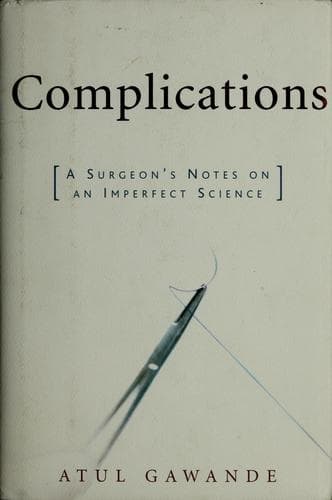
Core Idea
- Medicine is an “imperfect science”: it combines high stakes, incomplete knowledge, fallible people, and decisions made under pressure.
- Gawande’s core claim is that the real drama of medicine is not just disease, but the way doctors learn, err, improve, and sometimes fail in a system that asks them to act before certainty exists.
- Surgery is his main lens because it forces clinicians to make consequential choices amid uncertainty, where confidence, skill, and judgment matter as much as formal knowledge.
How Medical Skill Is Made
- Training is shown as a humiliating, embodied apprenticeship: “see one, do one, teach one” means real patients absorb the cost of learning.
- Early procedures like his first central line or first incision are terrifying, clumsy, and morally mixed: the act feels like violence, yet it is also an attempt to help.
- Mastery arrives only after repetition, and Gawande describes it as a tactile shift from confusion to elegance, when a procedure finally “goes in” almost automatically.
- Teaching hospitals do important work, but they also hide learning behind drapes, anesthesia, and euphemism because patients would rarely choose to be practiced on if asked directly.
- The burden of training is unevenly distributed; the poor, uninsured, intoxicated, and otherwise vulnerable are more likely to become the first independent cases.
- As he becomes more experienced, Gawande sees the reverse burden of training: supervising novices is painful because it makes visible how much judgment is still fragile and learned.
Systems, Errors, and the Limits of Judgment
- The book repeatedly shows that medical error is usually ordinary, not monstrous: good physicians can make devastating mistakes through fatigue, habit, pride, or bad systems.
- Gawande’s failed airway rescue becomes a case study in how errors unfold in chains, not single blunders; he should have called for help sooner and prepared a surgical airway earlier.
- He distinguishes guilt from shame and argues that some fear is useful, but denial and self-protection are dangerous.
- Morbidity and Mortality Conference (M&M) is presented as surgery’s internal mechanism for candor: hierarchical, formal, and designed to force responsibility without defensive concealment.
- Malpractice law is a poor safety system because it rarely identifies the truly unsafe physician and does little to change the patterns that produce error.
- The Harvard Medical Practice Study and later safety research support the view that errors are systemic and patterned, not just a few “bad apples.”
- James Reason’s idea of latent errors matters here: disasters usually arise from weak design, overloaded routines, poor communication, and predictable human fallibility.
- Anesthesia is the clearest success story, with safety improved through redesign, standardized equipment, monitoring, simulators, and an attitude that treats error as a systems problem.
- Even in surgery, checklists, body-part marking, and standardized ordering help, but the field has not achieved anesthesia’s level of safety revolution.
Judgment, Algorithms, and the Human Cost of Choice
- The book is skeptical of pure clinical intuition: a computer can outperform even elite doctors on tasks like EKG interpretation, and formulas often beat unaided judgment.
- At the same time, Gawande does not simply replace clinicians with machines; he argues for combining mechanization with compassion and clearer roles for doctors as guides and interpreters.
- Shouldice Hospital exemplifies the power of specialization and repetition: a focused factory model, standardized routines, and high volume produce unusually good hernia outcomes.
- Yet diagnosis remains hard to standardize because clinicians believe each patient is unique, and the book repeatedly shows that intuition can be both brilliant and wrong.
- The tension is clearest in cases where a doctor’s hunch catches a rare catastrophe, like necrotizing fasciitis, but formal decision analysis still cannot fully resolve what to do.
- Gawande values decision analysis and expected utility, but he shows its limits in messy real cases where probabilities and values are hard to quantify.
- The book’s deeper point is that medicine lives between algorithm and judgment: experts are indispensable, but so is humility about how often expertise depends on pattern recognition, habit, and luck.
Bodies, Symptoms, and the Strange Work of Intervention
- Gawande extends the same uncertainty to symptoms that are partly physical and partly psychological, especially pain, nausea, and blushing.
- Chronic pain is framed as more than tissue damage; context, loneliness, compensation systems, mood, and expectation all shape what is experienced as pain.
- His account of nausea, especially in pregnancy and chemotherapy, shows that symptoms can be conditioned and that reducing suffering sometimes means acknowledging uncertainty rather than pretending certainty.
- Pathological blushing and its treatment with endoscopic thoracic sympathectomy (ETS) show how surgery can change identity as well as physiology, with real benefits and real tradeoffs.
- Obesity surgery is presented as a direct intervention on appetite and will: gastric bypass works for many, but it is not a magic cure and raises questions about long-term effects, stigma, and the moral framing of fatness.
- Across these cases, the book emphasizes that bodily interventions are never purely mechanical; they alter self-control, social life, and how patients understand themselves.
What To Take Away
- Medicine is not a cleanly knowable discipline; it is a practice of making the best possible move under uncertainty.
- Good outcomes depend on more than talent: they depend on training design, systems, supervision, and candid review of failure.
- The book’s ethical center is that doctors must stay personally accountable even while recognizing that many errors are structural and shared.
- Gawande’s lasting message is that medicine can improve, but only if it admits how often it is unsure, how often it is wrong, and how much of its success comes from learning to live with that fact.
Generated with GPT-5.4 Mini · prompt 2026-05-11-v6