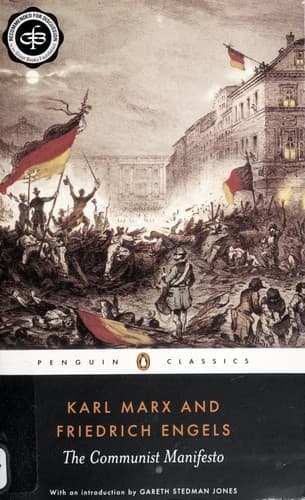
Core Idea
- All history is class struggle, and in modern society that struggle has become concentrated as bourgeoisie vs. proletariat.
- The bourgeoisie is historically revolutionary, but capitalism’s drive to expand, commodify, and revolutionize production also creates the conditions for its own overthrow.
- Communism is presented not as a utopian scheme but as the self-conscious movement of the majority to abolish class society and the property relations that sustain it.
How Bourgeois Society Develops Its Opponent
- Marx and Engels begin with earlier class antagonisms—free and slave, lord and serf, guildmaster and journeyman—to show that social history advances through conflict, transformation, or shared ruin.
- The bourgeoisie rose out of medieval towns and expanded through world trade, colonies, manufacture, steam power, and machinery.
- Its great historical achievement was to shatter feudal ties, dissolve inherited status, and reduce social relations to cash payment.
- But the bourgeoisie cannot stand still: it must constantly revolutionize production or perish, producing instability and the famous condition that “all that is solid melts into air.”
- Capitalism expands the world market, centralizes property and government, and creates interdependence across nations, while also generating commercial crises and overproduction.
- These crises reveal a basic contradiction: society has too much productive power for the property forms that contain it.
- Modern industry concentrates workers, standardizes their conditions, lowers skill barriers, and intensifies exploitation, thereby creating the bourgeoisie’s own gravediggers.
- The proletariat first resists as isolated workers, then as groups, trades, and unions, and finally as a political class as communication and industrial organization widen its scale.
- The deeper structural relation is reciprocal dependence: wage labor depends on capital, and capital depends on wage labor.
- Because modern industry destroys the isolation on which bourgeois rule rests, proletarian victory is presented as historically inevitable.
Communism, Property, and Political Power
- The Communists are not a separate sect with private doctrines, but the most advanced and resolute section of the proletarian movement.
- Their central demand is the abolition of bourgeois private property, not the abolition of all personal possession.
- Marx and Engels distinguish petty property based on personal labor from modern bourgeois property, which is really a social power rooted in exploitation.
- Under capitalism, the worker’s labor creates capital rather than independent ownership, while wages merely reproduce bare existence and surplus labor accumulates for the capitalist.
- The manifesto rejects the claim that communism abolishes individuality, freedom, culture, family, or morality.
- It argues that bourgeois “freedom” mostly means freedom to buy and sell, and that bourgeois ideas are themselves products of bourgeois social relations.
- Many claims treated as eternal truths are really historical forms tied to class society, and they disappear when class antagonisms disappear.
- The famous transitional program for advanced countries includes ten measures: land nationalization, progressive taxation, abolition of inheritance, confiscation of rebel property, centralized credit, centralized transport, extension of state-run production, labor obligation and industrial armies, combination of agriculture and manufacturing, and free public education with abolition of child factory labor.
- These measures are transitional, not the final goal, because once class antagonisms vanish, political power as class power becomes unnecessary and the state loses its political character.
Other Socialist Currents and Their Limits
- The manifesto groups rival doctrines into Reactionary Socialism, Bourgeois Socialism, and Critical-Utopian Socialism.
- Feudal socialism criticizes bourgeois society from an aristocratic standpoint and romanticizes the old order while pretending to defend workers.
- Petty-bourgeois socialism recognizes crises, concentration, and ruin, but wants to restore or preserve small property rather than move beyond capitalism.
- German, or “True,” Socialism is depicted as French socialist critique translated into abstract moral language, stripped of class content, and made usable by reactionary interests.
- Bourgeois socialism wants the benefits of capitalism without its contradictions, favoring reforms like charity, prison reform, labor improvement, and regulated trade while leaving capital-labor relations intact.
- Critical-utopian socialism contains real criticism of suffering and exploitation, and Marx and Engels respect figures like Saint-Simon, Fourier, and Owen.
- But utopian socialism treats the proletariat as passive material, rejects political struggle, and imagines ideal communities instead of recognizing class power and historical agency.
- Across all these currents, the decisive failure is the same: they do not see the proletariat as a self-acting historical class capable of transforming society.
What To Take Away
- The manifesto’s core claim is that economic structure shapes politics and ideas, and that historical change is driven by class antagonism.
- Capitalism is both revolutionary and self-undermining: it liberates productive forces, globalizes society, and also produces crises and a class able to overthrow it.
- Communism means ending bourgeois property and class rule, not erasing personal life or individuality.
- Its closing political wager is that “the free development of each is the condition for the free development of all.”
Generated with GPT-5.4 Mini · prompt 2026-05-11-v6