Core Idea
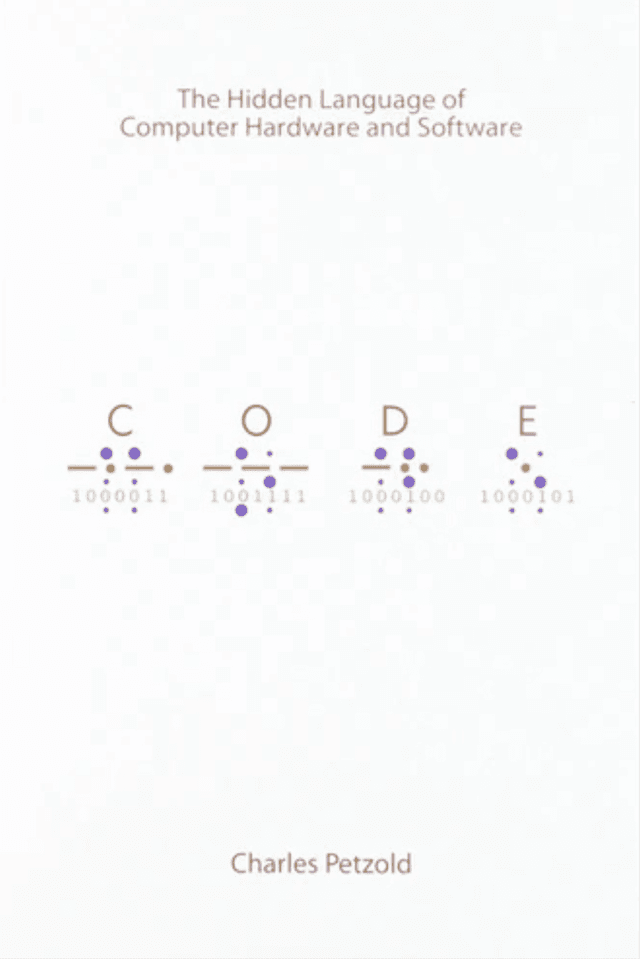
- Code is the book’s unifying idea: a system for representing and transferring information among people, between people and machines, and inside machines themselves.
- Petzold’s central claim is that computers rest on binary distinctions—on/off, yes/no, 0/1—and that these distinctions can be built up into codes, logic, memory, instructions, and whole programs.
- The book’s method is to start with familiar pre-digital systems like Morse code, Braille, telegraphs, and relays and show that the same hidden logic governs modern hardware and software.
From Codes to Circuits
- Morse code shows that a small symbol set can carry many meanings when the code is efficient and unambiguous.
- Braille makes the binary idea concrete: six dots produce 64 possible combinations, enough for letters, numbers, punctuation, and control symbols through shifts and context.
- The recurring mathematical pattern is powers of two, which explain why binary systems scale so naturally.
- A bit is the basic unit of information: one of two possibilities, with meaning determined by context.
- Petzold repeatedly separates code from meaning: the same bit pattern may stand for text, numbers, instructions, or nothing at all.
- Unicode appears as the modern correction to the narrowness and incompatibility of older encodings such as ASCII and its extensions.
Logic, Memory, and the Shape of a Computer
- Boolean algebra becomes the bridge from abstract logic to real circuits through AND, OR, and NOT.
- Switches in series behave like AND, while switches in parallel behave like OR; an inverter implements NOT.
- Relays make logic physical by letting electricity control other circuits, not just switch a load directly.
- Petzold develops the practical gate set used later in computer design: AND, OR, NAND, NOR, XOR, inverter, and buffer.
- NAND and NOR matter especially because either one can be used to construct the other gates.
- De Morgan’s laws are both algebraic identities and wiring tools, useful for moving inversions across AND/OR structures and simplifying circuits.
- A flip-flop is the key step from pure logic to stored state, making one bit of memory possible.
- From flip-flops come latches, registers, and ultimately RAM, so memory is built by layering many one-bit states.
- Petzold distinguishes level-triggered and edge-triggered D-type flip-flops: the first can pass data while the clock is high, while the second captures data only on the clock transition.
- Counters built from flip-flops show how binary counting emerges naturally from toggling and frequency division.
- BCD (binary-coded decimal) is a compromise for clocks and displays because it preserves decimal digits while using binary circuitry.
- Address bits determine how much memory can be reached, while data buses move the values stored there.
- Tri-state buffers are essential on shared buses because they allow a device to drive 0, 1, or effectively disconnect, preventing electrical conflict.
CPU, Software, and Networked Code
- A CPU repeatedly fetches, decodes, moves, computes, and stores: it reads instructions, interprets opcodes, performs operations, and writes back results.
- The ALU in Petzold’s model supports add, add with carry, subtract, subtract with borrow, AND, XOR, OR, and compare, with flags such as carry, zero, and sign.
- Compare is treated as subtraction without keeping the result; only the flags matter.
- Registers are the CPU’s fast working storage, and the accumulator is special because many operations use it as the primary operand and destination.
- Machine code is organized through opcodes, and instruction bytes in memory directly drive hardware through decoded control signals.
- A practical CPU also needs a program counter, instruction latches, increment/decrement logic, and carefully timed control signals.
- Jumps, conditional jumps, CALL, and RET turn linear instruction streams into general-purpose computation by enabling branches, loops, and subroutines.
- The stack is the LIFO structure that stores return addresses and makes nested subroutine calls possible.
- Petzold’s chosen CPU model is intentionally limited; it omits some Intel 8080 features, but still captures the essential logic of a real processor.
- Hardware is the circuitry itself, while software is code and data stored in memory that directs the circuitry.
- The distinction is real but porous because software becomes physical as bit patterns on buses, latches, and memory cells.
- Assembly language is the readable form of machine code, while high-level languages add abstraction and usually require compilation or interpretation.
- Operating systems such as CP/M and MS-DOS act both as UI and API, mediating between users, programs, and hardware.
- The web extends the book’s theme to a global scale: HTML, HTTP, URLs, DNS, and TCP/IP are all code systems for naming, transferring, and rendering information across networks.
- Petzold closes by linking the internet to the idea of a World Brain: a vast network of linked knowledge that also amplifies confusion, not just understanding.
What To Take Away
- Binary is foundational rather than limiting: two states, recursively organized, can encode text, numbers, logic, memory, and programs.
- Memory is what turns logic into computation: without state, gates are static; with flip-flops, registers, buses, and jumps, they become a CPU.
- Hardware and software are different levels of one system: software is stored code, but hardware gives that code meaning through control signals and physical execution.
- The same hidden-language idea scales from relays and opcodes to packets, filenames, web pages, and global information systems.
Generated with GPT-5.4 Mini · prompt 2026-05-11-v6