Core Idea
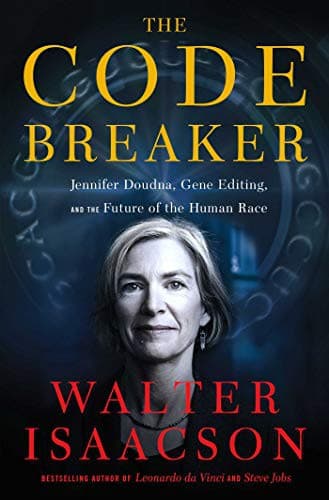
- CRISPR emerges as the book’s central breakthrough: a bacterial immune system turned into a programmable tool for gene editing, diagnostics, antivirals, and, potentially, heritable human engineering.
- Isaacson frames CRISPR as part of a larger gene revolution, comparable to the atom and the bit, where biology becomes an information technology shaped by structure, code, and collaboration.
- The book follows Jennifer Doudna, Emmanuelle Charpentier, Feng Zhang, and others through the science, patents, prizes, and ethics of rewriting life’s code.
From Curiosity to CRISPR
- Doudna’s path begins in Hawaii as an outsider drawn to biology’s puzzles, with James Watson’s The Double Helix teaching her that science is a detective story and that women could belong in it.
- Her early work on RNA—especially ribozymes and RNA interference—built the skills and structural insight needed to understand CRISPR.
- Isaacson stresses the recurring principle that structure determines function: knowing the 3D shape of RNA and protein machinery is what makes the biology intelligible and usable.
- The CRISPR story starts with obscure repeated DNA sequences, then Mojica’s insight that the spacers matched viral DNA and were an adaptive immune memory in bacteria.
- Doudna’s lab, with collaborators like Jinek, Wiedenheft, Haurwitz, Sternberg, and others, dissected the system into its parts and showed how Cas1, Cas6, and especially Cas9 work.
- The key advance came when Doudna and Charpentier proved that tracrRNA + crRNA + Cas9 were sufficient for DNA cutting and then fused the RNAs into a synthetic single-guide RNA (sgRNA) that could be reprogrammed to any target.
CRISPR Becomes a Technology
- The June 2012 Science paper turned CRISPR from a bacterial curiosity into a generalizable editing platform by showing how Cas9 can be programmed to cut chosen DNA sequences.
- The next race was to make CRISPR work in human cells, where Doudna, Zhang, Church, and others used known tricks like nuclear localization signals and codon optimization to adapt the system.
- The book presents the early human-cell papers as both a scientific breakthrough and a priority fight, with competing claims about who understood what first and who deserved credit.
- Patent disputes hinged on whether adapting CRISPR from bacteria to eukaryotic cells was obvious or non-obvious after the 2012 mechanism was known; the legal outcome did not settle the historical controversy.
- Isaacson treats the commercialization story as messy but inevitable: startups, licensing, venture capital, and institutional politics quickly followed the science.
- He repeatedly emphasizes that real innovation came from a network: academia, industry, government funding, philanthropy, and open exchange at early CRISPR meetings.
Therapy, Diagnostics, and the New Ethics
- The book follows CRISPR into medicine through somatic editing first, especially ex vivo treatment of sickle-cell disease, where edited stem cells can be removed, corrected, and returned.
- It also surveys CRISPR in cancer, blindness, and antiviral work, while stressing that the hardest problem is usually delivery: getting the editor to the right cells safely.
- CRISPR diagnostics become a major theme, especially Mammoth’s DETECTR and Zhang’s SHERLOCK, which use collateral cleavage by Cas enzymes to detect viral material quickly, including SARS-CoV-2.
- During COVID, Doudna’s Berkeley effort showed how fast institutions can pivot basic science into public service, building testing capacity and sharing tools more openly than usual.
- Isaacson connects CRISPR to a broader shift toward home biology and citizen science, exemplified by Josiah Zayner’s biohacking kits and self-experiments, though the book treats them as provocative rather than authoritative.
- A second major therapeutic frontier is antiviral CRISPR, such as CARVER and PAC-MAN, but these remain limited by delivery and safety.
Germline Editing, Inequality, and Governance
- The book’s deepest ethical concern is germline editing: changes that are inherited and could reshape future generations, as dramatized by He Jiankui’s embryo experiments in China.
- Isaacson argues that once disease correction is possible, the line to enhancement—IQ, height, appearance, athleticism, and other traits—becomes dangerously slippery.
- He returns to classic debates about eugenics, choice, and the possibility of a consumer-driven genetic supermarket that could widen inequality and reduce diversity.
- Rawls, Nozick, Sandel, Savulescu, Asilomar, and later summit statements appear as attempts to sort out who should decide, on what grounds, and under what limits.
- Doudna’s own view evolves: she moves from seeing germline editing as viscerally unnatural to accepting it for severe disease under a prudent path forward, while rejecting premature or unnecessary uses.
- Her response to He Jiankui is not a blanket rejection of the technology, but a demand for oversight, restraint, and a moral line between therapy and enhancement.
What To Take Away
- CRISPR is presented as a platform technology, not a single invention: it grew from bacterial defense biology, RNA structure, and shared laboratory effort.
- The book’s core tension is between CRISPR’s capacity to heal and its capacity to reorder human inheritance, especially if market forces push enhancement.
- Isaacson’s historical argument is that major breakthroughs come from basic science, but their consequences depend on patents, institutions, and social trust.
- His final stance is cautiously optimistic: use the code of life to fight disease and pandemics, but move step by step, with public discussion and limits, because the power cannot be unlearned.
Generated with GPT-5.4 Mini · prompt 2026-05-11-v6