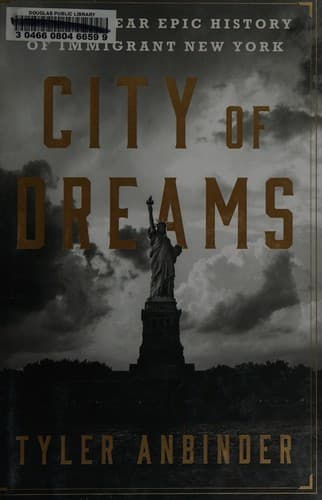
Core Idea
- New York is the product of successive immigrant waves, each reshaping the city’s politics, neighborhoods, labor markets, and culture while encountering a familiar cycle of fear, exclusion, and eventual incorporation.
- The book’s central argument is that immigrant New Yorkers were not marginal to the city’s history; they were often the people who built its institutions, fought its wars, powered its economy, and defined its political conflicts.
- Tyler Anbinder uses sweeping history plus vivid individual stories, especially Annie Moore, to show that the immigrant dream in New York has always meant more than arrival: it meant work, family survival, dignity, and a chance to become American on one’s own terms.
From Colony to Port City
- New York’s immigrant story begins in the Dutch era, when Peter Minuit and New Netherland made Manhattan a commercial node rather than a purely settler colony.
- The early colony was unusually mixed: Dutch, Walloons, English, Germans, Africans, Jews, Swedes, Irish, and others lived together, though Dutch tolerance remained limited and racial slavery expanded sharply.
- The English takeover in 1664 did not erase Dutch New York; instead, the city remained culturally hybrid, and later leaders repeatedly tried to Anglicize it through law, church power, and schooling.
- In the eighteenth century, English, Scots, Irish, and Caribbean arrivals turned New York into a port city whose population, occupations, and wards became increasingly stratified by ethnicity and origin.
- Immigrants were essential to colonial and revolutionary New York, appearing on both patriotic and loyalist sides; examples like Haym Salomon, Alexander Hamilton, and James Rivington show how foreign-born New Yorkers could shape independence and state-building.
Mass Immigration and the Making of the Modern City
- The Irish Famine transformed New York most dramatically in the nineteenth century: poverty, overcrowded sail crossings, Castle Garden, tenements, and exploitative runners defined the immigrant experience.
- Irish neighborhoods such as Five Points and the Fourth Ward became symbols of hardship but also of mobility, as Irish men moved into unskilled labor and saloon politics, and Irish women into domestic service, laundry, and needlework.
- German immigrants formed their own enclaves, especially Kleindeutschland, bringing skilled trades, beer culture, mutual aid societies, and a strong civic presence; Jewish peddlers, artisans, and laborers later followed similar enclave patterns.
- Immigration did not just fill neighborhoods; it shaped the city’s economy and politics. By 1860 New York had more immigrants than native-born residents, and immigrants increasingly demanded access to offices, labor power, and public influence.
- The Zenger trial, the draft riots, and the rise of Tammany Hall show the city’s recurring struggle over liberty, race, class, and who counted as a legitimate New Yorker.
- The Civil War did not fundamentally change New York’s immigrant composition, but it accelerated the move from sail to steamship, making crossing safer and allowing bigger, more complex migration flows.
- Postwar machine politics under William M. Tweed depended on immigrant votes and patronage, while Thomas Nast helped expose corruption and fix the popular image of immigrant political power.
- Anti-Catholic and anti-immigrant politics remained powerful, but immigrant New Yorkers repeatedly broke through, most visibly with the election of William R. Grace as the city’s first Irish Catholic immigrant mayor.
Ellis Island, the New Immigration, and the City of Enclaves
- The opening of Ellis Island marked not the start of immigration but the start of a new federal system for inspection, exclusion, and management; Annie Moore became its famous first face.
- Annie’s later rediscovery shows how immigrant memory is made: family lore, archival work, and public history turned a nearly forgotten Cork teenager into a symbol of arrival.
- The late nineteenth and early twentieth centuries brought the “new immigration”: Italians, eastern European Jews, and other southern/eastern Europeans increasingly replaced earlier Irish and German flows.
- The arrival process was both bureaucratic and intimate: Ellis Island’s Registry Room, medical inspection, the $25 cash rule, and the feared question of whether one had a job waiting could determine a family’s future.
- Ethnic aid societies such as HIAS, along with lawyers, settlement houses, and community networks, helped immigrants survive detention, find work, and fight exclusion.
- New York’s neighborhoods became more specialized and crowded: the Lower East Side for Jews, Little Italy for Italians, and later outer-borough settlements as families sought cheaper, roomier housing.
- The city’s tenement system, especially the dumbbell tenement, made housing a political issue; Jacob Riis’s How the Other Half Lives and flash photography made slum reform a national cause.
- Reform did not stop at housing: Lillian Wald and Henry Street Settlement linked nursing, childcare, baths, recreation, education, and labor activism to immigrant uplift.
- Immigrants also built labor institutions and radical movements: Samuel Gompers, Emma Goldman, Meyer London, and the shirtwaist strikers show how New York immigrants shaped unionism, socialism, and reform.
Restriction, Remaking, and the Modern Immigrant City
- The book emphasizes that modern restriction regimes were not natural or inevitable; they were political choices that targeted the immigrant groups then transforming New York.
- The 1921 quota law and 1924 National Origins Act sharply reduced legal immigration, especially from southern and eastern Europe, just as those groups had become central to the city.
- Restriction did not end migration; it redirected it into illegal entry, overstays, forged papers, chain migration, and smuggling through Canada and Cuba.
- Later waves of migration transformed New York again: Puerto Ricans, West Indians, Dominicans, Chinese, Koreans, South Asians, and Mexicans each found niches, built neighborhoods, and faced new forms of suspicion.
- The post-1965 city is defined by the same historical pattern as the colonial and Ellis Island city: newcomers arrive as outsiders, are blamed for disorder, then become indispensable to the city’s economy and identity.
- Anbinder’s final point is that New York has never had a single immigrant era of smooth assimilation; it has always been a place where dreams, labor, conflict, and reinvention arrived together.
What To Take Away
- New York’s history is best understood as a series of immigrant-led city makings, not a story of native institutions gradually absorbing outsiders.
- The city’s recurring debates over religion, race, labor, crime, and politics are all tied to which immigrants arrived, where they lived, and how quickly they were accepted.
- From Castle Garden to Ellis Island to modern border regimes, the mechanisms of entry changed, but the underlying struggle over belonging and exclusion remained constant.
- The enduring New York pattern is not assimilation without friction, but immigrants remaking the city and eventually redefining who counts as a New Yorker.
Generated with GPT-5.4 Mini · prompt 2026-05-11-v6