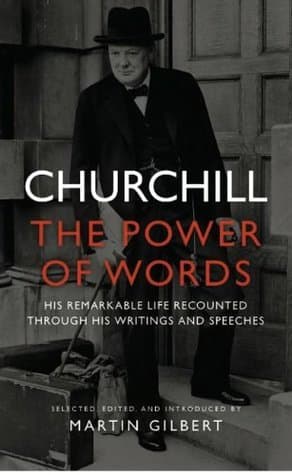
Core Idea
- Churchill presents himself as a statesman of war, freedom, and national character, using speeches and writings to argue that history turns on courage, endurance, and the disciplined use of power.
- The extracts show him moving from imperial soldier-journalist to democratic reformer, wartime leader, anti-totalitarian prophet, and finally elder defender of the English-speaking peoples, parliamentary liberty, and peace through strength.
- Across the book, Churchill’s central habit is to turn events into moral tests: war is not just strategy, but a struggle between civilization and organized tyranny, and politics is not administration but national self-definition.
Churchill’s Political Character and Early Formation
- Churchill repeatedly frames his childhood and education as selective: he disliked boarding school, learned best when interest was engaged, and remembered kindness—especially from Mrs. Everest—as proof of human goodness beyond utility.
- His early adventures, injuries, and near-death experiences become part of a lifelong self-portrait of a man who met danger repeatedly yet insisted he had always tried to avoid it.
- India was decisive in shaping him intellectually: he resolved to read history, philosophy, and economics, absorbed Gibbon, and began seeing politics through long historical perspective.
- His first political steps already mixed reform and rhetoric: he praised the Workmen’s Compensation Bill, attacked radical practice, and cast Tory policy as “rising tide of Tory Democracy.”
- In war reporting from Cuba, the North-West Frontier, Sudan, and South Africa, he depicts battle as both exhilarating and grim, celebrating comradeship while also confronting stench, dead bodies, and suffering.
Empire, Reform, and the Uses of Power
- Churchill’s imperial writings often combine admiration for martial energy with blunt hierarchy, as in The Story of the Malakand Field Force and The River War, where war is vivid, frontier life romanticized, and Islam treated with harsh contempt.
- Yet he also develops a recurring humane strain: after combat he insists on pity for enemy wounded, praises Boer courage, and rejects revenge as both morally wrong and strategically foolish.
- South Africa marks a political turning point: his capture, escape, and public fame feed a later argument that war should end in union, concord, and self-government, not punitive rule.
- In Parliament he supports responsible government for the Boer colonies, argues that military rule blocks reconciliation, and presents imperial settlement as a trusteeship for freedom.
- As a Liberal reformer he pushes a broader idea of citizenship: old-age pensions, unemployment insurance, labor rights, and social reform are justified because poverty, insecurity, and physical degeneration are national threats.
- He frames welfare not as leveling but as national strength: people need not only work, but “time to live”—to think, read, see their homes, and cultivate dignity.
- He also defends trade unions and parliamentary democracy, insisting that law should protect unions from harassment while public opinion and publicity remain the real safeguards against bullying and intolerance.
War, Nationhood, and the Democratic State
- Before and during World War I, Churchill repeatedly argues that modern war has become mass, industrial, and total, making old dynastic limits obsolete and future conflicts more terrible.
- He sees Britain’s war aim as survival of a constitutional civilization against Prussian militarism, and he rejects compromise because the conflict is “our life or it is theirs.”
- As First Lord of the Admiralty, he defends naval preparedness, convoy systems, sea power, and military secrecy, while also criticizing timid strategy and wasteful attrition.
- The Dardanelles and trench war reveal his willingness to accept catastrophe for decisive action; his later speeches defend hard choices while acknowledging loss, exhaustion, and the moral ambiguity of war.
- In 1918 he celebrates Allied unity, the moral effect of American entry, and the role of leaders like Clemenceau and Foch, but he also sees victory as only the beginning of an unstable peace.
- Post-1918, Churchill turns against Bolshevism as anti-liberty, anti-progress, and socially destructive, while still arguing that Russia must be contained by practical means, not sentimental crusades.
The Anti-Totalitarian Struggle and “The English-Speaking Peoples”
- In the 1930s Churchill becomes the clearest parliamentary critic of disarmament, appeasement, and Nazi expansion, warning that Germany’s “equal status” demands are a disguise for rearmament and conquest.
- He treats totalitarianism as a single family of systems: Nazi Germany and Soviet Russia both demand uniformity, crush dissent, persecute Jews and other groups, and build rule on fear, camps, and police power.
- His answer is not isolation but democratic unity: Westminster, free criticism, national service, and cooperation among Britain, the United States, and the Commonwealth.
- He insists the British and American worlds share law, language, literature, fair play, and personal freedom, and he increasingly casts their partnership as the decisive bulwark of civilization.
- During World War II, Churchill’s language of defiance becomes the book’s emotional center: “blood, toil, tears and sweat,” “we shall never surrender,” “Never give in,” and “so few” all condense his style of leadership.
- He presents Britain’s wartime endurance as moral proof that free peoples can outlast terror, and he repeatedly links military success to industrial mobilization, coalition government, and public resolve.
- His wartime decisions are often stark—Mers el-Kebir, bombing Germany, resistance to compromise with Hitler—but he treats them as necessities imposed by survival.
What To Take Away
- Churchill’s core worldview is that freedom survives only when backed by strength, organization, and readiness for sacrifice.
- He never separates politics from character: institutions matter, but so do courage, public opinion, national memory, and the will to endure.
- His history is also a warning about modernity: science, mass politics, and new weapons multiply both human power and the possibility of catastrophe.
- The late Churchill remains wary of ideology and revenge, but hopeful that parliamentary liberty, Anglo-American cooperation, and some form of European and world order can still preserve civilization.
Generated with GPT-5.4 Mini · prompt 2026-05-11-v6