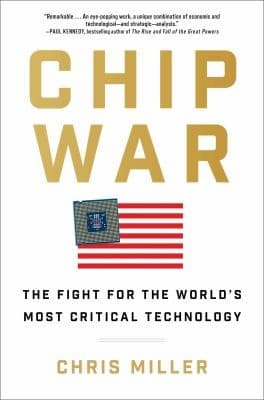
Core Idea
- Semiconductors are the key chokepoint of modern power: they underpin consumer tech, cloud computing, AI, and precision weapons, so control over chips now shapes geopolitics as much as oil or steel once did.
- The book’s central claim is that the chip industry is highly concentrated, globally interdependent, and strategically vulnerable, making supply chains and export controls instruments of state power.
- The U.S.-China rivalry is increasingly a struggle over computing capacity, fabrication, and design tools, not just trade, territory, or military hardware.
How the Chip Industry Became Strategic
- The story begins with the long climb from vacuum tubes and ENIAC to the transistor, integrated circuit, and photolithography, each step solving a problem of size, reliability, wiring, and mass production.
- Miller stresses that the decisive breakthrough was not invention alone but manufacturing mastery: yields, process control, and repeated cost reduction turned chips into cheap, ubiquitous infrastructure.
- Moore’s Law becomes the organizing dynamic: ever-denser chips made processing and memory dramatically cheaper, enabling the internet, smartphones, social media, and AI.
- Early demand from the Apollo program and Minuteman II missiles helped validate integrated circuits, but civilian markets later dwarfed military procurement.
- The semiconductor supply chain is presented as a fragile web of design software, IP, wafers, chemicals, optics, and tools, with critical bottlenecks in Taiwan, South Korea, Japan, the U.S., and especially ASML’s EUV lithography machines.
- The book repeatedly emphasizes that modern computing is concentrated in a few places: TSMC in Taiwan, memory leaders in Korea, and essential toolmakers in Europe and Japan.
Industrial Competition, State Power, and the U.S.-Asia Shift
- The U.S. pioneered the industry but gradually lost manufacturing leadership as firms chased lower costs and Asian governments built industrial ecosystems that combined state capital, bank lending, labor discipline, and export orientation.
- Japan’s rise came through deep integration with U.S. technology and consumer markets, not simple copying; firms like Sony used transistors to create new products and build global brands.
- In the 1980s, Japanese firms beat U.S. competitors in DRAM through quality, investment, and scale, pushing American chipmakers into crisis and prompting Sematech as a Pentagon-backed rescue attempt.
- The book contrasts this with the Soviet Union, whose copied designs could not overcome secrecy, poor materials, weak manufacturing, and a system that lacked market feedback and international supply chains.
- Micron survives as a case study in ruthless cost control: simplification, frugality, and manufacturing discipline mattered as much as technical know-how.
- Intel recovered by exiting DRAM, adopting “copy exactly” manufacturing, and pivoting into microprocessors, where pairing x86 with Microsoft Windows gave it enormous market power.
- South Korea followed a similar state-enabled path, with Samsung becoming a semiconductor giant by leveraging U.S. partners, cheap financing, and industrial policy.
- The book treats chip design itself as becoming more systematized through the Mead-Conway revolution, DARPA support, and software-driven design tools.
China’s Campaign for “Core Technology”
- Xi Jinping frames semiconductors as a national emergency: China must achieve breakthroughs in core technology, even as it relies heavily on foreign tools, software, IP, and fabrication.
- Georgetown data cited in the book shows China controlling only tiny shares of the global stack and having no leading-edge fabrication capacity, despite its enormous demand.
- Beijing’s strategy mixes subsidies, market access, coercive regulation, and industrial policy through vehicles like the Big Fund, but Miller argues this is state-directed investment, not Silicon Valley-style venture capital.
- China’s record is mixed: some firms advance, but others waste capital or collapse, as shown by Tsinghua Unigroup and scams like Wuhan Hongxin/HSMC.
- A central argument is that China is more likely to reduce dependence than achieve total self-sufficiency; the plausible gains are in lagging-edge logic, NAND, silicon carbide, gallium nitride, and RISC-V, not full mastery of the frontier.
- China also uses market access to pull technology from foreign firms through joint ventures, partnerships, and pressure on companies like IBM, Qualcomm, AMD, and Arm, often transferring know-how incrementally rather than through outright acquisition.
- Huawei is the key example of Chinese industrial rise: not just espionage, but heavy R&D, disciplined management, political skill, and global scale; it became deeply dependent on TSMC even as it tried to internalize more chip design.
Chips as Weapons, and the New U.S. Response
- The military logic of chips runs through the offset strategy: precision-guided bombs, sensors, satellites, and later AI-enabled systems let the U.S. substitute information and accuracy for mass.
- The Gulf War demonstrated this visibly, and the same logic now extends to AI, autonomy, cyber, and spectrum warfare.
- China’s modernization follows a parallel path, with “intelligentized warfare” built around anti-ship missiles, air defenses, ASAT weapons, and networked systems that still depend on foreign semiconductors.
- Miller argues that U.S. leverage comes from controlling choke points in chip design software, equipment, and lithography, which can cut off companies anywhere in the world.
- The ZTE and Huawei cases show this “weaponized interdependence” in action: export controls nearly collapsed ZTE and forced Huawei out of the global chip infrastructure.
- The book also uses the Micron-UMC-Jinhua theft dispute to show how stolen files, patent filings, and Chinese courts can be combined to lock rivals out of China until the U.S. and Japan block the needed tools.
- A major theme of the later chapters is that Washington moved from assuming globalization was neutral to treating semiconductors as a strategic battlefield, though the U.S. still depends heavily on foreign manufacturing.
- The book closes by stressing the instability of the current order: TSMC is indispensable yet exposed in Taiwan, U.S. manufacturing is still weak, China remains dependent but ambitious, and future conflict could be decided by who controls the chip stack.
What To Take Away
- Semiconductors are not just another industry; they are the physical basis of digital economies and a central lever of national power.
- Industrial leadership in chips depends on ecosystems, yields, tools, capital, and coordination, not invention alone.
- The U.S., China, Taiwan, Korea, Japan, and Europe are all trying to secure more of the value chain, but the industry’s concentration means choke points matter more than self-sufficiency slogans.
- The deepest warning in the book is that the global economy has become extraordinarily productive precisely where it is also most strategically fragile.
Generated with GPT-5.4 Mini · prompt 2026-05-11-v6