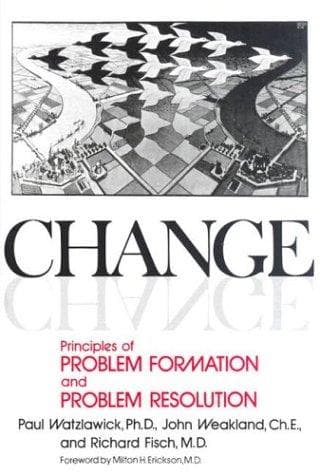
Core Idea
- Most problems persist because your attempted solutions are the problem itself — applying "more of the same" strategy deepens the trap
- Second-order change (changing the system's rules) works where first-order change (working harder within the system) fails — you must exit the logic, not optimize within it
- Problems are maintained by what happens now, not their origin — stop analyzing why and start changing what sustains it
How Problems Trap You
- "More of the Same": Insomniac tries harder to sleep → stays awake; depressed person gets cheerier advice → feels more inadequate
- Denial: Refusing to acknowledge a problem compounds it; hidden issues become "open secrets" everyone knows but can't discuss
- Utopian Ideals: Pursuing impossible standards (perfect happiness, total control) guarantees failure, blamed on personal inadequacy rather than the flawed premise
- Paradoxes: Orders to "be spontaneous" or demands for "willing compliance" create logical traps with no solution inside the system
How to Break Free: Second-Order Change Strategies
Reframing
- Interpret the same facts completely differently — a stammer becomes a sales advantage (clients listen); a dirty house proves you're needed
- New frame is impossible to unsee; the old game becomes unplayable
Prescribe the Symptom
- Tell insomniac to stay awake deliberately → removes the struggle, sleep returns
- Tell perfectionist to write something deliberately bad → removes paralysis
- Removes the hidden struggle; symptom loses its power
Make Hidden Patterns Overt
- Name the unconscious game explicitly → it cannot continue unplayed
- Husband told to deliberately start fights → pattern becomes visible and controllable
Minimal, Concrete Goals
- Replace vague aims ("be happy") with specific, measurable targets
- Set strict time limits (10 sessions max)
- Small change cascades through the entire system
Utilize Resistance
- Don't fight refusal; incorporate it: "Your situation is hopeless" makes them prove you wrong
- Ask "Why should you change?" — shifts the frame so their defense stops working
- Resistance reveals where the system's stability is strongest
Strategic Absence
- Stop the expected response: ignored lonely child seeks positive attention; runaway teen stops running when parents stop searching
- Absence disrupts patterns more than intervention ever could
Action Plan
- Identify your repeated "solution" — what you keep doing that never works
- Do the opposite or sideways action — not logically sound at your level, but sound at a higher logical level
- Reframe using the other person's language and values — not yours
- Set one concrete, minimal goal — not transformation; just the specific change needed
- Expect and utilize resistance — it's valuable data about what stabilizes the system
Generated with Claude Sonnet 4.6 · prompt legacy-pre-v6 · model inferred from repository history