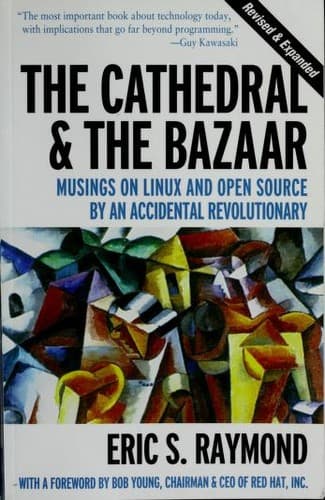
Core Idea
- Raymond contrasts “cathedral” development, which is centralized, carefully planned, and release-sparse, with “bazaar” development, which is open, rapid-release, and shaped by many independent contributors.
- His central claim is Linus’s Law: given enough eyeballs, all bugs are shallow, because broad exposure to real users and co-developers makes problems faster to find, explain, and fix.
- The book’s deeper thesis is that open source succeeds not mainly through heroic isolation, but through self-selected participation, fast iteration, and a social system that rewards useful work with reputation and satisfaction.
How Bazaar Development Works
- Raymond frames successful software as starting with a developer’s personal itch, as with his own mail-fetching problem that became fetchmail.
- He repeatedly favors reuse and rewriting over starting from scratch, arguing that good programmers know what to write, but great ones know what to rewrite.
- “Plan to throw one away; you will, anyhow” captures his view that the first version is often a learning step and the second is where real understanding arrives.
- His model depends on treating users as co-developers, since they supply bug reports, diagnostics, fixes, and feature ideas when the process welcomes them.
- Release early, release often is not just a slogan but a mechanism for maximizing feedback, exposing bugs, and keeping contributors engaged.
- The value of many testers comes from self-selection: the people who use and report on the software are the ones most likely to understand it and propose plausible fixes.
- Raymond distinguishes a large community from a large bureaucracy by emphasizing a small core plus a wider halo of testers and occasional contributors.
- He argues that open-source projects avoid much of Brooks’s Law because not everyone has to talk to everyone else; instead, many parallel subtasks feed a compact core.
- Frequent releases also reduce duplicate effort, because fixes propagate quickly and multiple people can chase the same bug in parallel until one finds the easiest route.
Fetchmail as Evidence and Design Lesson
- Raymond presents fetchmail as an empirical test of bazaar principles, not just a theoretical argument.
- A pivotal improvement came when a user suggested forwarding mail to SMTP instead of handling local delivery itself.
- That change reframed fetchmail from a tangled MTA/MDA hybrid into a cleaner pure MTA, reducing configuration complexity and lowering the risk of lost mail.
- The episode shows his broader point that stalled projects may suffer from the wrong framing of the problem, not merely from missing code.
- He treats design as an exercise in subtraction, captured by the line that perfection is achieved not when nothing more can be added, but when nothing more can be taken away.
- He emphasizes smart data structures and dumb code as a better balance than clever code over weak structures.
- Other fetchmail lessons include: value beta-testers highly, recognize good ideas from users, and expect truly innovative solutions to come from realizing the original concept was wrong.
- He warns that gateway software should disturb data streams as little as possible and never throw away information unless the recipient forces it.
- He also notes that tools should work in expected ways but be flexible enough to support unexpected uses, as happened with client-side mailing-list handling.
- His security maxim is that a system is only as secure as its secret, so pseudo-secrets are dangerous.
Why Open Source Outperforms Centralized Management
- Raymond links open source to egoless programming, where status, reputation, and utility reinforce one another rather than conflict.
- He describes this as a market in egoboo: contributors gain recognition and satisfaction, and the project gains labor and code quality.
- Open source works well because it combines peer review, modularity, self-selection, and low-friction Internet communication.
- He argues that innovation is not manufactured by process alone: social structures can nourish and test good ideas, but insight comes from individuals.
- In his critique of conventional management, he questions what heavy project management really adds beyond resource marshalling, organizing, motivating, monitoring, and goal-setting.
- Open source often escapes resource scarcity because volunteers contribute their own machines and time; the true scarce resource is skilled attention.
- He is skeptical of rigid deadline culture, suggesting that fixed dates plus fixed feature lists often force quality collapse, whereas open source can tolerate flexible scope or “wake me up when it’s done” timing.
- He uses the comparison to imply that closed-source firms may lose an evolutionary arms race if they cannot match the amount of skilled labor a motivated open-source community can assemble.
- His broader social claim is optimistic: joy, reputation, and voluntary participation are not side effects but part of the production system itself.
What To Take Away
- The book’s key insight is that open source changes the development problem by multiplying eyes, perspectives, and motivation.
- Raymond’s strongest evidence is fetchmail, where user feedback and simplification turned a personal hack into a robust tool.
- The organizational lesson is that communication structure matters: many contributors can work semi-independently if a small core can integrate their output.
- The cultural wager behind the book is that reputation, pleasure, and voluntary contribution can be a more powerful production engine than centralized control.
Generated with GPT-5.4 Mini · prompt 2026-05-11-v6