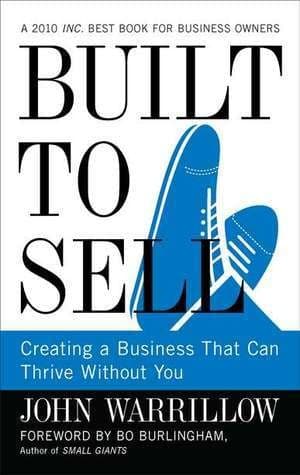
Core Idea
- Built to Sell argues that the best business is not one you plan to abandon, but one you build so it can be sold on your terms at any time.
- Warrillow’s central distinction is options strategy, not exit strategy: create a business that can be sold, kept, or stepped back from because it is no longer dependent on the founder.
- The book uses Alex Stapleton’s fictional agency to show how a founder-led service firm becomes valuable by becoming specialized, repeatable, productized, and less owner-dependent.
From Founder-Dependent Service Firm to Sellable Business
- Alex’s agency starts as a chaotic, custom, founder-centric shop: Alex sells most work himself, clients want him personally, cash flow is uneven, and one bank client accounts for too much revenue.
- Ted Gordon’s verdict is blunt: a small service business with concentrated client risk and no process is “virtually worthless” to a buyer.
- The first move is specialization: stop being a generalist and identify one service worth turning into a repeatable offering.
- Alex settles on logos and turns the work into a Five-Step Logo Design Process: Visioning, Personification, Sketch Concepts, Black-and-White Proofs, Final Design.
- Ted’s rule is that no customer should represent more than 10–15% of revenue, because concentration makes the business unattractive and fragile.
- The goal is to treat a standardized service like a product: clearly defined, repeatable, needed again and again, and ideally paid for in advance.
- Alex learns that saying no to custom work is part of the strategy; mixed offerings keep the firm looking like a generic service shop and preserve founder dependence.
- The business must also be able to run without Alex “piecing every project together,” which means staff need an instruction manual and training to deliver the process consistently.
The Mechanics That Create Value
- The book’s value framework emphasizes three traits for a sellable offering: teachable, valuable, repeatable.
- Repeatable matters most because recurring revenue is more valuable than one-off work; Warrillow ranks recurring models from lower to higher value, from consumables to contracts.
- Logos fit the ideal zone because they can be both teachable and valuable, while custom services like agency-style advertising work are harder to scale and less buyer-friendly.
- Charging up front changes the cash cycle and reduces working-capital strain, which raises acquisition value because the buyer does not need to fund as much growth.
- Warrillow stresses that the working-capital clause can materially change deal value; the offer details matter nearly as much as headline price.
- Productizing also changes the sales function: hire people who sell products, not professional-service customizations, because product sellers can adapt the pitch without changing the offering itself.
- Ted prefers two sales reps over one: competition helps, and it proves the business is not dependent on a single rainmaker.
- The business must stop selling anything outside the standard offer, even when extra custom work seems profitable, because exceptions destroy focus and create future dependence.
- The transformation may temporarily hurt reported earnings because accounting spreads revenue over time, so the P&L can look worse even as cash improves.
- Ted’s advice is to accept the short-term pain and keep at least two years of standardized financials before selling so a buyer can see the model working in practice.
Management, Sale Process, and Negotiation
- To reduce founder dependence further, Alex builds a management team and uses a long-term incentive plan rather than equity to keep key people aligned through a sale.
- The book contrasts that with misaligned profit-sharing: if managers want annual profit while the owner wants market value, conflict and delay follow.
- Once the business is more system-driven, Alex shifts from survival thinking to growth thinking, aiming for a larger business that could sell for materially more later.
- Warrillow argues that the right adviser is a boutique M&A firm or broker that matters on the deal, not a giant intermediary that will treat the business as generic or try to hand it to an existing buyer.
- The sell-side process includes a teaser, NDA, Book, buyer shortlist, and management presentations; serious buyers are strategic acquirers with a specific reason to buy.
- Language matters throughout: calling buyers customers, contracts contracts, and the company a business helps signal that this is a product company, not an interchangeable agency.
- When a buyer asks why the owner wants to sell, the “right” answer is not simply wanting out; buyers want to hear that the seller sees future upside and will help unlock it.
- Even after a letter of intent, the deal is not safe: due diligence is a long, invasive exam of leases, contracts, IP, finances, customers, and founder dependence.
- Buyers may re-trade price after diligence, so the seller must be willing to pound the table and force a close date if the process drags.
What To Take Away
- The book’s enduring lesson is that a valuable service business is built by removing founder dependence, not by maximizing the founder’s personal output.
- Specialize, document, standardize, and productize before you try to sell; those changes improve both sellability and day-to-day business quality.
- Protect the deal economics by watching client concentration, working capital, and earn-outs, because the headline number can mislead.
- Build the business so you always have options: sell it, keep it, or step back from it without the company falling apart.
Generated with GPT-5.4 Mini · prompt 2026-05-11-v6