Core Idea
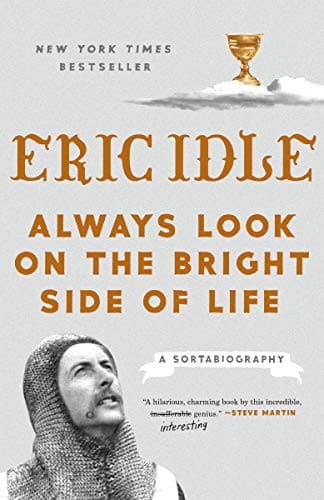
- Eric Idle presents the book as a “sortabiography”: part memoir, part history of “Always Look on the Bright Side of Life,” and part comic self-defense.
- The central story is how a joke written while he was literally crucified on the set of Life of Brian became an enduring anthem for funerals, football terraces, emergencies, and collective survival.
- He frames his life as a series of improbable pivots: postwar childhood, boarding-school brutality, Cambridge comedy, Monty Python, Broadway, film, pop music, and late-life reunion.
Becoming Eric Idle
- Idle’s childhood was shaped by war, loss, and comic coping: his father died in an accident after the war, his mother struggled with depression, and he was partly raised by his gran.
- He credits show-business instincts to a family circus connection, childhood exposure to music hall, films, radio comedy, and the first wave of television.
- Boarding school, especially the abusive Royal School Wolverhampton, taught him to distrust authority, bond with peers, and survive by subversion and laughter.
- Writing, guitar playing, and performance became escapes; he also absorbed protest music, Elvis, and the anti-nuclear politics that pushed him away from military pretensions.
- Cambridge gave him freedom, collaborators, and a route into Footlights, where he met or worked near future Pythons such as John Cleese, Graham Chapman, Michael Palin, Terry Jones, and Terry Gilliam.
- He describes comedy as something he learned by doing: writing sketches, watching what made audiences laugh, and discovering that character, timing, and performance matter as much as the line itself.
Python, Fame, and the Bright Side Song
- Monty Python’s Flying Circus emerged from a loose writer-performer culture, with no fixed format, a BBC slot that initially seemed marginal, and a willingness to combine verbal wit, visual absurdity, and brazen bad taste.
- Idle stresses Python’s method: write what amused them, keep only what survived laughter in rehearsal, and let each member occupy recognizable comic territory.
- He credits the group’s success to timing, color television, animation, and the fact that the BBC largely left them alone despite early hostility.
- “Always Look on the Bright Side of Life” began as a solution to the problem of ending The Life of Brian, whose crucifixion finale was historically ordinary but theatrically difficult.
- The song’s first form came from his own quick guitar writing and was then reshaped in Tunisia into the cheeky Cockney version that made the single work.
- He insists the crucifixion set and the song’s tone were not meant as cheap irreverence; the point was that optimism can be a comic and existential response to absurdity and pain.
- He also treats the song’s later afterlife as a surprise, noting its use at funerals, on sports terraces, and in public rituals where it became both ironic and sincerely consoling.
Films, Side Projects, and the Art of Making Chaos Work
- Python’s move into film and live performance brought bigger audiences, more money, and more chaos, from And Now for Something Completely Different to The Holy Grail and the books, albums, and tours that grew around them.
- The Holy Grail was made on a tiny budget, with rock-star investors, miserable weather, broken cameras, and reshoots, but it became a cult event through screenings, publicity stunts, and audience devotion.
- Idle’s account of Rutland Weekend Television and The Rutles shows his taste for parody built from specific musical and televisual details, especially when he can mimic a form so precisely that it becomes funny.
- He calls The Rutles the first mockumentary and treats it as a playful but serious example of how pastiche can become its own original work.
- George Harrison is a major figure in the book: he backed Life of Brian, helped fund freedom for Python projects, and became Idle’s friend, collaborator, and model of spiritual seriousness mixed with mischief.
- Idle repeatedly argues that many of his “bad films” were enjoyable because they were made with strong collaborators, decent goodwill, and room for improvisation, even when the final product disappointed critics or distributors.
- He values directors and partners who can shape comedy without sanding it down, and he names Mike Nichols as the clearest example of the kind of seriousness that makes comedy land.
Broadway, Reunions, and What Endures
- Spamalot proved to Idle that Python could be translated into Broadway form if the director, producers, cast, and structure were right; he treats Mike Nichols as the key figure who made the show work.
- The musical’s success depended on placing familiar Python material inside a theatrical structure that still played like a real story, not a scrapbook of jokes.
- The later Python reunion at the O2 became a farewell rather than a comeback, and Idle presents it as a final triumph made possible by careful staging, rehearsal, and public appetite.
- Throughout the book, he returns to collaborators and friends—John Du Prez, Terry Jones, Robin Williams, Steve Martin, David Bowie, Billy Connolly, George Harrison—as proof that his life has been built through comic fellowship.
- His friendship with Robin Williams is especially moving: he admires Williams’s speed, generosity, and intensity, while also recognizing the damage caused by addiction and illness.
- Age, fame, and national identity become late-book themes: he dislikes being treated as a “national treasure,” prefers being a foreigner, and resists the idea that art should be turned into institutional heritage.
- He is skeptical of mysticism and celebrity pretension, but not of collaboration, craft, or the pleasure of making audiences laugh.
What To Take Away
- Idle’s life story is less about triumph than about comic survival, where jokes become tools for coping with loss, authority, embarrassment, and mortality.
- Bright Side endures because it captures one of his deepest instincts: turning bleakness into shared, performative optimism without pretending the bleakness is not real.
- Python, as he tells it, worked because it was a gang of writers-performers who trusted one another enough to cut jokes, share credit, and chase weirdness all the way to the stage or screen.
- The book’s final note is not nostalgia but continuity: the work mattered, the friendships mattered, and the song keeps circulating because people still need a funny way to keep going.
Generated with GPT-5.4 Mini · prompt 2026-05-11-v6