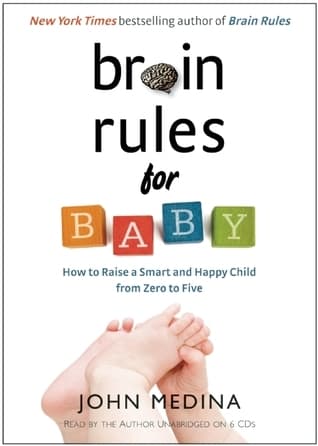
Core Idea
- Medina argues that raising a child is fundamentally a brain-building project, and the best guidance comes from practical science rather than parenting folklore or “brainy” consumer products.
- His central claim is that children’s outcomes are shaped by a seed-and-soil interaction: genes matter, but ordinary experiences, relationships, stress, language, and structure matter enormously too.
- The book is built around a few big outcomes parents care about most: intelligence, happiness, and morality, all of which Medina ties to early caregiving, especially in the first five years.
How Brain Development Works
- Medina emphasizes that prenatal and early childhood brain development follows a sequence: neurogenesis first, synaptogenesis later, with wiring continuing well past birth into the early 20s.
- He repeatedly rejects prenatal hype, arguing that products and schemes like Mozart piping, educational DVDs, and fetal “universities” have not been shown to improve brain performance.
- Sensory systems develop in staged, practical ways: babies can respond to sound, smell, touch, balance, and taste before birth, but meaningful experience depends on real exposure in utero and after birth.
- He uses specific evidence such as fetal auditory memory, newborn preference for familiar sounds, and flavor exposure through amniotic fluid to show that the womb is not silent or inert.
- The most important prenatal message is the Goldilocks Effect: development needs the right amount of growth, nutrition, stress, and exercise, not extremes.
- Medina highlights four evidence-based prenatal balancing acts: gain the right weight, eat the right foods, avoid too much stress, and exercise the right amount.
- He treats folic acid as a major intervention because it reduces neural tube defects, and omega-3 fatty acids as one of the few supplements with meaningful evidence for fetal brain support.
What Makes Kids Smart
- Medina argues that IQ is only a partial measure of intelligence, and that smartness is better understood as a mix of ingredients rather than one number.
- He is skeptical of genetic determinism: no “smart gene” has been found, and brain scans do not reveal a single signature of genius.
- Intelligence is also malleable: it shifts with stress, culture, income, family environment, and adoption, and the Flynn Effect shows average IQ scores rose dramatically over time.
- He treats early cognitive prediction cautiously, but notes that infant measures like cross-modal transfer and visual recognition memory can predict later IQ.
- His broader “intelligence stew” includes memory, improvisation/fluid intelligence, exploration, self-control, creativity, verbal communication, and reading nonverbal cues.
- Self-control is especially important; delay-of-gratification findings are presented as strong predictors of later school success.
- Verbal communication is built by real human conversation, not passive media, and parentese helps infants parse speech and learn language.
- Nonverbal communication matters because reading faces, gestures, and emotional cues supports friendship, teamwork, and later success.
- He warns against hyper-parenting, since pushing too hard too early can crush curiosity, create toxic stress, and weaken the very capacities parents want to build.
- The strongest environment for smartness is not expensive equipment but breast-feeding, rich talk, open-ended play, and praise for effort rather than innate talent.
How to Raise a Happy and Moral Child
- Medina treats happiness as deeply relational: babies are not blank slates but are prewired for safety, attachment, and social connection.
- He argues that what parents do with emotions matters more than suppressing them; interaction synchrony and responsive back-and-forth are the foundation of secure attachment.
- He rejects the idea that bonding is a one-time event after birth; attachment builds over time, and children need consistent caregiving, not just immediate contact.
- Insecure attachment, chronic deprivation, and family hostility can damage stress regulation, empathy, grades, and later relationships; the Romanian orphanage studies are his most dramatic warning.
- The Four Grapes of Wrath that often damage marriages after a baby arrives are sleep loss, social isolation, unequal workload, and depression.
- He stresses that children are highly sensitive to marital conflict, but also that repair matters: seeing reconciliation is better than seeing only fighting.
- His antidote to conflict is empathy—first notice the emotion, then guess at its cause—which he sees as one of the strongest predictors of marital and parenting success.
- For happiness, Medina recommends an authoritative style: warm and demanding, emotionally aware, and able to track a child’s feelings without smothering them.
- He argues that parents should name emotions, because verbal labels calm children by linking feeling to language and improving self-soothing.
- Children learn morality through a mix of innate moral intuitions, observation, and discipline; the brain systems for judgment depend on both emotion and reasoning.
- Effective moral teaching rests on three supports: clear rules and rewards, swift and consistent punishment, and explanations of why the rule exists.
- He favors inductive discipline over “because I said so,” because reasoning helps children internalize guilt about harm rather than merely fear detection.
- He criticizes spanking as a lazy and harmful strategy, and argues that children respond best to firm but emotionally safe correction.
What To Take Away
- The book’s big wager is that ordinary parenting behaviors are brain-shaping forces with lasting effects on IQ, emotional life, and conscience.
- Medina’s strongest recurring idea is that warmth plus structure beats both harshness and permissiveness.
- His most distinctive practical theme is that empathy is not soft sentimentality; it is a learnable skill that lowers conflict and helps children regulate themselves.
- The deepest message is that parents do not simply produce children; they help create the kind of minds and hearts those children will become.
Generated with GPT-5.4 Mini · prompt 2026-05-11-v6