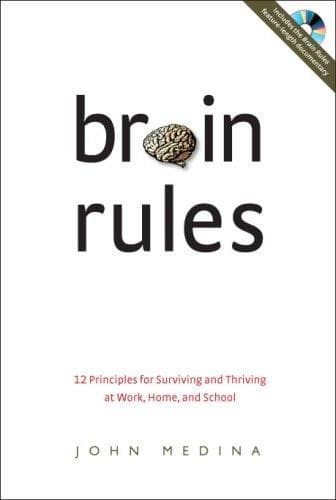
Core Idea
- Brain performance is governed by biology, not willpower—optimize your environment and habits to work with your brain's wiring, not against it
- Every brain is uniquely wired; one-size-fits-all approaches fail—personalize learning, work schedules, and team composition
- Action follows from understanding: apply neuroscience to exercise, sleep, attention, memory, and stress to see measurable gains
Physical Foundation
- Exercise 2-3x weekly (30 min aerobic + strength): improves memory, reasoning, attention, problem-solving by increasing BDNF and hippocampal blood flow
- Match work/school schedules to chronotypes (larks/owls): productivity gains offset adaptation costs
- Integrate movement into daily work/school: treadmills in offices, walking meetings, active breaks—don't silo exercise
Attention & Memory
- Brain disengages after 10 minutes—deploy emotionally compelling hooks every 10 min to recapture attention
- Multitasking is neurologically impossible: task-switching adds 50% more time and 50% more errors
- Space repetition, don't cram: repeat at 90-min intervals, then days/weeks later; elaborate with real-world examples at learning moment
- Match retrieval to encoding environment: study the way you'll perform (oral practice for oral exams, hands-on practice in actual workspace)
Sleep & Stress
- Normalize 26-minute afternoon naps (34% performance boost); install nap pods and flexible schedules
- Chronic stress kills learning: control and predictability reduce toxic stress; marital stability directly affects work/school performance
- Address family stability as business asset: offer marriage counseling and childcare; intervention before deterioration compounds into child development and turnover problems
Sensory & Communication
- Vision dominates: uses 50% of brain resources—replace text-heavy slides with image-rich presentations
- Multisensory > single-sense: 50-75% more creative solutions; pair content with consistent scent for retrieval boost; touch + vision increases recognition 30%
- Place critical info at start/end (serial position effect): middle content gets lowest recall
- Pictures over oral alone: 65% retention with images vs. 10% oral alone at 72 hours
Learning Design
- Abandon grade-level systems: every brain wires differently—use smaller classes, adaptive software, and personalized instruction to track individual progress
- Provide meaning before details: hierarchical information architecture improves comprehension
- Preserve curiosity: babies learn via hypothesis-test-conclude cycles—extend this exploratory model through adulthood and professional training
Team & Organizational Design
- Build mixed-gender teams for complex problems: women excel at emotional detail, men at gist—complementary strengths
- Embed researchers into practice: pair brain scientists with educators in onsite schools/labs within colleges of education (model: medical schools with teaching hospitals)
Action Plan
- This week: Map your chronotype; negotiate flexible start time; add 30-min aerobic activity 2-3x weekly
- This month: Redesign one presentation/training with images over text; add 26-min nap window; schedule walking meetings
- This quarter: Audit your team for gender diversity on problem-solving groups; propose marriage/family support as employee benefit
- This year: Establish one interdisciplinary team pairing practitioners with researchers; pilot spaced-repetition schedule for critical knowledge domains
Generated with Claude Sonnet 4.6 · prompt legacy-pre-v6 · model inferred from repository history