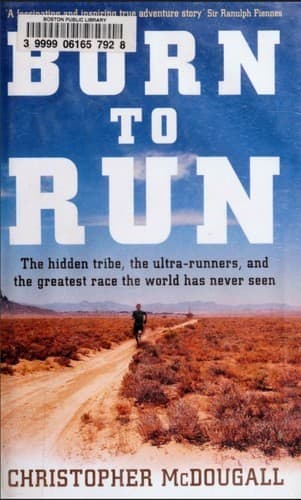
Core Idea
- Born to Run argues that humans are built for endurance running, but modern shoes, training culture, and fear of injury have obscured that ability.
- The book uses the Tarahumara (Rarámuri) of Mexico’s Copper Canyons as proof-of-concept: they run huge distances joyfully, stay remarkably healthy, and do so through a culture of cooperation rather than modern sport science.
- McDougall’s personal problem—chronic running injuries—becomes the book’s engine for exploring biomechanics, barefoot/minimalist running, diet, and the evolutionary roots of human endurance.
The Tarahumara as the Living Answer
- The Tarahumara are portrayed as the “Running People,” legendary for extreme ultradistance ability, calmness, and apparent resistance to many modern diseases.
- Their running is embedded in a social world of korima (sharing), indirect etiquette, family support, and communal races rather than individual obsession.
- Their signature races, rarájipari, are long, unpredictable ball races that require cooperation, adaptability, and persistence more than pure speed.
- Caballo Blanco, the ghostlike outsider who lives among them, becomes the bridge between McDougall’s world and theirs; he embodies the idea that running can be a way of life rather than a workout.
- McDougall uses the Tarahumara to challenge the assumption that endurance running must be grim, coached, technologically optimized, or chronically injurious.
Running Mechanics, Injury, and the Barefoot Argument
- McDougall starts from the injury epidemic: he and many runners keep breaking down, while experts give contradictory advice about orthotics, motion-control shoes, cortisone, and gait changes.
- Dr. Irene Davis’s treadmill analysis shows McDougall’s form as inefficient and jarring, but the book emphasizes that “fixes” can simply trade one problem for another.
- The central critique is that modern running shoes may worsen mechanics by cushioning impact, encouraging harder strikes, weakening feet, and increasing knee and foot problems.
- The book draws on researchers such as Daniel Lieberman, Gordon Bramble, David Carrier, and others to argue that human bodies evolved for sustained running, not as fragile machines needing constant correction.
- The minimalist/barefoot thread is advanced through figures like Barefoot Ted, Ken Bob Saxton, and Eric Orton, who argue that shoes hide pain, distort movement, and keep runners from learning efficient form.
- A recurring formula for good mechanics is Caballo’s cue: “Easy, Light, Smooth, and Fast”—with “easy” as the foundation, not speed.
- The technique lesson is not “run harder,” but to shorten stride, increase cadence, keep the feet under the body, and let efficiency emerge from relaxed movement.
Evidence Through Racing, Characters, and Evolution
- The Leadville Trail 100 becomes the proving ground where Tarahumara runners first shock the ultrarunning world, showing that old men in sandals can outperform elite Western ultrarunners on brutal terrain.
- Their initial failure is due less to lack of ability than to unfamiliarity with modern race culture; once the right older, deeper-canyon runners are recruited, the Tarahumara dominate.
- The Leadville women’s race highlights the same point: Ann Trason runs with tactical intelligence, joy, and toughness, showing that endurance talent is not about macho suffering.
- The Tarahumara later race in Urique, where the social atmosphere matters as much as competition: food, music, betting, and village pride turn the event into communal theater.
- McDougall repeatedly contrasts characters who run with joy and adaptability—Scott Jurek, Jenn Shelton, Billy Barnett, Caballo Blanco—with figures driven by ego, paranoia, or self-promotion.
- The book’s evolutionary argument is that humans likely became endurance runners because running aided persistence hunting, heat management, and survival.
- The body traits cited as evidence include the Achilles tendon, arched feet, short toes, large gluteus maximus, sweating, and head/neck stabilization; together these suggest adaptation for long-distance running.
- The hunting theory is strengthened by stories of trackers and Bushmen who “speculatively” read animal behavior, showing that running success depends on brains, tracking, and social coordination as much as legs.
- McDougall extends the idea into a moral claim: running and hunting likely made humans more cooperative, less isolated, and better at shared effort.
Diet, Simplicity, and What Running Means
- The Tarahumara diet—pinole, beans, corn, tortillas, greens, and occasional tesvino—functions as another challenge to sports-nutrition orthodoxy.
- The book suggests that light, plant-based eating can support endurance, recovery, and general health better than the processed, protein-heavy assumptions many runners carry.
- McDougall’s own turnaround comes from combining form changes, lighter shoes, and diet changes; as pain recedes, he runs more, sleeps better, and feels calmer.
- Caballo’s life story gives the book its philosophy: after boxing, labor, and self-reinvention, he chooses disappearance, freedom, and running over status, money, and conventional success.
- The final racial/social point is that the best running world in the book is not the most commercial or elite, but the one where people come together to run, eat, laugh, and support each other.
What To Take Away
- Running is presented as a human inheritance, not a niche athletic hobby reserved for the gifted or the pain-tolerant.
- The book’s strongest claim is that movement quality, not expensive technology, is the path away from many common running injuries.
- The Tarahumara function as both evidence and ideal: they show how endurance, health, and joy can coexist in a culture built on sharing and motion.
- McDougall’s larger message is that the point of running is not just performance, but a freer way to live—lighter, more social, and less ruled by fear.
Generated with GPT-5.4 Mini · prompt 2026-05-11-v6