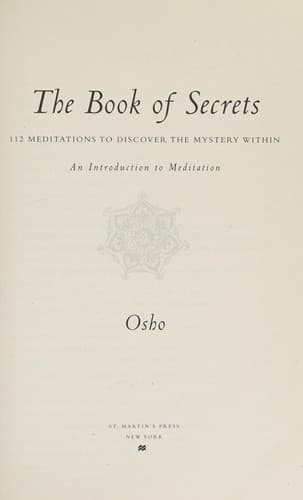
Core Idea
- The book is a manual of 112 meditation “keys,” not a doctrine, and Osho repeatedly says the reader must experiment rather than believe.
- Its central claim is that you are already divine; meditation does not create the truth, it uncovers what is hidden beneath body, mind, conditioning, and ego.
- Osho presents Tantra as a scientific, amoral, experiential path: it asks how to transform consciousness, not why to justify beliefs.
Main Teachings and Methods
- Osho contrasts Tantra with philosophy: philosophy feeds the intellect, while Tantra requires doing, receptivity, vulnerability, and surrender.
- The Vigyan Bhairav Tantra is framed as a love-dialogue between Shiva and Devi, so the disciple must take a feminine attitude of openness rather than argumentative skepticism.
- He treats mind as the source of doubt, duality, and projection; the aim is no-mind, not a better-conditioned mind.
- A recurring claim is that all repression is harmful: morality without technique creates guilt, inferiority, and split personality, whereas Tantra transforms energy first and character later.
- He repeatedly insists that acceptance comes before transformation: anger, sex, greed, fear, and desire must be seen as facts, not condemned as sins.
- In his view, Yoga and Tantra aim at the same liberation but by opposite routes: Yoga is struggle and suppression, Tantra is indulgence with awareness and total acceptance.
- He says surrender itself is the method when it is possible; otherwise one must use one of the 112 techniques to loosen the ego until surrender becomes natural.
- The first major cluster of techniques works with breath: watching the gap between breaths, the turning point, the fusion point, and the moments when breath stops by itself.
- Breath is treated as the bridge between body and cosmos, and the pauses in breathing are where the small self disappears.
- Another major cluster centers on the third eye, the navel, and other bodily centers; Osho says attention can be shifted from outer objects to subtle centers where consciousness becomes witness-like.
- He often uses weightlessness, levitation, stillness, staring, and body-deadening postures to break hypnosis with the body and reveal consciousness as bodiless.
- He also uses sound extensively: Aum, inner sounds, mantra-like repetition, listening to music, and the transformation from word → sound → feeling → silence.
- A key distinction is between repetition as a tranquilizer and repetition as awareness; mechanical mantra can sedate, but conscious sound can open meditation.
- He repeatedly recommends stop techniques: stop when an impulse arises, stop movement suddenly, stop between actions, or stop on the first stir of desire so energy turns inward.
- A major theme is witnessing projection: moods, anger, and love are not caused by others but projected onto them; the method is to return to the source inside.
- He claims that if anger or sex is brought back to its source through awareness, it transforms into compassion, love, or brahmacharya instead of being merely expressed or suppressed.
The Larger Framework
- Osho treats religion as a question of type: some people are thinking/intellectual, others feeling/devotional, and the right technique must match the person.
- He distinguishes faith-based and experimental paths: some need devotion, others need verification through practice; mixing the two can deepen confusion.
- He insists that initiation is individual and secret, because the right method depends on the disciple’s readiness, unconscious pattern, and temperament.
- A major theme is play versus seriousness: meditation works best when approached as play, while goal-hunger turns even spiritual practice into another form of desire.
- He repeatedly says the world is a drama / leela; seeing life as a play reduces possessiveness, fear, and ego.
- Desire is treated as the basic obstacle, whether it is for sex, God, liberation, or success, because it always projects fulfillment into the future.
- Death-awareness is central: when death becomes certain, clinging weakens and inwardness becomes possible.
- He uses dreamless sleep, emptiness, supportlessness, and silence as images for the highest states, but warns that even the desire for emptiness can become a new barrier.
- His language is often deliberately paradoxical: freedom requires surrender, knowledge requires unknowing, being requires no-doing, and the goal is reached by dropping even the methods that helped.
What To Take Away
- The book’s practical center is not belief but experimentation with awareness: breath, sound, stopping, witnessing, and surrender are all used to interrupt identification.
- Osho’s deepest distinction is between surface change and transformation of the center; he wants the whole basis of identity to shift, not just behavior.
- He sees ego, repression, and conditioning as the real enemies, and meditation as the way to uncover the already-present inner mystery.
- The book’s final emphasis is that what is ultimately real is available now, if one can drop the mind’s demand for certainty, purpose, and control.
Generated with GPT-5.4 Mini · prompt 2026-05-11-v6