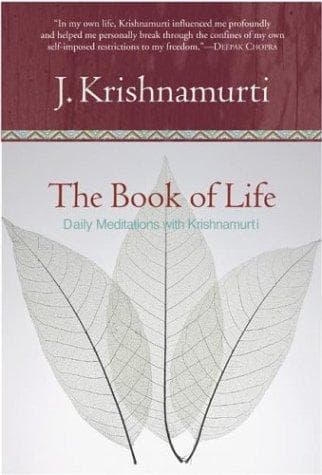
Core Idea
- Truth is found in direct observation of life, not in secondhand authority, belief, or accumulated knowledge.
- Krishnamurti treats the mind’s conditioning, especially authority, time, belief, and self-image, as the main obstacles to seeing what is.
- The book’s recurring claim is that freedom, intelligence, love, and perception are immediate, not products of method, effort, or gradual becoming.
Seeing, Listening, and Self-Knowledge
- True learning is not storing information but seeing freshly from moment to moment in relationship, action, and daily reaction.
- He repeatedly insists that the listener must come without projection: quiet attention, alert passivity, and listening without effort are what make understanding possible.
- The speaker is not an authority but a kind of “telephone”; ideas do not transform the mind by themselves.
- Self-knowledge cannot be given by priests, psychologists, books, or systems; it is discovered in relationship, where the self is mirrored in real life.
- He rejects all methods for self-knowledge because methods seek results, create dependence, and replace freedom with imitation.
- Relationship is the mirror in which one sees fear, jealousy, hurt, ambition, and resistance as they actually arise.
Conditioning, Time, and the Self
- The mind is shaped by knowledge, memory, tradition, race, religion, nation, and habit, and this conditioning makes perception narrow and repetitive.
- Krishnamurti treats belief as an escape from fact: religious and political beliefs divide people and keep them from meeting reality directly.
- Psychological time—the inner use of yesterday/today/tomorrow as a bridge to becoming—is a central source of fear and disorder.
- Time is not merely chronological; it is the mind’s structure of postponement, hope, memory, and self-continuity.
- He argues that “becoming” is strife: trying to become nonviolent, virtuous, or secure only extends conflict.
- The self is not a stable essence but a bundle of memory, conclusion, striving, ambition, and identification, and it is inherently divisive.
- The key division is between the observer and the observed; in fear, anger, loneliness, and emptiness, the “I” is not separate from the state it tries to control.
Love, Fear, Sorrow, and Violence
- Love is not sentiment, pleasure, desire, possession, duty, or jealousy; it is a state in which the self is absent.
- Because love is not an idea or formula, it cannot be pursued through discipline, recognized as a possession, or turned into a contract.
- In sex and marriage, the real problem is not the act itself but the mind that turns it into a psychological problem and an escape from self.
- Chastity is not suppression or celibacy; it exists only where there is love.
- He distinguishes emotion, sentiment, and enthusiasm from love; these are thought-based reactions tied to pleasure and pain.
- Jealousy, envy, and hurt are not resolved by explanation or forgiveness; they end only when seen directly and wholly.
- Fear is rooted in dependence, uncertainty, and the gap between what is and what should be; direct contact with the fact ends it.
- Sorrow cannot be escaped by gurus, mantras, drink, or belief; it must be lived with completely until the mind sees it clearly.
- He treats violence as a human structure sustained by division, nationalism, belief, and psychological security, not just physical aggression.
- The ideal of nonviolence is not the solution if it is merely another becoming; seeing one’s actual violence is the beginning of change.
Attention, Silence, and Freedom
- Attention is central and differs from concentration: concentration narrows and resists, while attention has no frontier and no motive.
- In full attention, thought does not dominate perception; observation without naming is presented as a source of energy and clarity.
- Krishnamurti warns that words and labels—including religious, national, and personal labels—create frontiers and distort direct seeing.
- He says truth is perceived in a flash, not in time; delaying understanding is a form of fear or laziness.
- Awareness is not disciplined introspection but nonjudgmental seeing of the whole movement of thought, feeling, and contradiction.
- When a feeling is fully seen without naming or resistance, the separate censor/thinker disappears with it.
- Habit, analysis, and suppression all keep problems alive; what is fully understood does not recur.
- The still mind he describes is not passive in the ordinary sense but “astonishingly active”, because it is free from the dead weight of memory and effort.
- Meditation here is not a technique but the watching of the whole movement of mind—conscious and unconscious—until it becomes quiet.
- Genuine transformation is immediate rather than gradual; it lies outside the field of thought and cannot be guaranteed by authority, systems, or technique.
What To Take Away
- The book’s core demand is to see life directly, without leaning on authority, belief, or the comfort of becoming.
- Krishnamurti’s recurring method is to expose how the mind manufactures division through time, labels, memory, and the self.
- He presents love, freedom, and intelligence as states that appear when the observer stops separating itself from experience.
- The book is less a doctrine than a relentless attempt to make the reader notice that what blocks truth is usually the mind’s own movement.
Generated with GPT-5.4 Mini · prompt 2026-05-11-v6