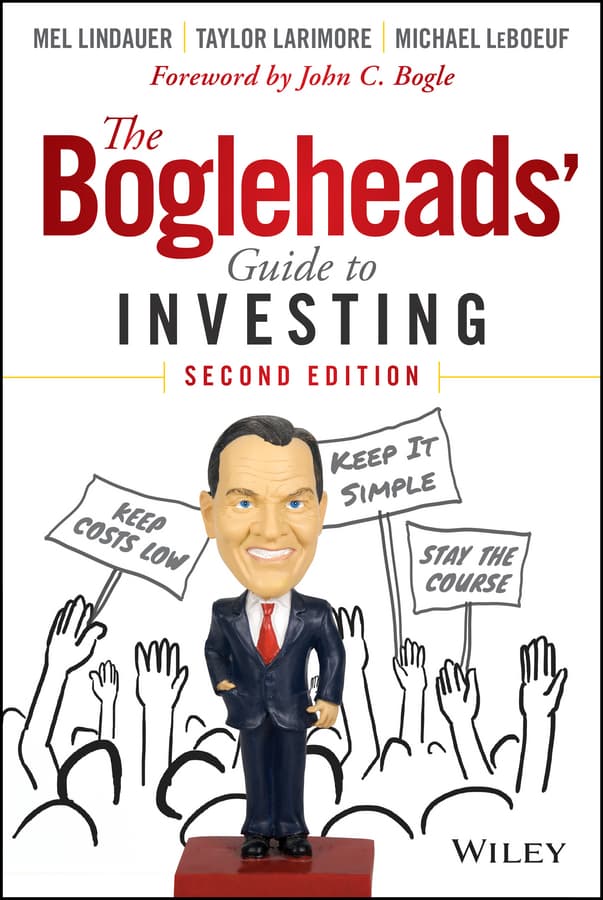
Core Idea
- Investing is a loser’s game after costs, so the winning strategy is not brilliance but discipline: save early, spend less than you earn, keep costs and taxes low, and own a broadly diversified portfolio.
- The book translates John Bogle’s low-cost indexing philosophy into a full personal-finance system that covers debt, emergency reserves, asset allocation, retirement, insurance, and estate planning.
- Its recurring message is that behavior matters more than stock-picking skill: performance chasing, market timing, and emotional reactions usually destroy returns.
The Boglehead Philosophy
- The opening contrast is between a paycheck mentality and a net worth mentality; wealth is measured by assets minus debts, not by income alone.
- Three financial lifestyles are distinguished: Borrowers live on credit, Consumers spend what they earn, and Keepers pay themselves first and build net worth.
- Before investing, the authors insist on three steps: pay off high-interest debt, build an emergency fund, and shift into saving-first habits.
- Credit card debt is singled out as the highest-risk “return” to eliminate first, because interest compounding works against you and rates can jump without much protection.
- Saving is treated as the real engine of wealth; the book repeatedly argues there is no shortcut that substitutes for a high savings rate.
- Small regular contributions matter because of compounding; the book uses examples like monthly investing, the Rule of 72, and a penny doubling to show how time amplifies returns.
- Starting early is crucial: waiting even ten years can dramatically reduce final wealth, and the authors contrast early savers with later savers to make the point concrete.
- Practical ways to free money include pay yourself first, reduce spending, buy used cars, lower housing costs, and create side income; every dollar not spent is cheaper to invest than every dollar earned and taxed.
Building a Portfolio the Boglehead Way
- The most important portfolio choice is asset allocation: how much to hold in stocks, bonds, and cash, based on goals, time horizon, risk tolerance, and overall financial situation.
- The book leans on Efficient Market Theory and Modern Portfolio Theory to argue that prices already reflect information and that diversification reduces risk without requiring market-beating skill.
- Evidence from Brinson, Hood, and Beebower and a later Vanguard study is used to claim that asset allocation explains most of the variation in returns, while active management usually subtracts value through costs.
- Stocks provide ownership and growth, but their volatility makes them poor choices for money needed in the near term; bonds provide stability, income, and lower risk, but lower expected return.
- Diversification is framed as protection against ignorance: owning many uncorrelated assets is better than concentrating in a few names, sectors, or styles.
- The book recommends broad exposure across large/small, value/growth, and selectively REITs and international stocks, while keeping sector bets small or avoiding them entirely.
- International diversification matters because foreign markets do not move exactly with U.S. markets, though the authors also note that overseas stocks are not essential for every diversified portfolio.
- For bonds, a single low-cost, short- or intermediate-term, high-quality bond fund is usually enough; junk bonds are excluded from model portfolios because they behave too much like stocks.
- Inflation is treated as a hidden risk that erodes purchasing power, so nominal returns must be judged in real terms.
- The book compares I Bonds and TIPS as inflation-protected tools, noting that taxes, inflation assumptions, and holding period can change which is superior for a given investor.
- TIPS bought at auction and held to maturity are presented as the cleanest way to protect principal against unexpected inflation, though taxable accounts create “phantom income.”
- Mutual funds are preferred because they offer instant diversification, low minimums, liquidity, and automatic reinvestment; index funds are the ideal version because they minimize costs and style drift.
- ETFs can also be low-cost and useful, but the authors warn against using them for market timing or day trading.
- Annuities are treated skeptically: fixed and variable versions often hide high costs and surrender charges, while immediate annuities are irreversible and depend on insurer strength.
Behavior, Rebalancing, and Retirement
- Rebalancing is presented as a risk-control tool that restores the chosen stock/bond mix and forces investors to sell high and buy low.
- Letting winners run means letting the market, not the plan, determine risk; the dot-com boom and Nasdaq collapse are used as a warning.
- A cited study found that never rebalancing may raise volatility without improving results enough to justify the risk; the point is discipline, not cleverness.
- Rebalancing can be done by time schedule or by bands; the authors also suggest using new contributions, distributions, or tax-aware trades to reduce costs.
- Asset allocation should be adjusted for life stage and temperament, and nervous investors are encouraged to hold more bonds than their instincts initially suggest.
- The book’s warning against noise is strong: financial media, newsletters, seminars, and forecasts are often sales tools, and short-term predictions are usually just entertaining fiction.
- The key behavioral traps are greed, fear, recency bias, overconfidence, loss aversion, herd behavior, mental accounting, anchoring, and paralysis by analysis.
- The antidote is to write down goals, use a simple plan, confine speculation to a tiny “casino account” if desired, and keep employer stock modest.
- Retirement planning is built around realistic saving rates and withdrawal rates, not wishful thinking; the book rejects the idea that a long-run market average means you can safely spend 10% of your portfolio.
- The authors favor withdrawal rates in roughly the 4% to 6% range depending on circumstances, with flexibility from lower living costs, part-time income, delayed retirement, or immediate annuities.
- Insurance is treated as catastrophe protection, not as an investment: term life is preferred, disability coverage is emphasized, major medical and umbrella liability are encouraged, and long-term care insurance is for selected situations.
- Estate planning should prevent probate headaches and family confusion through wills, trusts, powers of attorney, beneficiary designations, and written instructions.
What To Take Away
- Do less, but do it consistently: save more, own broad index funds, keep fees and taxes low, and rebalance instead of reacting.
- Risk comes from concentration and behavior, not just from market volatility; the book’s core defenses are diversification, humility, and patience.
- Financial success is mostly a system: debt control, emergency savings, asset allocation, retirement spending discipline, insurance, and estate planning all belong together.
- The Boglehead ideal is not to outsmart markets but to build a life that lets compounding work while avoiding the expensive mistakes most investors make.
Generated with GPT-5.4 Mini · prompt 2026-05-11-v6