Core Idea
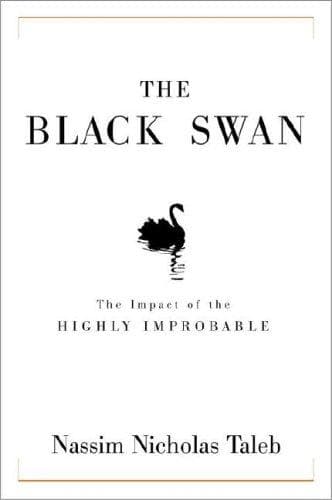
- A Black Swan is an outlier with extreme impact that is retrospectively explainable but not prospectively predictable.
- Taleb’s central claim is that a tiny number of such events shape history, markets, science, culture, and personal lives far more than routine, average cases do.
- The book argues that our main enemy is not randomness itself but blindness to randomness, especially our habit of mistaking what is visible, narrated, and statistically “normal” for what is actually important.
How Humans Misread Reality
- People suffer from confirmation error, narrative fallacy, silent evidence, tunneling, and Platonicity: they seek confirming cases, invent tidy stories, ignore missing failures, focus narrowly, and prefer abstract models over messy reality.
- Taleb treats history as opaque: we see outcomes, not the generator of events, so we confuse the observed script with the underlying process.
- The mind is a powerful interpreter that rewrites memory after the fact, making events seem more coherent, causal, and inevitable than they were.
- Media and experts amplify this distortion by offering confident explanations for every event, even when the honest answer is “I don’t know.”
- He repeatedly attacks the illusion that more data, more commentary, or more mathematical dressing yields better understanding when the real issue is structural unpredictability.
Mediocristan, Extremistan, and the Black Swan Problem
- Taleb’s key contrast is between Mediocristan and Extremistan: in Mediocristan, single observations barely matter; in Extremistan, one observation can dominate the whole.
- Examples of Mediocristan include height, weight, and other bounded physical quantities; examples of Extremistan include wealth, book sales, citations, city sizes, war deaths, and financial markets.
- Black Swans are tied to Extremistan because scalable, social, and informational systems allow rare events to have enormous consequences.
- He warns that not every rare event is a Black Swan: some are gray swans or more tractable Mandelbrotian risks, but true Black Swans remain outside reliable prediction.
- The turkey problem captures induction’s weakness: a long streak of good evidence says little about the one event that destroys the pattern.
- His round-trip fallacy is the confusion between “there is no evidence of X” and “there is evidence of no X,” which encourages false confidence in absences.
Prediction, Serendipity, and the “Fourth Quadrant”
- Taleb argues that forecasts usually omit error bars and degrade rapidly as horizons lengthen, making corporate and government predictions far less reliable than their tone suggests.
- He criticizes the culture of forecasting as often institutional theater: people produce projections because the system demands them, not because the projections are epistemically sound.
- He emphasizes serendipity in discovery: penicillin, cosmic microwave background radiation, and the laser show that major breakthroughs are often found, not planned.
- His practical stance is not “predict better” but reduce exposure to downside and maximize exposure to positive surprises.
- The book’s risk map culminates in the Fourth Quadrant: complex payoffs in Extremistan, where standard statistical tools, optimization, and point forecasts are least trustworthy.
- In that quadrant, Taleb prefers what not to do over elaborate positive prescriptions, because avoiding fragile mistakes is more robust than pretending to optimize the future.
Fractals, Fat Tails, and Why Standard Statistics Fail
- Taleb draws heavily on Mandelbrotian or fractal randomness: many real-world phenomena are scale-invariant, self-affine, and jagged rather than Gaussian and smooth.
- Fractal thinking explains why small samples can mislead, why extreme observations matter so much, and why exponents and tail behavior dominate outcomes.
- He argues that Gaussian assumptions systematically understate tail risk, especially in domains where extremes are more important than averages.
- His “masquerade problem” is that fat-tailed processes can look deceptively normal when extreme events are rare in the sample.
- He criticizes overreliance on variance, standard deviation, least squares, and similar tools in domains where tails and nonlinearities rule.
- In these settings, the key quantity is not just probability but probability times consequence, because tiny probabilities can carry catastrophic impact.
Fragility, Iatrogenics, and Stoic Robustness
- Taleb extends the argument from prediction to action: fragile systems are those that break under stress, while robust systems survive because they are not overoptimized.
- He introduces iatrogenics to name harm caused by intervention, especially in medicine, where action can create damage under the illusion of control.
- He is skeptical of incentives and institutions that privatize gains and socialize losses, especially in finance and regulation.
- His preferred response is not a fantasy of being “Black-Swan-proof” but becoming more robust through redundancy, humility, and respect for uncertainty.
- The closing Stoic note, via Seneca, is that freedom comes from learning how to lose less psychologically and materially, and from loving fate rather than demanding control over it.
What To Take Away
- Black Swans matter because history is driven by a small number of extreme events, not by the average cases we are most tempted to study.
- The biggest errors come from explaining too much, predicting too confidently, and ignoring what failed, disappeared, or never got recorded.
- In fat-tailed, complex domains, the right posture is humility: distrust neat stories, distrust precise forecasts, and focus on fragility rather than optimization.
- Taleb’s deepest practical advice is to stay exposed to upside while limiting ruin, because the future will include surprises that no model can safely price.
Generated with GPT-5.4 Mini · prompt 2026-05-11-v6