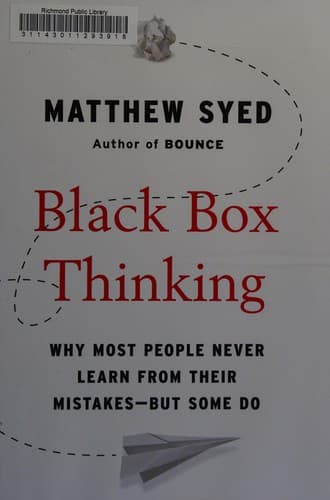
Core Idea
- Black box thinking = rigorously investigating failures, extracting lessons, and adapting systems—not hiding problems
- Aviation learns from every accident; healthcare conceals errors, perpetuating preventable deaths
- Failure is data-rich feedback; self-deception blocks learning and progress
Why We Don't Learn
- Self-justification (unconscious reframing) is more dangerous than deliberate lying—you won't recognize it to fix it
- Higher status/investment in a decision = stronger denial of contradictory evidence (prosecutors fighting DNA exonerations for years)
- Cognitive dissonance protects ego but destroys learning
How to Extract Lessons from Failure
- Use randomized control trials (RCTs) to cut through narratives and reveal truth: "Scared Straight" programs increased youth crime 25% despite compelling stories
- Test everything: measure before optimizing; 12,000 RCTs annually at Google; Mercedes F1 uses 16,000+ data channels per car
- Break problems into testable components: each failure reveals data for the next iteration (Dyson: 5,127 prototypes)
- Small pilots before scaling: test on representative (not optimal) conditions to surface blind spots
- Prospective hindsight (pre-mortem): assume failure happened before launch; list why—surfaces blind spots 30% more effectively than standard planning
Building a Learning Culture
- Create "just culture": staff must trust honest mistakes won't be punished; low-blame units catch more errors, not fewer
- Replace preemptive blame with investigation: treat errors as learning opportunities, assign blame only after full analysis
- Celebrate failure openly: design "failure week" events in schools and orgs; destigmatize mistakes
- Break rigid hierarchies: engagement and information-sharing beat distance; get hands dirty
Personal Growth Mindset
- Reframe failure as data, not identity: "I failed this task" ≠ "I am a failure"—neurologically, growth mindset activates larger error-correction signals
- Notice self-handicapping: when you avoid challenges to protect ego (last-minute cramming, skipping prep), do the opposite
- Maximize feedback frequency: practice on smaller fields (more touches, faster learning); objective outcome data drives improvement
Innovation & Optimization
- Innovation = disciplined iteration: epiphany is 2% of innovation; 98% is adapting insights through failure
- Dissent beats brainstorming: criticism generates 25% more ideas than removing obstacles
- Decouple perfection from competence: competence grows with effort; perfection is a static illusion—praise strategy and effort, not innate talent
Action Plan
- Run one pilot test this month on a conviction (A/B test messaging, policy, or process) instead of rolling out full-scale
- Create psychological safety in one team: announce that honest mistakes won't trigger blame; measure how error-reporting and learning improve
- Implement a pre-mortem before your next major decision—assume it failed, list why, adjust accordingly
- Institute objective feedback loops in roles where they're absent (especially where narrative bias thrives: hiring, performance, strategy)
- Reframe one recent failure as data, extract one actionable lesson, and iterate—then share the lesson publicly to normalize learning
Generated with Claude Sonnet 4.6 · prompt legacy-pre-v6 · model inferred from repository history