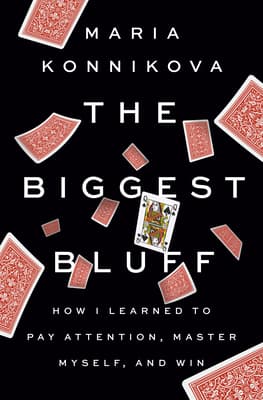
Core Idea
- Maria Konnikova uses No Limit Texas Hold’em as a compressed model of life because it forces decisions under uncertainty, incomplete information, psychology, and pressure.
- The book is not a claim that poker eliminates luck; it argues that poker trains you to notice variance, separate process from outcome, and make better decisions when results are noisy.
- What begins as a beginner’s apprenticeship under Erik Seidel becomes a study of what can be controlled, what cannot, and how to stay mentally clear when you cannot know enough.
Poker as a Model for Thinking
- Poker matters because, unlike chess, you can win with the worst hand and lose with the best hand, which makes it closer to ordinary decision-making than pure logic games.
- Konnikova stresses the difference between chance and skill: short-term outcomes are unstable, but over time skill should surface if you keep learning correctly.
- She points to the description-experience gap: people may understand probabilities in theory but still behave badly until they get real feedback.
- Her Columbia research on a simulated investing game showed that people often overestimate control, stick with bad choices, and learn less when they think they already know the answer.
- Poker becomes a useful learning environment because it gives immediate feedback on decisions, even when that feedback is partially contaminated by luck.
The Practical Vocabulary of Poker
- Seidel’s first lesson is pay attention: presence and observation matter more than flashy style.
- Position is central because acting later gives more information, and more information usually means a better decision.
- Board texture changes hand strength and strategy; dry, wet, static, and dynamic boards all demand different judgments.
- Blockers and range thinking shift the focus from a single hand to what cards an opponent can or cannot have.
- Bet sizing is not a formula but a purposeful choice about how much to risk to accomplish a specific strategic goal.
- The book repeatedly warns against playing scared, where fear of looking weak or being wrong produces bad aggression or passivity.
- The deeper lesson is that poker is less about winning any one hand than about making good decisions and evaluating them honestly afterward.
Reading Others and Reading Yourself
- Konnikova begins by hoping for reliable psychological reads, but learns that faces are noisy evidence and often mislead more than they help.
- She finds hand motion more informative than facial expression, drawing on Michael Slepian’s work that chips and cards often reveal more than a poker face.
- Blake Eastman’s “Beyond Tells” approach reinforces that good reads come from patterns over time, not isolated gestures or mythic “tells.”
- A strong read is often dynamic: how someone acts after winning, losing, bluffing, or being challenged matters more than static personality labels.
- This fits Walter Mischel’s CAPS view, which emphasizes if-then behavioral patterns rather than fixed traits.
- Phil Galfond’s metaphor of poker as storytelling matters because each action should fit a coherent narrative, and strong players look for holes in that story.
- Konnikova also has to read herself: she notices impostor syndrome, fear of looking weak, social conditioning around female assertiveness, and a tendency to over-explain.
- The book treats self-knowledge as part of poker skill because your own emotional leaks can distort judgment as much as an opponent’s deception.
Variance, Tilt, and Emotional Discipline
- A major theme is learning to live with variance without turning every bad run into a personal failure story.
- Konnikova’s rule of “no bad beats” means not obsessing over how a hand ended, but asking whether the decision itself was correct.
- Tilt is any emotion—anger, fear, excitement, shame—that intrudes on decision-making; the goal is not to become emotionless, but to notice when emotion is irrelevant.
- Jared Tendler’s mental-game work helps her identify triggers, write logic statements, and build routines that interrupt tilt before it takes over.
- Tendler also pushes her to replace hope with preparation and to treat emotional control as a trainable skill rather than a mood.
- The book is skeptical of superstition and magical thinking, because rituals and lucky charms can distort confidence and block learning.
- Still, Konnikova acknowledges that the feeling of a hot streak can matter psychologically, even though cards themselves are not actually hot.
- The philosophical payoff is a more honest understanding of the ratio between pluck and luck: skill matters, but it never abolishes chance.
What To Take Away
- Poker is presented as a practice field for uncertainty, not a way to eliminate it.
- The best players stay accountable to decision quality, not short-term results.
- Attention, range thinking, and position matter because they improve judgments under incomplete information.
- Self-control and emotional discipline are core poker skills because they determine whether knowledge can be used well under pressure.
Generated with GPT-5.4 Mini · prompt 2026-05-11-v6