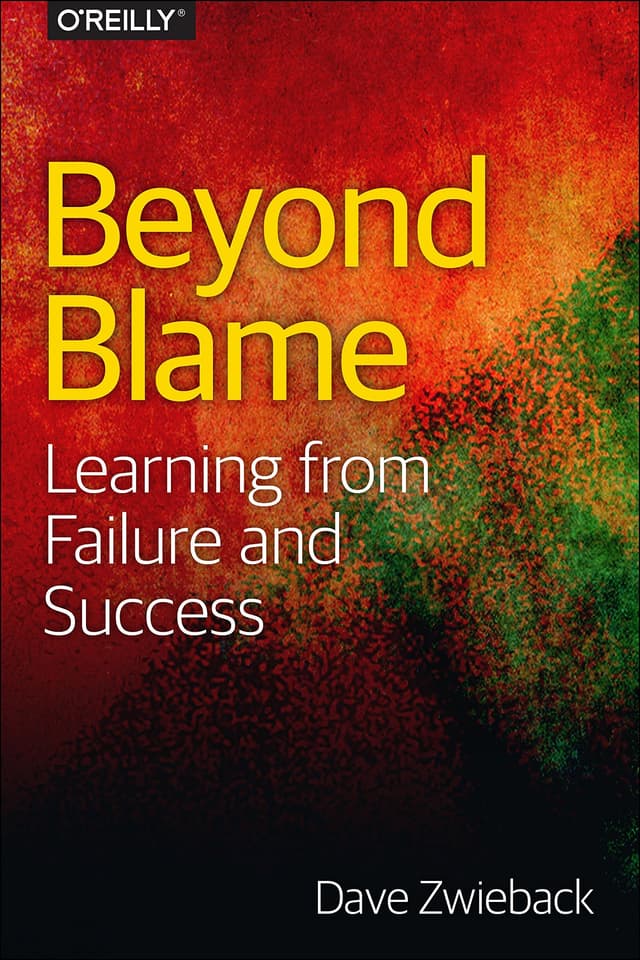
Core Idea
- Blame is a learning shortcut that feels satisfying but blocks understanding; the book argues that in complex work, especially IT incidents, the point is not to identify a villain but to understand the conditions that made the event possible.
- Accountability is not punishment: true accountability means getting the full account of what happened, which is only possible when people can speak honestly without fear of being blamed, shamed, demoted, or fired.
- Complex systems fail and succeed through change, impermanence, and adaptation, so investigations should focus on context, trade-offs, bias, and system conditions rather than a single “root cause.”
Why Root Cause and Blame Fail
- The opening outage story shows the familiar corporate reflex: executives demand a root cause, label the event operator error, and fire the person who touched the system most visibly.
- The book rejects the idea that punishing the operator prevents recurrence; removing the person with the most system knowledge makes future learning and resilience worse.
- A single root cause is described as a comforting but misleading story that simplifies messy reality and hides how multiple factors accumulated over time.
- Human error is treated as a symptom, not the cause; the “few bad apples” explanation misses the technical and organizational conditions that enabled the incident.
- Most people are trying to do a good job with the information they had at the time, and later judgment is distorted by hindsight.
How Complex Systems and Decisions Really Work
- The book draws on complexity science, resilience engineering, human factors, cognitive science, and organizational psychology to explain why incidents cannot be understood as isolated mistakes.
- A central idea is impermanence: all compounded phenomena are changeable, and that changeability is the common factor behind both functioning and malfunctioning systems.
- Cause and effect in complex systems are only partly knowable, because outcomes depend on many interacting conditions, some unknown or uncontrollable.
- Bill’s analogies contrast simple and real systems: a car key is easy, an antique car is harder, and modern production systems are like “a bunch of Model Ts on a 12-lane highway.”
- Complex systems require learning from both failures and successes, because the same system produces both and resilience comes from feeding those learnings back into the system.
- The book uses trade-offs to explain “mistakes,” especially E.T.T.O. — the efficiency-thoroughness trade-off — which means people cannot maximize both at once under pressure.
- The jaywalking ticket illustrates that behavior often makes sense in context; what later looks foolish may have been a rational optimization for speed, convenience, or normal practice.
Biases That Distort Incident Review
- The book names several recurring distortions: hindsight bias, outcome bias, fundamental attribution error, and availability bias.
- Hindsight bias is dangerous because phrases like “should have,” “could have,” “if only,” and “didn’t” smuggle in the assumption that the outcome was obvious beforehand.
- Outcome bias judges decision quality by what happened instead of by what was knowable when the decision was made, which can also produce hero worship when risky actions happen to work.
- Fundamental attribution error appears when people explain behavior as personality, such as “careless” or “cowboy,” instead of conditions like stress, context, or decision fatigue.
- The point is not that people never make bad decisions, but that incident reviews too easily confuse judgment after the fact with understanding at the time.
What a Learning Review Requires
- The alternative to punitive postmortems is a learning review.
- A learning review begins by stating the purpose, promising that participants will not be punished for a full account, and assuming the organization is operating inside a complex, adaptive system.
- The review aims to reconstruct what happened from each person’s perspective: what they knew, when they knew it, and how their actions made sense at the time.
- It deliberately seeks both what went wrong and what went right, because learning only from failures leaves out much of the system’s behavior.
- The facilitator listens for blaming, counterfactuals, and bias, uses empathy and humor to reduce fear, and asks whether a claim is only obvious in hindsight.
- The process should build a timeline before jumping to remediation, collecting multiple and even divergent viewpoints so the incident is synthesized rather than narrated from one office’s perspective.
- Remediation items matter, but they are secondary to understanding; the timeline should not become a premature action list.
- A healthy review treats the resulting information as privileged/protected, separating learning from discipline so the organization can tell the truth.
What To Take Away
- Do not confuse blame with accountability; accountability means a complete account, not a scapegoat.
- Do not force incidents into a single-cause story; ask what conditions, trade-offs, and system interactions made the event possible.
- Expect bias in every review; watch for hindsight, outcome, attribution, and availability distortions.
- Use learning reviews to increase resilience by preserving candor, collecting timelines, and learning from both success and failure.
Generated with GPT-5.4 Mini · prompt 2026-05-11-v6