Core Idea
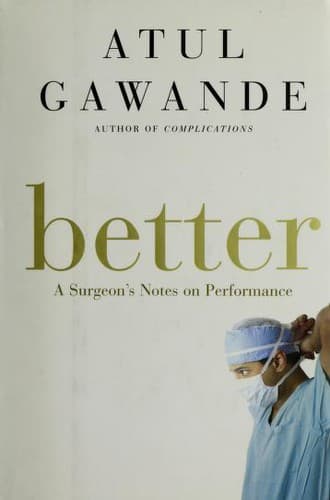
- Gawande argues that medicine is a performance profession: lives depend not only on knowledge and technical skill, but on what clinicians do in specific moments, under pressure, with imperfect systems.
- The book’s recurring claim is that better performance comes from diligence, doing right, and ingenuity—usually through small, disciplined improvements rather than one grand breakthrough.
Medicine Fails or Succeeds Through Systems, Not Just Heroics
- A pneumonia patient is saved because a resident checks on her twice in one morning and catches septic shock early, showing how vigilance can matter as much as brilliance.
- Virginia Magboo’s delayed surgery shows the opposite: even routine care can be derailed by OR bottlenecks, staffing shortages, and competing emergencies, though two nurses staying late ultimately make the case happen.
- In infection control, Gawande shows that knowledge is not the problem; compliance is.
- Hand washing remains stubbornly hard to enforce despite signs, sinks, incentives, and report cards, even though hospital-acquired infections kill tens of thousands.
- Semmelweis got the science right but failed socially, while alcohol gel proved easier and better than soap, yet still required a redesign of habits and workflow.
- Even after gel use improved hand-hygiene rates from roughly 40 percent to 70 percent, infection rates did not fall enough, showing that partial compliance is not enough.
- The book repeatedly contrasts wards with operating rooms: surgery has built sterility into its workflow, while routine care often relies on individual virtue and memory.
- A Pittsburgh VA effort reduced MRSA by redesigning the environment around cleanliness, and the positive deviance approach found useful local practices instead of imposing outside theory.
- Gawande’s near-miss with a central-line infection underlines his point that ordinary lapses can have catastrophic moral consequences.
High-Stakes Public Health and War Depend on Execution
- The India polio campaign shows eradication as a brutal logistics problem: one “mop-up” required tens of thousands of vaccinators, supervisors, and vehicles to immunize millions of children in days.
- Polio is harder than smallpox because infections are often silent, vaccine response is imperfect, and the target area must be revisited.
- WHO has little coercive power, so success depends on microplans, cold-chain discipline, population counts, access, and rumor control.
- Gawande is clear-eyed about the tradeoff: India still needed clean water, sewage, and basic care, yet he argues the final eradication push was still worth doing if eradication was to mean anything.
- In war, military medicine improved survival in Iraq and Afghanistan not through miracle therapies but through system design: fast evacuation, better equipment use, disciplined coordination, and detailed outcome tracking.
- Forward Surgical Teams brought damage-control surgery close to the battlefield, focusing on stopping bleeding, limiting contamination, stabilizing patients, and moving them onward.
- The military’s “Golden Five Minutes” reflects how much shorter battlefield urgency is than civilian trauma’s “Golden Hour.”
- Logs with 75-plus data fields per casualty, combined with changes like better eye protection and improved blast wound care, turned combat medicine into an iterative learning system.
- The wars also exposed new problems, including Acinetobacter baumanii infections and staffing strain, yet survival still reached about 90 percent by 2006.
- The war chapters emphasize that even lifesaving systems exact a human cost in amputations, disability, and death.
Professional Boundaries, Accountability, and Payment Are Part of Performance
- In “Naked,” Gawande treats the physical exam as an ethical and cultural problem, especially for women examined by male doctors.
- He concludes U.S. norms are vague, so he settles on gowns, formality, and routine chaperones for intimate exams, while noting that other countries handle modesty through different conventions.
- He does not present chaperones as a proven cure; he treats them as one way to support trust and clearer standards.
- “What Doctors Owe” argues that malpractice is about more than money: families want explanation, accountability, and a nonadversarial way to understand harm.
- The melanoma and missed-cancer cases show how missing documentation, unclear conversations, and institutional defensiveness can shape outcomes as much as clinical facts.
- Gawande is deeply critical of the malpractice system: most injured families never sue, and among those who do, very few deserving families are compensated.
- He prefers no-fault compensation models, citing vaccine-injury compensation and New Zealand, because they pay injured patients without forcing everyone into a negligence battle.
- “Piecework” reveals that physician pay is also a system problem, with the fee schedule rewarding procedures more than cognitive work.
- Physician income is shaped by overhead, malpractice premiums, coding, denials, and insurance rules, so even “professional” work is tied to business realities.
- The Matthew Thornton Health Plan shows both the promise and strain of salaried, fixed-fee medicine: it worked at first, then ran into productivity and compensation tensions.
- Gawande’s conclusion is not that money should disappear, but that no payment system perfectly balances thrift, simplicity, and reward.
What To Take Away
- Better medicine comes from reliable execution, not just better ideas; hospitals and systems must be designed so the right thing is also the easy thing.
- Small, repeated lapses matter because in medicine they can become infections, complications, mistrust, or death.
- Measurement and transparency drive improvement when they are tied to action, whether in surgery, polio campaigns, or cystic fibrosis centers.
- Gawande’s larger lesson is that medicine is honorable but imperfect work, and the real challenge is to keep making it more consistently right.
Generated with GPT-5.4 Mini · prompt 2026-05-11-v6