Core Idea
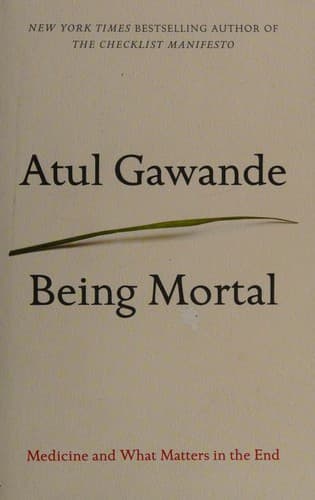
- Being Mortal argues that medicine has become excellent at defeating disease but poorly equipped for the realities of aging, frailty, dependence, and dying.
- Gawande’s central question is not how to prolong life at any cost, but how to help people live well when cure is no longer possible and what matters most becomes autonomy, meaning, and comfort.
- Modern medicine often mistakes survival, treatment, and safety for success, even when those goals strip away the person’s identity and life worth living.
Aging, Decline, and the Limits of Medicine
- Gawande opens by noting that medical training taught him how to save lives, but almost nothing about decline, frailty, or how to care for the dying.
- The death of Joseph Lazaroff, who chose high-risk surgery despite terminal metastatic cancer, shows the danger of avoiding honest talk about prognosis and treatment limits.
- Aging is presented as a gradual systemic breakdown rather than a single diagnosis: bodies lose redundancy, functions accumulate defects, and eventually one more failure can tip the whole system.
- Gawande stresses that old age is often medicalized into proximate causes like respiratory failure or cardiac arrest, while the deeper reality is accumulated wear and loss.
- He contrasts elderhood in multigenerational India, where his grandfather retained role and dignity despite dependence, with modern Western life, where independence is idealized and dependence is treated as failure.
- Longevity and social change have produced “intimacy at a distance,” weakening family-based care and pushing frail elders toward institutions.
- The book repeatedly returns to the fact that the real fear of old age is often not death itself, but the long loss of hearing, memory, mobility, friends, control, and familiar life.
What Good Care Looks Like
- Gawande argues that geriatrics is not about fixing every problem but about preserving function, reducing avoidable harm, and protecting what still makes life livable.
- Juergen Bludau’s clinic visit with Jean Gavrilles shows this approach: he focuses on falls, medications, hydration, nutrition, balance, feet, and daily life rather than only on disease labels.
- The University of Minnesota study he cites found that geriatric teams reduced disability, depression, and home-health use even though mortality was unchanged, using low-tech interventions like medication simplification, meal support, and safety changes.
- Geriatrics remains undervalued because the system rewards procedures more than the slower work of maintaining resilience and quality of life.
- Felix Silverstone embodies successful adaptation in old age: despite multiple health problems, he preserved purpose by changing habits, tools, and routines, and later centered his life on caring for his wife Bella.
- Bella’s decline shows a painful truth of dependence: once she lost the ability to communicate and function, even devoted care at home could no longer sustain their shared life.
- Nursing homes are critiqued as total institutions—ordered for safety and efficiency, but often stripping residents of privacy, agency, routine, and purpose.
- Alice Hobson’s move into assisted living and then skilled nursing care reveals how “safe” environments can feel like an alien land when they replace home, control, and ordinary choice.
- Gawande traces nursing homes to hospitals and poorhouses, emphasizing that their historical purpose was custodial containment, not helping people live meaningfully with disability.
- Even when regulations improved safety, the central unresolved question remained: how do institutions make life worth living for people who are weak and dependent?
Better Institutional Models: Home, Loyalty, and Purpose
- Bill Thomas’s Eden Alternative attacks the “three plagues” of nursing homes: boredom, loneliness, and helplessness.
- His use of plants, animals, children, and gardens was not decoration; it was an attempt to reintroduce life itself into a deadening institution.
- The changes produced measurable effects, including reduced psychotropic drug use and lower costs, suggesting that meaning and engagement can be therapeutic.
- Keren Brown Wilson’s assisted-living model was built around a different principle: frail elders still want home—private space, their own furniture, schedule control, possessions, and visitors.
- Park Place showed that preserving autonomy while providing help could improve satisfaction, function, mood, and public cost compared with nursing homes.
- Laura Carstensen’s research on socioemotional selectivity theory explains why older people prioritize emotionally meaningful relationships when they sense time is limited.
- Gawande connects this to Tolstoy’s Ivan Ilyich: as death approaches, priorities narrow toward comfort and companionship, and the servant Gerasim becomes the model of uncalculated, humane care.
- In better-designed settings like the Green House model, residents regain ordinary pleasures and some risk, while staff act more like companions and generalists than rule-bound custodians.
- Gawande’s deeper point is that people do not just want freedom from restraint; they want to remain the author of a life shaped by loyalties, habits, and relationships.
Dying Well: Conversations, Hospice, and the Final Tradeoffs
- The last section shifts to end-of-life care, where Gawande argues that medicine often defaults to Do Something even when intervention is unlikely to help.
- Sara Monopoli’s case shows how treatment momentum can crowd out preparation, leading to repeated interventions that prolong illness without preserving the life the patient values.
- Gawande distinguishes the experiencing self from the remembering self: people judge suffering by peak moments and endings, which is why the shape of the story matters, not just survival statistics.
- The book presents hospice as active care aimed at the fullest possible life now—relief of symptoms, support for family, and protection of awareness and comfort.
- Hospice nurses like Sarah Creed make practical adjustments that can unexpectedly lengthen life and improve it, showing that comfort-focused care is not abandonment.
- Advance-care planning works best when it is repeated and concrete, as in La Crosse, Wisconsin, where clinicians ask about CPR, ventilation, antibiotics, and feeding tubes long before crisis.
- Susan Block’s guidance emphasizes that these are skilled conversations, not casual ones; the key question is what matters if time becomes short.
- Gawande also examines physician-assisted death cautiously, worrying that it may become a substitute for better palliative care rather than a last-resort option.
- His father’s illness becomes the book’s final case study: careful conversations, hospice support, and home-based adjustments allowed time for meaningful activity, family presence, and less suffering.
- The ending lesson is that medicine’s job is not mere survival, but helping people maintain a life worth living until the end, according to their own values and limits.
What To Take Away
- Longevity creates new problems: more people survive into prolonged frailty, and medicine must learn how to care for decline, not just cure disease.
- Safety is not enough: institutions often protect bodies while damaging the identity, agency, and relationships that make life feel like home.
- Good end-of-life care is interpretive: doctors must help patients clarify what they are trying to preserve, not just present options or keep treating by default.
- The book’s most enduring claim is that a humane medicine must measure success by whether it supports a person’s purpose, comfort, and selfhood when cure is no longer possible.
Generated with GPT-5.4 Mini · prompt 2026-05-11-v6