Core Idea
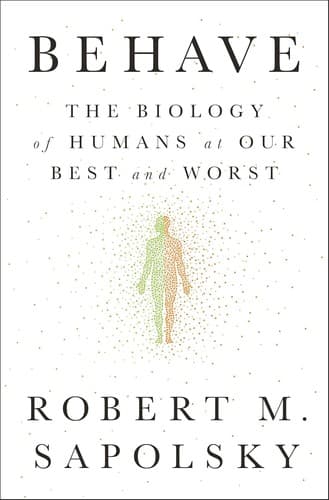
- Sapolsky’s central claim is that behavior is never explained by one bucket alone—biology, psychology, culture, development, and evolution all matter, and each behavior must be understood across multiple time scales.
- The book’s organizing question is: what happened one second before, minutes before, hours-to-days before, during development, and over evolutionary history to make this act happen?
- Humans are biologically continuous with other animals, but we repurpose shared circuits in uniquely human ways, producing both extraordinary cruelty and extraordinary cooperation.
The Brain, Hormones, and the Minutes-to-Days Before Behavior
- The amygdala is Sapolsky’s central node for threat, uncertainty, fear, and reactive aggression; it also shapes social judgment, unfairness detection, and snap mistrust.
- The frontal cortex, especially dlPFC and vmPFC, is where impulse control, planning, emotion regulation, and “doing the harder thing when it is the right thing to do” happen.
- These systems are not “reason vs emotion” modules; they are bidirectionally connected, and context determines whether frontal control restrains or collaborates with limbic impulses.
- The dopamine system is about reward anticipation, motivation, and relative reward more than pleasure; it is strongest for cues, uncertainty, and “maybe,” which helps explain gambling and delayed gratification.
- Serotonin is tied more to impulsive aggression and inhibition failure than to premeditated violence.
- Over hours-to-days, hormones mainly amplify existing tendencies: testosterone heightens sensitivity to status threat, while oxytocin and vasopressin can deepen trust and bonding but often only within the in-group “Us.”
- Stress is a recurring amplifier: acute stress can help, but chronic stress biases attention toward threat, weakens prefrontal control, strengthens fear learning, and increases reactive aggression or emotional selfishness.
- Sapolsky stresses the brain’s plasticity: learning, stress, enrichment, trauma, sleep, and hormones can change synapses, dendrites, neurogenesis, and even brain size.
Development, Childhood, and Why Early Life Matters So Much
- Prenatal and early childhood environments have organizational effects: fetal hormones, maternal stress, nutrition, and toxins can shape later brains and behavior long before “choice” exists.
- Epigenetics is real but often overclaimed; environmental inputs can alter gene expression long term, but it is one mechanism among many, not a magic explanation.
- Childhood adversity—abuse, neglect, poverty, violence, institutional deprivation—tends to produce smaller/less effective frontal systems, larger and hyperreactive amygdalae, worse impulse control, anxiety, depression, and aggression.
- Developmental timing matters: the frontal cortex matures late, so adolescence is a period of risk-taking, peer sensitivity, and stronger reward-driven behavior before adult-level self-regulation arrives.
- Adolescent violence peaks not because testosterone simply spikes, but because immature control systems, peer effects, novelty seeking, and heightened reward sensitivity converge.
- Moral and social cognition develop gradually: children move from concrete empathy and fairness concerns to more abstract theory of mind, perspective taking, and moral reasoning, but moral action often depends more on context than on sophisticated reasoning.
- The marshmallow test matters in the book because delay of gratification reflects trust, strategy, and executive control, and predicted later outcomes better than simple “willpower” stories suggest.
Genes, Evolution, and Why Nothing is Destiny
- Sapolsky treats genetics as essential but deeply non-deterministic: genes create propensities, vulnerabilities, and potentials, not fixed behaviors.
- Heritability is repeatedly clarified as a population statistic, not a statement that a trait is immutable or “genetically caused” in any simple sense.
- The book’s big genetic lesson is gene-by-environment interaction: the same variant can matter a lot in one setting and almost not at all in another.
- Classic examples include MAO-A, 5HTT, DRD4, FKBP5, and oxytocin/vasopressin-related variants, but Sapolsky emphasizes their effects are small, context-dependent, and never destiny.
- The famous “warrior gene” story is rejected as oversimplified: low-activity MAO-A predicts risk mainly when paired with severe childhood abuse.
- Evolutionary explanations are framed through individual selection, kin selection, reciprocal altruism, and group selection, with humans complicating every one of them.
- Humans are not pure monogamists or pure polygynists; we are mildly polygynous, pair-bonded, kin-sensitive, and unusually capable of nonkin cooperation.
- Sapolsky also highlights pseudokinship and pseudospeciation: humans can be made to feel deep kinship with strangers or total dehumanization toward out-groups, and that flexibility helps explain both altruism and atrocity.
Culture, Authority, Morality, and What Humans Actually Do
- Culture is not decoration; it is a causal layer that shapes attention, norms, parenting, status, cooperation, and aggression.
- Humans rapidly sort into Us/Them categories, often from faces, language, clothing, status cues, or even arbitrary group assignments.
- Subtle cues matter: IAT effects, eye contact, race and gender cues, music, smell, framing, crowds, disorder, and social primes can all shift trust, empathy, and violence.
- Conformity and obedience are distinct: conformity is going along with the group, obedience is going along with authority, and both can support either cooperation or atrocity.
- Milgram and Asch show how ordinary people can conform or obey under pressure, while the Stanford Prison Experiment dramatizes how roles, institutions, and situation can produce brutality.
- Sapolsky treats moral judgment as mostly fast, intuitive, and emotion-laden, with reasoning often arriving afterward as a justification.
- The trolley problem, moral dumbfounding, and commission vs omission asymmetries show that framing and proximity strongly alter moral judgment.
- Lying, cheating, and heroic restraint all recruit frontocortical control, but Sapolsky’s point is that the “right” act is often the easier, habituated act, not a miraculous triumph of free will.
What To Take Away
- Human behavior is best explained by nested causes, not single causes: immediate triggers, hormones, development, genes, culture, and evolution all matter together.
- Many of our most important traits are context-sensitive: the same hormone, gene, or brain circuit can promote aggression, care, conformity, or restraint depending on circumstance.
- The book’s deepest caution is against determinism in either direction: biology does not make people helpless, but neither do people simply author themselves outside biology.
- Sapolsky’s portrait of human nature is unsettling but humane: we are capable of both great harm and great goodness, and both arise from the same biologically embedded, socially shaped organism.
Generated with GPT-5.4 Mini · prompt 2026-05-11-v6