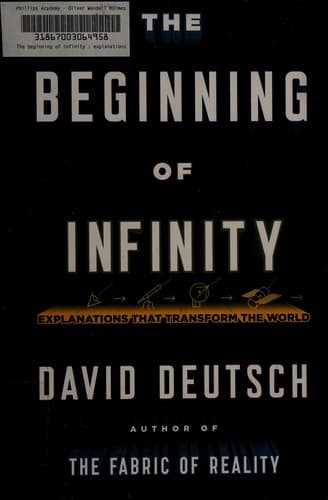
Core Idea
- Deutsch’s central thesis is that human progress is potentially unbounded because knowledge can grow through good explanations, and good explanations are rooted in the fact that reality obeys universal laws.
- What changed with the scientific revolution was not just better technology but a new kind of epistemology: bold conjectures, criticism, and error-correction replaced appeals to authority, induction, or mere observation.
- The “beginning of infinity” is any starting condition that allows open-ended improvement; once a culture discovers how to create better explanations, progress can spread across science, technology, politics, morals, and welfare.
Knowledge, Explanation, and Science
- Deutsch rejects empiricism, inductivism, and justificationism as accounts of how knowledge is generated: theories are not drawn mechanically from data, and no finite set of experiences can justify a theory about the world beyond those experiences.
- Observation is always theory-laden; senses deliver local signals, while the mind interprets them through explanatory frameworks, so data never arrive as raw, authoritative foundations.
- Science is defined by explanation, not prediction alone: a good theory is hard to vary, fits the facts for the right reasons, and has genuine reach beyond the problem that first prompted it.
- Bad explanations are easy to vary without losing their predictive claims, as with the myths of Persephone and Freyr; good ones, like the Earth’s axial tilt explanation of seasons, are constrained and explanatory.
- Scientific instruments extend knowledge by adding layers of theory, making us epistemically closer to distant reality even though we are physically farther away from it.
People, Evolution, and Creation
- Deutsch argues that both biological adaptation and human knowledge arise through evolutionary processes: variation plus selection, with mutations selected by natural selection and conjectures selected by criticism and experiment.
- Knowledge is information that causes itself to remain embodied; in organisms this is genetic adaptation, while in people it is explanatory understanding that can be intentionally improved.
- He sharply distinguishes people from other living things: people are universal explainers and constructors whose knowledge can be transmitted culturally and used to transform hostile environments into habitable ones.
- Creationism fails because it explains adaptation only by invoking a designer while leaving the creation of knowledge unexplained; it is “creation denial” because it relocates explanation into mystery.
- Likewise, old ideas such as spontaneous generation, divine revelation as a source of knowledge, or Lamarck-style inheritance of acquired improvements fail because they do not explain how the relevant knowledge gets into the system.
- Neo-Darwinism matters because evolution does not optimize for species good; it selects selfish replicators that spread best, even when that harms individuals or species, as in peacock tails or other maladaptive outcomes.
Infinity, Multiverse, and Physics
- Deutsch treats infinity as mathematically coherent and philosophically unavoidable; finitism is rejected as a poor, instrumental view of mathematics that arbitrarily denies the existence of infinite structures.
- Hilbert’s hotel, Cantor’s diagonal argument, and the distinction between countable and uncountable infinity show that infinities are real mathematical objects, not just verbal tricks.
- He argues that probability and typicality become meaningless in infinite sets unless a physical measure is supplied; bare counting cannot explain anthropic reasoning or multiverse claims.
- His interpretation of quantum theory uses a multiverse of initially fungible histories: identical branches can later diverge without violating determinism, symmetry, or no-signaling.
- Quantum randomness is therefore subjective randomness: the world evolves deterministically, but observers experience probabilistic outcomes because they inhabit one branch among many.
- The Mach–Zehnder interferometer, decoherence, and the loss of interference when path information is recorded are presented as evidence for branching histories rather than single-history chance.
- The uncertainty principle is recast as objective diversity within fungibility, not merely human ignorance.
Society, Choice, and Progress
- Deutsch’s theory of choice is that the key problem is not selecting from fixed options but creating new options through explanation and criticism.
- In politics, he uses apportionment and social choice to show that apparently technical rules encode values, and that no perfect rule can satisfy all desirable constraints at once.
- He draws on Arrow’s theorem and the Balinski–Young theorem to argue that no-go results are real; institutions should be judged by how well they let us remove bad ideas and bad rulers without violence.
- He favors societies that enable criticism, replace failed policies, and keep knowledge growth open-ended; democracy matters less as a mirror of “the people’s will” than as a mechanism for continuous error-correction.
- A central cultural divide is between static societies, which suppress criticism and preserve the same patterns, and dynamic societies, which survive by generating and testing better ideas.
- Rational memes survive by withstanding criticism, while anti-rational memes survive by disabling criticism through authority, fear, or taboo.
What To Take Away
- The book’s deepest claim is that explanatory knowledge is the engine of civilization, and that there is no known limit to how far it can extend.
- Progress is not about getting better at prediction or managing resources within fixed limits; it is about creating better explanations that convert the impossible into the possible.
- Human beings matter cosmically because they are not passive occupants of the universe but knowledge-creating systems that can transform matter, energy, and evidence into new forms of order.
- The proper stance toward the future is not sustainability as stasis, but fallibilism, criticism, and openness to surprise, because the next improvement is usually not foreseeable in advance.
Generated with GPT-5.4 Mini · prompt 2026-05-11-v6