Core Idea
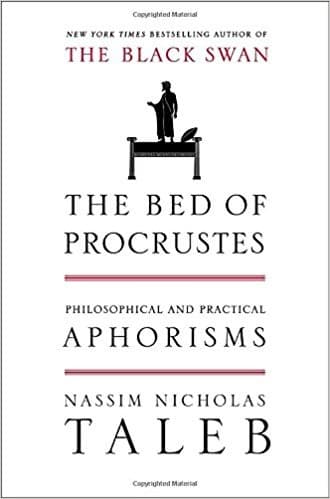
- Taleb uses Procrustes as the master metaphor for the human habit of forcing reality into neat categories by altering the person or the data instead of the bed.
- The book’s central warning is that modern institutions, experts, and narratives often manufacture false order, fragility, and sucker problems by shrinking the unknown into tidy but misleading models.
- His counterweight is epistemic humility: favor subtraction over addition, robustness over optimization, and respect what cannot be cleanly measured, predicted, or explained.
Knowledge, Prediction, and the Fragile Mind
- Taleb treats much of intellectual life as a struggle against the mind’s tendency to over-detect patterns and invent stories, especially in complex systems.
- He repeatedly contrasts the observed with the unobserved, arguing that people wrongly treat what they have not seen as nonexistent or insignificant.
- Real knowledge is often subtractive: it comes from eliminating what does not work, not from piling up theories, explanations, or data.
- In his framework, the important question is not merely true versus false but robust versus fragile, and socially, sucker versus nonsucker.
- A model is dangerous when errors in representation can produce ruin; robustness means the system survives mistaken beliefs, while fragility means hidden risks or expert errors can cascade.
- He is skeptical of prediction because forecasts without skin in the game are easy to make and hard to trust.
- Taleb mocks the confidence of economists, consultants, journalists, and academics who speak as though they understand nonlinear, interdependent systems.
- More information can increase delusion, because data often intensifies false pattern recognition faster than it improves understanding.
Sacred, Ethics, and the Good Life
- Taleb distinguishes the sacred from the profane: the sacred is governed by unconditionals, while the profane runs on conditionals, bargaining, and utility.
- He argues that religion, art, and some moral realities are distorted when translated into purely instrumental language.
- His ethics favor deontic action over payoff-seeking behavior: generosity is only pure when it is not performed for reward, whether social or emotional.
- Friendship, love, and respect are defined as things that lose their essence once they can be fully rationalized by a reason.
- He values the magnificent person: one who is great-souled, not dependent on petty validation, and able to act without constant self-display.
- A recurring claim is that much modern unhappiness comes from lives that are over-structured, over-compared, and over-justified.
Modernity, Work, Technology, and Form
- Taleb treats employment as a liminal condition, a socially acceptable form of slavery softened by flattery.
- Modern life is criticized for converting free action into repetitive, scheduled, instrumented routines that make people more compliant and less autonomous.
- Technology is best when invisible, but modernity often turns it into a source of dependency, fragility, and self-deception.
- Schools, offices, gyms, airports, and social media all create domain dependence, where habits learned in one setting are mistaken for wisdom in life.
- He distrusts “efficiency” when it merely postpones damage; many efficiencies are really deferred punishment.
- The Web and social networks are portrayed as informationally promiscuous and spiritually cheap, increasing exposure and attention-seeking while reducing privacy and depth.
- Institutions that claim to improve people often end up making them more generic, more compliant, and less free.
Style, Literature, and Aphorism
- The book’s form is part of its argument: the aphorism preserves compact, high-density thought without flattening it into sterile exposition.
- Taleb treats aphorisms as an old, quasi-sacred form closer to prophecy and poetry than to “content.”
- He contrasts literature with journalism, self-help, and business writing, which he sees as low-resolution and contaminated by commercial motives.
- Real literature, in his view, hides more than it explains; too much explanation can destroy the charm of what it tries to clarify.
- Clichés, overexplanation, and forced clarity are often signs of intellectual weakness rather than rigor.
- He prefers classical, slow, unsalaried forms of life: walking, leisure, silence, and the ability to do nothing without guilt.
What To Take Away
- Do not mistake neat explanations for truth, because in complex reality the wrong reduction can be worse than no reduction.
- Ask what was changed when a system only “works” after people are forced to fit it.
- Prefer robustness to optimization, especially where hidden risks, incentives, and nonlinear effects matter.
- Keep sacred, moral, and literary realities distinct from commercial or bureaucratic logic, because collapsing them produces bad philosophy and fragile institutions.
Generated with GPT-5.4 Mini · prompt 2026-05-11-v6