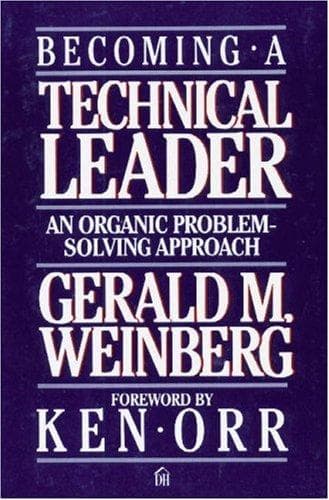
Core Idea
- Weinberg’s core claim is that technical leadership is a form of self-development, not a title you receive or a personality type you are born with.
- He contrasts linear models of leadership with an organic model in which leaders create conditions for other people to solve problems, grow, and contribute their best work.
- The book’s stakes are practical and personal: becoming a technical leader changes how you understand problems, generate ideas, organize groups, help others, and handle your own growth.
Leadership as an Organic Process
- Weinberg rejects the idea that leadership means controlling people; instead, a leader leads the process by creating an environment in which people become empowered.
- His seed metaphor says leadership is like gardening: the leader does not force growth but provides conditions in which growth can happen.
- He contrasts this with threat/reward leadership, which assumes one right answer, one authority, and a morally charged hierarchy of smart and dumb, good and bad.
- Technical leadership is especially suited to innovation, because observers often miss good ideas if they do not already understand them.
- The recurring theme is that change is organic, not mechanical: people do not transform one piece at a time, but by adding new behaviors and gradually cultivating what already exists.
The Three Core Functions: MOI, Problems, Ideas, Quality
- Weinberg’s MOI model says leadership environments consist of Motivation, Organization, and Ideas/Innovation.
- Motivation is the push or pull that gets people moving; Organization is the structure that lets ideas become practice; Ideas are the seeds of improvement.
- A technical leader needs to understand the problem, manage the flow of ideas, and maintain quality; these are the book’s central problem-solving functions.
- He treats innovation as cumulative: leaders improve by strengthening their weakest element rather than trying to amputate strengths.
- Quality control is not a final check at the end; it is ongoing measurement, customer checking, tool design, and morale repair when an idea fails.
- The book repeatedly warns that teams can suppress change by killing motivation, creating chaos, or discouraging ideas.
Obstacles to Leadership and Idea Generation
- Weinberg identifies self-blindness as a major obstacle: people are often least able to see their own unproductive behavior when it matters most.
- His recommended remedy is mutual observing relationships, where people can safely observe and learn from each other without pretending to be neutral experts.
- The second obstacle is No-Problem Syndrome (NPS), the reflexive “No problem!” response that jumps to solutions before the problem is understood.
- The third obstacle is belief in the central dogma of academic psychology: that there is one and only one correct solution and some authority knows it.
- His journaling exercise—five minutes a day for three months—is both a self-observation tool and a test of whether someone truly wants to change.
- In the idea chapters, he argues that real problems often have one more solution than anyone has found yet.
- He treats accidents, typos, misunderstandings, borrowing, and combining ideas as legitimate sources of innovation.
- His terms stealing and copulation are deliberately provocative: good ideas can be borrowed across contexts, and many good ideas come from combining existing ones into something better.
- He warns that punishment for error, copying, or experimenting trains people to avoid the very processes that generate ideas.
Vision, People, Help, and Power
- A leader needs a vision that is both ordinary and personal: something worth doing plus a unique contribution only the person can make.
- Vision creates persistence and an obsession with quality, while motives like money or prestige alone do not reliably inspire followership.
- Weinberg insists the false opposition between people and task is misleading: in complex work, the people are the work.
- Helping others requires mutual agreement on the problem, respect for what they actually want, and honesty about whether help is welcome.
- He ties effective helping to self-worth: people cannot genuinely care for others if they do not care about themselves.
- His discussion of rules and meta-rules shows how early survival beliefs can block growth until they are transformed into conditional guides rather than absolutes.
- Power is not a thing you possess but a relationship; expertise becomes power only in specific contexts and with specific people.
- He stresses power conversion: technical, social, positional, and organizational forms of power can be converted into one another, but only if you know what you want power for.
- Effective organizing depends on form follows function; voting, strong leadership, and consensus all have uses, but no single structure is always best.
- He attacks three organizing traps: the Big Game of orders vs. taking orders, treating people like machines, and rewarding heroic crisis management instead of prevention.
What To Take Away
- Technical leadership is not charisma or status; it is the disciplined creation of conditions in which others can think, learn, and solve problems.
- The book’s practical center is a three-part discipline: understand the problem, manage the ideas, and preserve quality.
- Growth requires tolerating ravines, embarrassment, failure, and self-observation; many apparent setbacks are the route to a higher plateau.
- Weinberg’s closing message is that leadership is worth pursuing only if you know why you want it, what you bring, and what you are willing to change.
Generated with GPT-5.4 Mini · prompt 2026-05-11-v6