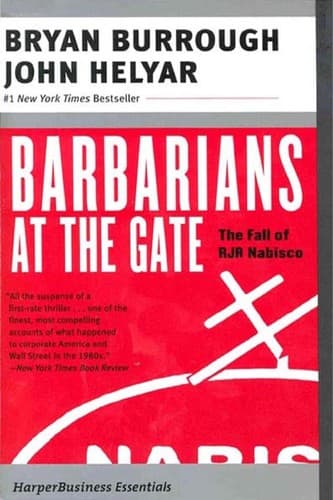
Core Idea
- Barbarians at the Gate is a blow-by-blow history of the RJR Nabisco LBO battle, but its deeper subject is the collision between corporate empire, Wall Street finance, and executive ego in the late 1980s.
- The book’s central claim is not that leveraged buyouts are always good or bad, but that some companies are suited to LBOs and others are not; RJR Nabisco became the decade’s emblematic case because it was so large, so contested, and so structurally awkward.
- At the center stands Ross Johnson, a charming, improvisational “shit-stirrer” who thinks in deals, not stewardship, and whose appetite for action eventually helps destroy the company he leads.
Ross Johnson and the Corporate Culture Clash
- Johnson’s career is built on survival, dealmaking, and constant reorganization: he learned early that organizations decay unless they are shaken up.
- At Standard Brands and later Nabisco, he mixes lavish perks, social access, and hard bargaining to build loyalty, but he also creates dependence on favoritism rather than process.
- His style is the opposite of the old corporate steward model: he is a noncompany man who values movement, publicity, and upside over austerity or hierarchy.
- The book contrasts Johnson’s world with the cultures he inherits: Nabisco is slow and managerial; Reynolds is paternal, procedural, and tobacco-rooted; Johnson’s arrival feels like “Hell’s Angels merged with the Rotary Club.”
- He repeatedly wins by forcing reorganizations, exploiting openings, and moving quickly when others hesitate, but many of his products and ideas fail.
- His rise also depends on board management: he flatters directors, gives them access and celebrity, and keeps them entertained enough to avoid scrutiny.
Why RJR Nabisco Was Vulnerable
- Nabisco brought world-class brands and food assets, but years of complacency, diversification failures, and under-management left it ripe for valuation arguments.
- R.J. Reynolds was still defined by tobacco cash flow and by Winston-Salem’s Moravian, paternal, local-control culture; it had strong brands but also succession problems, parochialism, and awkward strategic drift.
- Reynolds’s later management suffered from loading—pushing product ahead of price increases to inflate short-term profits—which helped Wall Street sense weakness beneath the numbers.
- Both companies were rich in cash, yet each carried cultural baggage: Nabisco was undervalued as tobacco-adjacent property, and Reynolds was exposed to smoking backlash, capital-market pressure, and the need to diversify.
- Johnson’s obsession with valuation grows from this mismatch: the market keeps pricing RJR like a tobacco company even though he sees the food business as the real hidden asset.
The LBO as Financial and Political Warfare
- The book explains the 1980s LBO boom through tax-deductible interest, then junk bonds, which made giant deals possible and turned financing into a contest of speed, access, and credibility.
- A recurring mechanism is the “friendly deal” structure: management seeks to control the process, while bankers, boards, and rival bidders fight over timing, disclosure, and who gets to set the terms.
- Johnson initially resists a buyout because he dislikes debt and fears losing his perks and autonomy, but he eventually accepts the logic that an LBO may be the only way to unlock value.
- Once the auction starts, he tries to rewrite the normal power structure: he wants board control, veto rights, and an unusually rich equity promote, which makes his management bid unlike standard LBOs.
- Shearson views RJR as a once-in-a-decade fee bonanza and builds a merchant-banking machine around it; KKR sees a megadeal that justifies moving from classic friendly LBOs into the aggressive auction era.
- Kravis is driven by discipline, scale, and speed; he believes a hostile bid must seize the initiative before the target and its bankers can lock up the field.
- Forstmann represents the older moralized anti–junk bond stance: no funny money, no junk paper, and no partnership that compromises reputation or control.
- The battle becomes as much about structure and optics as price: cash vs. securities, “reset” protections, who runs the bonds, who gets credit, and whether management is really selling or stealing its own company.
- The management group’s huge economics become a scandal because the insiders’ package can be worth billions; the deal exposes how deeply Wall Street had normalized fee extraction and private enrichment.
The Auction, the Leak Cycles, and the Ending
- Due diligence is portrayed as a brutal used-car inspection: the buyer must kick the tires, estimate debt capacity, and avoid one bad assumption that can trigger collapse.
- The committee process is theater and leverage at once; executives are interviewed, but information is tightly rationed, and every side uses backchannels, press leaks, and timing pressure to shape the auction.
- The book repeatedly shows how media coverage and public outrage start to matter: LBOs are no longer just finance; they are political symbols, and RJR becomes a national story.
- First Boston’s late, tax-driven restructuring proposal briefly threatens to upend the contest, showing how an exotic legal/tax idea can still matter in a megadeal if it creates enough value.
- Greeniaus’s internal leaks then help KKR rerun the numbers and raise its bid, reinforcing a key theme: inside information and morale fractures can change the final price almost as much as pure finance.
- In the end, KKR wins because its package is judged more credible and employee/shareholder-friendly, even though Shearson can point to a higher nominal number.
- Johnson loses the company but accepts the result more calmly than many around him; Horrigan and others react with bitterness, underscoring how much pride, status, and identity were bound up in the deal.
- The epilogue and aftermath matter: the transaction creates enormous fees, huge payouts, and a fragile debt structure whose later problems reveal the hidden cost of the 1980s boom.
What To Take Away
- The book’s lasting insight is that finance is inseparable from personality: in RJR Nabisco, deal structure followed ego, style, and boardroom politics as much as arithmetic.
- Leveraged buyouts are presented as powerful but conditional tools, not universal answers; the RJR case is too large and too culturally loaded to serve as a simple model.
- The RJR battle captures the decade’s “casino society”: CEOs, bankers, lawyers, and financiers competing inside a high-stakes system built on leverage, spectacle, and brinkmanship.
- The deal both crowned and exposed the 1980s takeover era, showing how mega-finance could create fortunes while leaving behind fragility, resentment, and a lot of debt.
Generated with GPT-5.4 Mini · prompt 2026-05-11-v6