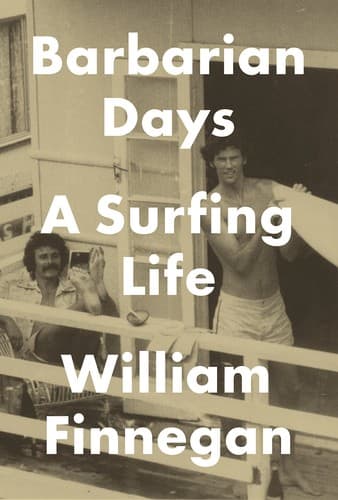
Core Idea
- Barbarian Days is a memoir of a life organized by surfing, but it is also a story about class, race, violence, work, love, travel, and aging as seen through the demands of chasing waves.
- Finnegan treats surfing as an activity shaped by fear, humility, and local knowledge: the ocean is never just “fun,” but a shifting, dangerous world that rewards judgment more than bravado.
- The book’s deeper arc is that surfing keeps returning as both an obsession and a measure of the self, even when jobs, relationships, politics, and age seem to pull him away from it.
Surfing as a Way of Knowing
- Hawaii is the book’s original surf education: Finnegan arrives as a haole outsider in Honolulu, feels racialized and vulnerable at school, and learns that local surf culture has its own codes, hierarchies, and styles.
- At places like Cliffs, Patterson’s, the Bomb, Kaikoos, Honolua, Sunset, Kirra, Grajagan, Nias, Tavarua, Cloudbreak, Makaha, and Ocean Beach, he learns that every break has its own bottom, current, tide, crowd, and threshold of danger.
- Surfing is presented as a technical craft as much as an identity: reading swell, reef geometry, wind, channels, and takeoff points matters more than romantic “wave chasing.”
- He repeatedly emphasizes the fear line: a surfer must know limits, stay calm under hold-downs, and understand that panic is the real enemy.
- Style matters, but locally specific style matters most; Hawaiian “Island” surfing, California longboard culture, Australian tube-riding, and later East Coast and Madeira styles each have their own aesthetics and ethics.
- Equipment is part of the argument: boards, fins, glassing, leashes, and shape are not accessories but determinants of what kind of wave can be ridden and how.
Places, People, and the Social World Around Surfing
- Hawaii gives him formative friendships and rivalries, especially with Roddy and Glenn Kaulukukui, whose family embodies Hawaiian surf continuity and whose bilingual code-switching shows the lived mix of pidgin and standard English.
- His teenage world is inseparable from school violence, gang posturing, class division, and casual racism; surfing offers refuge, but the book never lets readers forget the surrounding social roughness.
- The memoir repeatedly links surfing scenes to labor and class: his father’s work in film and unions, the railroad job he loves in California, and later travel work all shape the freedom to surf.
- In California, surf life grows out of family beach worlds at Newport, San Onofre, Ventura, Santa Cruz, and eventually Ocean Beach in San Francisco, where shifting sandbars and cold water demand constant adaptation.
- People matter as much as waves: Domenic, Bryan Di Salvatore, Caryn, Sharon, Caroline, Peter Spacek, Mark Renneker, Peewee Bergerson, and others become mirrors for different modes of seriousness, restlessness, loyalty, or obsession.
- Women are not side notes; Caryn and Sharon in particular give the book its emotional pressure, showing how travel and surf obsession can distort intimacy even when it feels communal and free.
Travel, History, and the Moral Cost of Surf Paradise
- The long middle of the memoir turns surf travel into a global education across the South Pacific, Australia, Indonesia, Africa, and the Atlantic.
- Finnegan is repeatedly drawn to places that look like surf utopias but are actually marked by colonial history, poverty, labor conflict, political repression, or environmental damage.
- He is skeptical of surf-tourism fantasy: Bali, Tonga, Fiji, Madeira, and other “paradise” destinations are shown as crowded, precarious, politically charged, or ecologically vulnerable.
- In the South Pacific, he sees how surf exploration depends on local hosts, translators, boatmen, fishermen, and villagers who understand the sea far better than visiting surfers do.
- His respect for local knowledge becomes strongest at places like Tavarua and Cloudbreak, where survival depends on recognizing when to paddle, when to abort, and when to trust an indigenous guide like Inia Nakalevu.
- The book keeps returning to the costs of chasing the next wave: sickness, injuries, broken boards, money problems, jealousy, and the repeated sense that paradise is never simple or free.
Work, Politics, and Aging
- Finnegan’s life is structured by serious jobs as much as surfing: railroad brakeman, journalist, teacher, freelancer, and writer, each one giving him a way to stay afloat while the surf obsession persists.
- Politics never disappears into the background; the book moves through Vietnam-era counterculture, anti-apartheid struggle in Cape Town, apartheid’s brutality, anti-hippie and anti-colonial critique, and the exploitative logic of surf tourism.
- His writing life and surf life increasingly intertwine, especially in the long reporting and essaying that emerge from places like Ocean Beach, South Africa, and Bali.
- The memoir becomes more reflective with age: by the later sections, Finnegan is no longer trying to become a pure surfer or pure traveler, but trying to understand what it meant to have lived that way.
- He comes to see obsession itself as double-edged: surfing gives him joy, discipline, and a way of seeing, but it also encourages restlessness, self-dramatization, and avoidance of ordinary obligations.
What To Take Away
- Surfing, in this book, is a discipline of attention: to weather, water, local custom, fear, and one’s own limits.
- No surf paradise is innocent: every great wave sits inside a history of labor, race, tourism, empire, and ecological fragility.
- Identity is unstable in Finnegan’s world: outsider, local, traveler, lover, worker, and writer all compete, and surfing keeps exposing the tensions between them.
- The memoir’s final force is its refusal to romanticize the life it celebrates; it honors surfing while insisting on everything it costs.
Generated with GPT-5.4 Mini · prompt 2026-05-11-v6