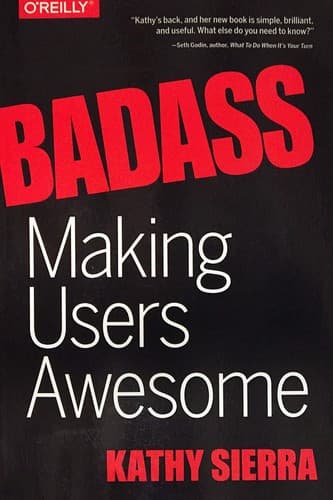
Core Idea
- The book’s central claim is that sustainable success comes less from making awesome products and more from making awesome users.
- Users spread word of mouth when they can say, in effect, “I’m awesome because of this,” so the real design target is user capability, not product admiration.
- Sierra repeatedly reframes the goal as “Don’t make a better [X], make a better user of [X].”
The Badass User Thesis
- A badass user is someone who becomes more skilled, more powerful, and better at getting meaningful results in a larger context than the product itself.
- Sierra treats the product as a means to a compelling context or superset—for example, photography matters more than the camera.
- The book’s core distinction is “not badass products, badass users,” because durable enthusiasm comes from users’ growth, not from polish alone.
- As users improve, they develop higher resolution: they notice finer distinctions, value more advanced features, and can benefit from better tools.
- Sierra warns against faux-badass, where companies reward desired behavior without actually helping users become better at what they care about.
- Merely sounding supportive, or delivering “world-class customer service,” is not the same as improving user skill or results.
- The path matters: users move past the Suck Threshold and the Badass Threshold, while the Stuck Zone describes people who never develop deeper skill and therefore never become strong advocates.
How Expertise and “Badass” Are Built
- Sierra treats badass, expertise, and mastery as effectively interchangeable, grounding the book in the science of expertise.
- Experts are defined by what they do repeatedly, not by tenure, status, or abstract knowledge.
- One mechanism is Deliberate Practice, which means designing small, fine-grained tasks that move a single sub-skill from can’t do to can do with effort to automatic within one to three sessions.
- The point of deliberate practice is better practice, not just harder or longer practice.
- If a task cannot reach about 95% reliability in a few sessions, Sierra says it is too big and should be broken down further.
- She warns that ordinary practice can lock in mediocrity because practice makes permanent, not perfect.
- Sometimes expertise requires de-automating a skill that has become automatic but is now limiting progress.
- The second mechanism is Perceptual Exposure, a less obvious but powerful way the brain learns patterns from many examples and feedback.
- Sierra illustrates perceptual exposure with chick sexing, WWII plane spotting, and flight-training studies where non-pilots improved instrument reading and navigation after a small amount of instruction plus many trials.
- Effective perceptual exposure uses many diverse examples, strong feedback, and pattern-similar examples that differ on the surface.
- She emphasizes that the brain learns goodness first: seeing good examples before bad ones helps users internalize the pattern of rightness.
- A key point is that builders do not need to know the hidden pattern themselves in order to create a perceptual-exposure experience for users.
Helping Users Keep Moving
- Sierra argues that users usually already want the bigger goal, so the main job is not to manufacture motivation but to remove blocks to progress.
- Early pain creates the Gap of Suck, where users interpret difficulty as personal failure, and the Gap of Disconnect, where tool-focused support severs the link between the tool and the user’s larger dream.
- Her recurring fix is Just Tell Them: explain that struggle is normal, expected, and temporary.
- She also recommends anticipate and compensate by answering the fears, questions, and confusions users would have if you were standing beside them.
- A visible Performance Path Map helps users trust the journey by showing credible stages of growth, like martial arts belts.
- Progress must include real payoffs along the way, not only a promised end-state.
- Small early wins matter because they give users a first meaningful superpower before they are fully expert.
- The book also emphasizes cognitive resources: willpower and thinking draw from a limited pool, so confusion, bad instructions, and unnecessary choices drain the energy users need to learn.
- To reduce cognitive leaks, Sierra urges moving knowledge into the world through labels, defaults, cheat sheets, affordances, trusted recommendations, and simple practice-tracking tools.
- She prefers Just-in-Time learning over Just-in-Case learning unless preloading knowledge is truly necessary.
- To pass the brain’s spam filter, instruction must feel relevant through emotion, surprise, danger, faces, unresolved tension, or vivid context rather than dry explanation.
What To Take Away
- The book’s distinctive move is to shift the design target from product desirability to user capability.
- Sustainable word of mouth comes from users who become more capable, more perceptive, and more clearly better in a meaningful domain.
- Deliberate Practice and Perceptual Exposure are the two main engines of skill growth.
- Everything else—Just Tell Them, progress maps, early payoffs, and reducing cognitive leaks—exists to keep users moving up and to the right.
Generated with GPT-5.4 Mini · prompt 2026-05-11-v6