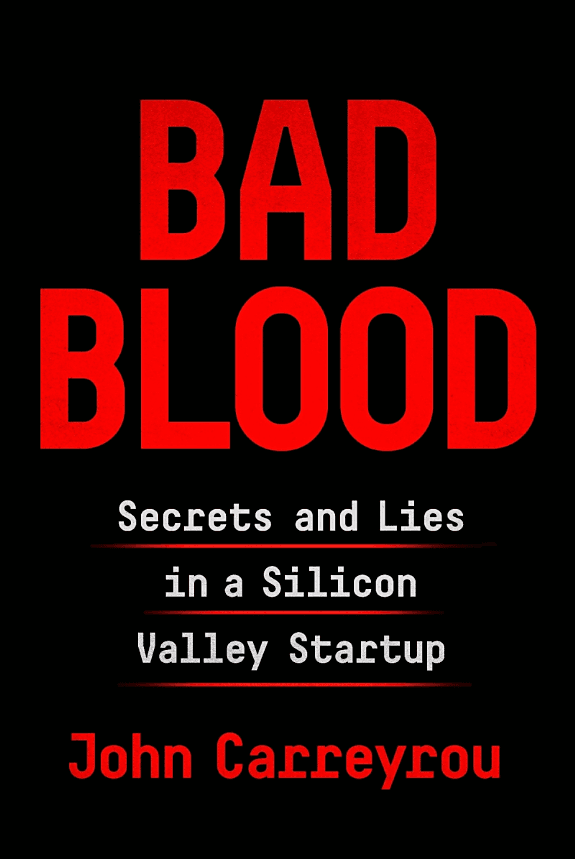
Core Idea
- Bad Blood is a reporting-driven account of how Theranos, led by Elizabeth Holmes and Sunny Balwani, turned a plausible vision of disruptive blood testing into a sustained fraud built on secrecy, intimidation, and hype.
- The central tragedy is not just investor deception: because Theranos was a healthcare company, its false claims and broken technology could directly mislead doctors and endanger patients.
- Holmes’s real gift was persuasion; she used prestige, board theatrics, Apple-style branding, and controlled access to sustain belief long after the underlying science kept failing.
How the Fraud Was Built
- Holmes began with a sincere-seeming origin story: a childhood steeped in ambition, Stanford chemical engineering, and a desire to revolutionize diagnostics after seeing the pain of blood draws and medical testing.
- Her first concepts, from the TheraPatch to the later Edison and miniLab, repeatedly shifted as the technology failed, but the public narrative always stayed ahead of the product.
- Theranos’s core technical claim was that it could run many lab tests from a tiny finger-prick sample, but in practice the devices were brittle, error-prone, and often unable to reproduce results.
- A recurring pattern was demonstration over substance: live demos were staged or partially faked, results were cherry-picked, and failures were hidden behind labels like “for research use only.”
- Holmes and Balwani ran Theranos with extreme compartmentalization: silos, disabled messaging, restricted lab access, NDAs, surveillance, and frequent firings made it hard for employees to connect the technical and business lies.
- The company’s most serious deception was not one mistake but a system: claims about validation, test menus, regulatory status, and device capability were all presented more confidently than the evidence supported.
Key Evidence of the Collapse
- Early warning signs came from insiders like Henry Mosley, Tony Nugent, Avie Tevanian, Todd Surdey, Tyler Shultz, Erika Cheung, Alan Beam, and others who saw the gap between Theranos’s story and its actual operations.
- The Edison did not perform as Holmes implied; many tests were run on commercial Siemens analyzers, with finger-stick samples diluted and sometimes rerouted through workarounds that compromised accuracy.
- Theranos repeatedly stretched or manipulated validation data, including syphilis and vitamin D testing, while using vague concepts like an “equivocal zone” to inflate apparent performance.
- The lab culture treated dissent as betrayal, and employees who raised concerns were marginalized, threatened, or pushed out, often with lawyers and nondisparagement agreements waiting at exit.
- Tyler Shultz’s complaint to regulators, Erika Cheung’s CMS complaint, and Alan Beam’s testimony were pivotal because they showed the same pattern from different vantage points: Theranos knew its devices were not working as advertised.
- CMS’s inspection of the Newark lab was decisive evidence; it found serious deficiencies, immediate jeopardy to patient safety, and that Theranos had used Edison for only a tiny fraction of reported tests.
- Theranos’s customer relationships with Walgreens and Safeway helped legitimize the company publicly, but those partnerships were sustained by charm, fear of missing out, and misleading assurances rather than reliable technology.
Why So Many Smart People Bought In
- Holmes understood the power of elite validation: George Shultz, James Mattis, Henry Kissinger, Bill Perry, and others gave Theranos institutional credibility that masked weak scientific and operational foundations.
- She also mastered the aesthetics of innovation, borrowing Apple’s design language, controlled reveal, and product mythology to make Theranos feel like the future before it functioned like one.
- The company exploited the unicorn era, when private-market valuations and media enthusiasm let a startup reach a $9 billion valuation without the scrutiny public markets would have imposed.
- Investors and partners often saw only the board, the branding, and the promise of a platform that could transform pharmacy and diagnostics, not the broken lab routines or missing evidence underneath.
- David Boies and Theranos’s legal apparatus helped maintain the illusion by using litigation threats, trade-secret claims, and PR pressure to delay, intimidate, and muddy criticism.
- The author stresses that Sunny was deeply harmful and controlling, but Holmes was not a passive victim; she had final authority, controlled voting power, and actively chose secrecy and misrepresentation.
What To Take Away
- Secrecy can be diagnostic, not protective: in Theranos, every barrier to scrutiny also made it easier to hide the gap between claims and reality.
- Prestige is not proof: famous board members, admired investors, and glowing profiles created confidence that exceeded the evidence.
- In healthcare, hype has physical consequences: bad diagnostics are not just financial fraud; they can lead to false alarms, missed illness, unnecessary procedures, and real patient harm.
- The book’s final judgment is that Holmes likely began with a real ambition, but ambition, charisma, and ruthless image management corroded judgment until Theranos became a large-scale deception.
Generated with GPT-5.4 Mini · prompt 2026-05-11-v6