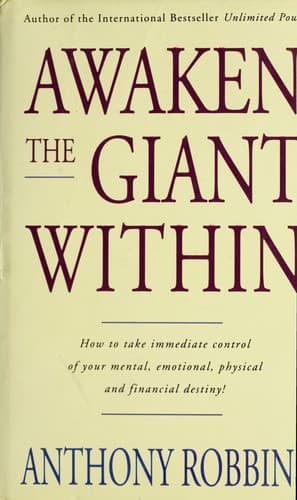
Core Idea
- Robbins’s core claim is that destiny is shaped from the inside out: what you decide, believe, focus on, and repeatedly condition determines your emotional, physical, relational, financial, and time outcomes.
- He argues that lasting change comes not from “willpower” alone but from changing the internal machinery of behavior: standards, beliefs, strategies, pain/pleasure associations, questions, metaphors, values, rules, references, and identity.
- The book is built as a practical manual for immediate change, with Robbins insisting that people can alter their state and behavior quickly if they stop letting circumstances, habits, and cultural conditioning run them.
How Change Happens
- The first lever is decision: Robbins defines a real decision as cutting off other options and following it with action, not merely preferring or wishing.
- He pairs decision with the Ultimate Success Formula: decide what you want, take action, notice feedback, and change strategy until you succeed.
- He repeatedly warns against the Niagara Syndrome, in which people drift with current events and fear instead of choosing a destination.
- The deeper driver of behavior is pain and pleasure; people do what they believe will reduce pain or increase pleasure, even when that creates long-term suffering.
- His solution is to reassociate: link pain to old habits and pleasure to new ones until the new pattern becomes automatic.
- He frames most procrastination, addiction, and self-sabotage as failures to manage these associations, not as fixed character defects.
- Neuro-Associative Conditioning (NAC) is his six-step change method: decide what you want, get leverage, interrupt the pattern, create an alternative, condition it, and test it for ecology.
- “Get leverage” means making the cost of staying the same more painful than changing; “pattern interruption” means breaking the old state; “ecology” asks whether the new behavior fits the larger life system.
- He stresses that real change often requires repetition and reinforcement, not a single insight, because people are conditioned over time and must be reconditioned over time.
Beliefs, State, and the Master System
- A major thesis is that events do not control people; meanings do: two people can live through similar trauma and emerge with radically different identities because they interpret the experience differently.
- Beliefs are described as feelings of certainty built from “reference legs” — accumulated memories, examples, images, and emotional experiences that support a conclusion.
- Robbins distinguishes opinions, beliefs, and convictions by emotional intensity, and warns that convictions can drive greatness or fanaticism.
- He says change often begins when a belief becomes sufficiently painful to maintain, or when doubt cracks its “reference legs.”
- His Master System reduces behavior to five interacting elements: state, questions, values, beliefs, and references; changing one can change the whole system.
- Values are the emotional destinations people move toward or away from; conflicts between values explain self-sabotage, because the brain avoids the most painful outcome even when the goal is attractive.
- Rules are the conditions that determine when a value counts as satisfied; Robbins argues many people have impossible or externalized rules that make happiness hard to access.
- References are the raw material of belief, including personal experience, other people’s stories, books, media, and even imagination, which the brain can treat as real enough to condition certainty.
- Identity is the deepest layer: once people say “I am this kind of person,” their choices, rules, and references reorganize around that self-image.
State, Language, and Emotional Mastery
- Robbins says people mostly want external things because they want the state those things promise, such as love, pride, freedom, or meaning.
- He argues that state is shaped immediately by physiology: posture, breathing, facial expression, movement, and vocal intensity can change emotion fast.
- He uses questions as state-shaping tools, since what you ask determines what you notice and feel; better questions create better focus.
- He treats submodalities — brightness, size, distance, volume, speed, and similar sensory details — as ways to intensify or diminish experience.
- He also gives metaphors enormous power, since global frames like “life is war,” “life is game,” or “life is sacred” quietly govern behavior and emotion.
- Negative feelings are renamed Action Signals: fear, anger, hurt, frustration, disappointment, guilt, inadequacy, overwhelm, and loneliness each point to a needed change.
- Their counterparts are the Emotions of Power: love/warmth, gratitude, curiosity, excitement/passion, determination, flexibility, confidence, cheerfulness, vitality, and contribution.
- The practical aim is not emotional suppression but state control: notice what you feel, appreciate the signal, find the message, and shift into a resourceful state.
The Applications Robbins Emphasizes
- Robbins extends the same model to the book’s “destiny” areas: mental, emotional, physical, relationship, financial, and time mastery.
- In the physical section, he distinguishes fitness from health and argues for building an aerobic base, using heart-rate awareness, and avoiding a culture of chronic anaerobic stress.
- In relationships, he says success depends on knowing one another’s values and rules, choosing to be in love rather than right, and keeping intimacy alive through conscious reassociation and vocabulary.
- In financial mastery, he treats wealth as a matter of value creation, spending less than you earn, investing the difference, protecting assets, and aligning money with contribution rather than scarcity or resentment.
- In time mastery, he argues stress is often a time-frame problem; mastery means shifting frames, prioritizing importance over urgency, and learning to distort time through focus and sequencing.
- The recurring practical ethic is CANI — Constant And Never-ending Improvement: tiny, believable gains compound into major change.
- Robbins also leans heavily on modeling excellence: study people who already produce the results you want and borrow their beliefs, strategies, and emotional patterns.
- He treats contribution as central: the healthiest use of power is to help others, because meaning, certainty, and fulfillment grow when life is organized around service.
What To Take Away
- Robbins’s book is less about motivation than about reprogramming the decision-making system that generates behavior.
- The book’s central tools are decision, leverage, pattern interruption, conditioning, and modeling, all aimed at changing internal associations rather than merely managing outward conduct.
- His most important diagnostic idea is that many problems are rules, values, or identity conflicts disguised as behavior problems.
- The book’s distinctive promise is that if you can change your state, language, references, and standards, you can change the quality of your life faster than you think.
Generated with GPT-5.4 Mini · prompt 2026-05-11-v6