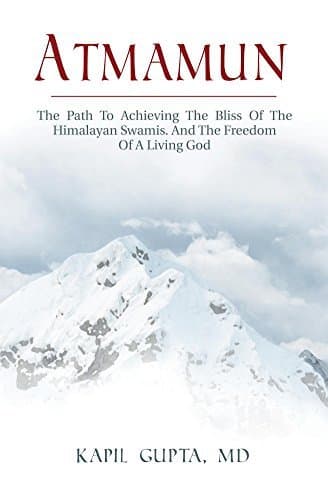
Core Idea
- Atmamun means the “Mind of the Spirit” and is presented as a path to bliss, No-Mind, and the freedom of a living god.
- The book’s central claim is that you are not your mind; most human suffering comes from mistaking the mind’s activity for the self and trying to improve captivity instead of escaping it.
- Liberation, in the author’s view, is not self-improvement, positive thinking, or technique; it is seeing through the manufactured self and giving oneself wholly to truth, God, or direct reality.
The Mind as Prison
- The author describes ordinary life as “Spinal Cord Existence”: thought produces emotion, emotion produces behavior, behavior produces consequences, and the cycle repeats.
- The mind is portrayed as a prison of likes/dislikes, cravings, aversions, hopes, vices, ideals, prejudices, and philosophies.
- Positive thinking is rejected as another prison, because it still comes from the same mind and merely swaps one form of bondage for another.
- Bliss is defined as equanimity rather than happiness; nature is used as the model because it does not divide events into good and bad.
- What people call “the self” is often only a manufactured self: body image, preferences, reputation management, habits, and social persona maintained by the mind.
- The book treats the ordinary ego as the illusion that “you exist at all” as a separate entity, not merely as vanity or pride.
- A key exercise is to let the “person in the mirror” be alone for a few minutes, revealing a strange lightness and confusion when the persona is not continuously fed.
Death, Time, and the Urgency of Truth
- The author says the most important awakening begins with death-awareness: not intellectual knowledge that you will die, but a heart-level realization that your time is running out.
- He contrasts knowing of the head with knowing in the heart; only the latter has transformative force.
- Human beings live as if time is abundant, and that illusion causes them to squander life and postpone seriousness.
- He argues that if birth certificates announced the time of impending death, people would waste less time and live with far more intensity.
- Death is presented as the great motivator because it collapses trivial concerns and makes one value the present moment.
- The common pursuit of retirement plans, life management, and future security is treated as a distraction from the fact that death comes without appointments.
- The author repeatedly insists that bliss is available in this very moment, not after circumstances improve.
Surrender, God, and the Price of Freedom
- The road to God is not religious barter, prayer for favors, or worship as insurance; it is total surrender with no divided loyalty.
- The book’s recurring metaphor is the leaf in the river: only when the leaf gives itself wholly does it become one with the river’s power.
- The “price” of God is the loss of the separate self; there is no room for both “you” and God.
- Historical figures such as Francis of Assisi and Meera are cited as examples of lives so surrendered that they appeared insane to ordinary people.
- The author rejects partial enlightenment and says there can be no compromise: one must want the kingdom of God more than oneself.
- He also uses the Sahara/water metaphor: a thirsty person does not need information about water, but to drink it; likewise, one must not merely study God but “drink” God.
- The same logic underlies his view of wealth, success, family, and spirituality: they are not the problem, but attachment to them is.
Life, Conflict, and Performance
- Life is portrayed as fundamentally meaningless, absurd, and undefinable; meaning is said to be an intellectual overlay humans project onto raw existence.
- Because life has no inherent meaning, one is freed to pursue greatness, craft, or wealth without needing those things to justify existence.
- The author distinguishes work from art: a person who loves his trade is an artist, while a “job” is treated as a form of slavery.
- In his view, most people are trained to be workers and sheep rather than kings; a king is someone who possesses things without being possessed by them.
- He extends the same idea to elite performance: exceptional athletes and performers are shaped more by perception, innocence, devotion, and inner clarity than by technique alone.
- In golf, for example, he argues that the body responds to perception, and that fear of losing often creates the losing outcome.
- His concept of mindfulness is sharply criticized as effortful and unsustainable; he prefers Awareness, Wakefulness, and especially No-Mind.
- Meditation is redefined as a way of being, not a 20-minute practice: brushing teeth, driving, working, and speaking can all become meditation when the doer disappears.
- “World peace” is dismissed as a dodge; the true gift to the world is peace in one’s own life, since outer conflict reflects inner conflict.
- Parenting is heavily criticized because parents often project their own minds onto children, trying to control rather than love them.
- Children are said to need silence, freedom, and peace, not lectures, indoctrination, or the parent’s fears and prejudices.
- The family is described as dangerous because mind collides with mind through guilt, expectation, and control.
What To Take Away
- The book’s core move is to replace self-improvement with self-transcendence: stop polishing the persona and see through it.
- Its most recurring test is whether you can value truth, death-awareness, and surrender more than comfort, identity, and time.
- Its harshest claims about mind, family, work, and spirituality all point to the same thesis: freedom begins when you stop being owned by thought, attachment, and the manufactured self.
- The author frames Atmamun as a non-teaching: a path away from techniques and slogans toward direct seeing, No-Mind, and immediate peace.
Generated with GPT-5.4 Mini · prompt 2026-05-11-v6