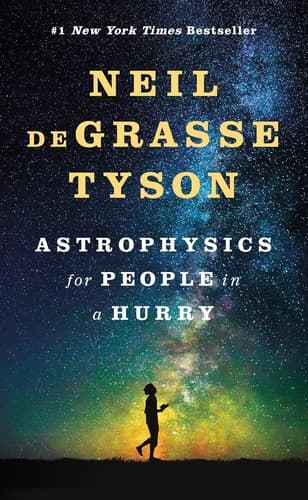
Core Idea
- Tyson’s central claim is that astrophysics is a coherent, evidence-based story of the universe, from the hot big bang to galaxies, stars, planets, and life.
- The deepest theme is universality: the same physical laws and constants apply everywhere, so the heavens are not mystical but scientifically knowable.
- A second major theme is cosmic incompleteness: most of the universe is still invisible to us, with dark matter and dark energy dominating the cosmic budget.
How the Universe Became What It Is
- The universe began in an extremely hot, dense state smaller than a pinhead, with forces initially unified before separating into the strong, electroweak, electromagnetic, weak, and gravitational forces.
- Tyson treats the Planck era as a hard limit of current theory, because general relativity and quantum mechanics are not yet reconciled there.
- In the first moments, the universe was a plasma of quarks, leptons, bosons, and antimatter partners; a tiny matter surplus, about a billion-and-one to a billion, allowed anything to remain after annihilation.
- As cooling continued, quarks formed hadrons, then nuclei, and about 380,000 years later electrons bound to nuclei and light began traveling freely.
- That released light is the cosmic microwave background (CMB), which Tyson treats as the most important empirical anchor for modern cosmology.
- The CMB lets scientists infer the universe’s temperature, composition, geometry, and likely fate from its spectrum and tiny fluctuations.
- Tyson’s memorable point is that without the matter-antimatter imbalance, the universe would have been mostly photons, with no stars, planets, or people.
Why Astronomy Counts as Hard Science
- Newton established that the same laws of motion and gravity govern both Earth and the sky, collapsing the old division between terrestrial and celestial physics.
- Spectroscopy extended that universality by showing that the Sun and distant stars are made of the same elements found in laboratories on Earth.
- The discovery of helium in the Sun before it was found on Earth is one of Tyson’s favorite examples of science moving from sky to lab.
- Tyson repeatedly stresses that constants such as big G, the speed of light, and the fine-structure constant appear universal and time-independent.
- Scientific theories gain strength by working across regimes: Newton explains ordinary gravity, while Einstein extends it to strong fields and light bending, and relativity reduces to Newtonian physics when conditions are mild.
- Tyson’s blunt motto is that after the laws of physics, everything else is opinion, meaning evidence outranks ideology or speculation.
The Invisible Majority and the Expanding Cosmic Census
- Dark matter was inferred because visible matter cannot explain galaxy-cluster dynamics or the rotation speeds of stars in spiral galaxies.
- Tyson highlights Fritz Zwicky’s Coma cluster work and Vera Rubin’s galaxy rotation curves as the decisive observations behind the dark-matter case.
- Ordinary hidden matter does not solve the problem well, because dark matter does not seem to absorb, emit, or scatter light and is not concentrated like familiar matter such as dust or planets.
- Tyson’s rough accounting gives dark matter about six times the gravity of ordinary matter.
- He notes alternative explanations such as modified gravity, extra dimensions, and multiverse leakage, but treats them as unproven compared with dark matter.
- Dark energy is even stranger: it behaves like a vacuum pressure or cosmological constant (lambda) that drives accelerated expansion.
- Einstein introduced lambda for a static universe, then abandoned it after Hubble showed the universe expands; the 1998 supernova results revived lambda under the name dark energy.
- Tyson emphasizes the vacuum-energy mismatch from quantum theory: the predicted value is more than 10^120 times larger than the observed one.
- His best-known census is the modern cosmic breakdown: about 68% dark energy, 27% dark matter, and 5% ordinary matter.
Matter, Light, and the Wider Search for Life
- The Periodic Table records cosmic history: the big bang made mostly hydrogen, helium, and a little lithium, while stars and supernovas forged heavier elements.
- Tyson keeps returning to iron as the fusion endpoint, because once a massive star builds iron it can no longer gain energy from fusion and becomes vulnerable to collapse and supernova.
- The chapter on spheres explains that gravity and surface tension naturally make round objects, from soap bubbles to planets, stars, pulsars, and even the observable universe.
- Rotation complicates that shape, since fast spin flattens bodies into oblate spheroids, seen in the Milky Way’s disk and Saturn’s squashed form.
- Astronomy is not limited to visible color; the electromagnetic spectrum includes radio, microwaves, infrared, ultraviolet, X-rays, and gamma rays, each revealing different phenomena.
- Radio can expose gas and pulsars, microwaves reveal the CMB, infrared can peer through dust, and X-rays or gamma rays uncover high-energy events.
- The solar system is not empty space but a crowded environment of meteors, asteroid belts, Kuiper Belt objects, the Oort cloud, solar wind, magnetic fields, and gravity-assisted debris.
- Exoplanet research shows that Earth-like worlds can be detected by transits, stellar wobble, and atmospheric spectroscopy.
- Tyson treats biomarkers such as oxygen, methane, and certain acids as possible hints of life or technology, while stressing that a signal’s presence does not by itself reveal its cause.
What To Take Away
- The universe is not a story of guesswork but a lawful history that leaves traces we can measure across vast time and space.
- The biggest unanswered questions are not small technicalities; they are the nature of dark matter and dark energy, which dominate the cosmos.
- Astronomy advances by widening what we can observe, from visible light to the full spectrum, from nearby objects to the CMB, and from direct sight to inference.
- Tyson’s larger message is philosophical as well as scientific: a cosmic perspective should make us humble, evidence-minded, and less centered on ourselves.
Generated with GPT-5.4 Mini · prompt 2026-05-11-v6