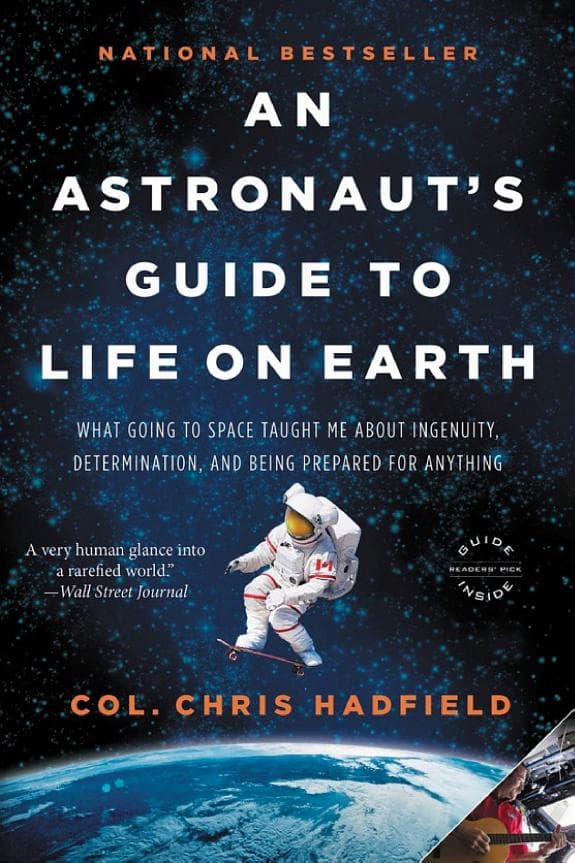
Core Idea
- Hadfield’s central lesson is prepare for the worst, and enjoy every moment of it: excellence comes from disciplined readiness, not entitlement or swagger.
- Becoming an astronaut was not destiny but a long chain of deliberate choices, detours, and habits that made him useful when opportunity finally appeared.
- The book argues that the real astronaut’s job is mostly on Earth—training, learning, debriefing, supporting others, and becoming the kind of person who can perform when conditions are uncertain.
How to Become the Kind of Person the Job Requires
- Hadfield starts with childhood and farm life, where chores, accountability, and persistence taught him that wanting something is not enough; you work for it after the necessary duties are done.
- After the Moon landing inspired him at age 9, he acted like an astronaut-in-training long before there was any realistic program to join: studying, reading, flying, skiing, and building competence wherever possible.
- He calls this posture “square astronaut, round hole”: he was not a natural fit for any obvious path, so he made himself fit through cumulative preparation.
- He avoided tying his self-worth to selection, because the odds were tiny; the point was to move in the right direction while staying psychologically intact.
- His marriage to Helene was central to the path, and he emphasizes that ambitious goals are never solo achievements.
- The route to NASA passed through setbacks and substitutions, including the canceled French test-pilot-school slot and the eventual U.S. Air Force Test Pilot School, which he describes as a “Ph.D. in flying.”
- He treats astronaut selection as a brutal filter rather than a glamorous prize: exhaustive résumés, medicals, interviews, long silence, and a final emotional response of relief more than triumph.
- Selection does not make someone an astronaut in the meaningful sense; it only begins years of further technical, physical, and psychological transformation.
Training, Teamwork, and the Discipline of Small Things
- NASA culture is intensely competitive, but the job requires turning competition into cooperation because long missions punish ego and reward crew fit.
- Early years at JSC felt like a status collapse from elite newcomer to ASCAN beside legends; the antidote was attitude, humility, and steady learning.
- He repeatedly stresses expeditionary behavior: help the group thrive, not just yourself, because on a small crew your own survival depends on everyone else.
- Leadership means setting others up to succeed, not grabbing the heroic role; even small self-serving acts, like trimming fingernails over a filter, can burden the team later.
- Humor, storytelling, and deliberate morale-building are operational tools, not luxuries; whining is corrosive because it spreads resentment in a confined, repetitive environment.
- He learned to criticize surgically—attack the problem, not the person—because ridicule and snap judgments poison trust.
- Training in survival courses, NOLS expeditions, and water/flight exercises built the habit of ignoring distractions and asking only, “What’s the next thing that could kill me?”
- In crises, astronauts are trained from fight-or-flight into warn, gather, work and a stepwise “working the problem” discipline.
- His aviation experience reinforced that boldface procedures are survival-critical and often written “in blood,” meaning they come from real accidents and hard lessons.
- He frames risk as acceptable only when the reward outweighs it, and insists astronauts must never add unnecessary risk themselves.
Living in Space, and Why It Matters on Earth
- The ISS is a huge, international, oddly segmented place whose routines—hatches, orientation, noise, sleep stations, Velcro, exercise, cleaning, and recycling—make adaptation a skill in itself.
- Weightlessness feels magical but takes weeks to become natural; even basic movements, hygiene, and sleep require learning new habits.
- Daily life is highly scheduled, yet microgravity also creates small pleasures—floating water, music, views from the Cupola, and the strange delight of ordinary actions made extraordinary.
- The station is both workplace and testbed: it supports exploration logistics while revealing what long-duration spaceflight does to the body, from bone loss and radiation exposure to vision changes and immune effects.
- Astronauts are also research subjects, and Hadfield notes both the value and the invasiveness of some experiments, drawing a line at anything that felt like giving away pieces of his flesh.
- He uses the station’s mundane details to make space legible to the public, which is why videos, photos, and later social media became part of his outreach mission.
- The Space Oddity video and his online following were not the mission itself, but tools for showing people that space is real, human, and full of recognizable daily life.
- Command changed his responsibility more than his routine: as commander he was accountable for crew and vehicle safety, and in emergencies he had to coordinate calmly even when tasks collided.
- The ammonia leak and unplanned EVA show the book’s core principle in action: success comes from preparation, cross-training, redundancy, and a crew that can adapt quickly without drama.
- His closing judgment is that he became a good fit for NASA not because he was a born astronaut, but because 21 years of preparation made him useful when the world’s spaceship needed someone dependable.
What To Take Away
- Preparation is a psychological strategy as much as a technical one: knowing what to expect reduces fear and makes real emergencies manageable.
- Small details matter because the difference between success and catastrophe in space often comes from residue, leaks, procedures, or one overlooked step.
- Team behavior is mission behavior: on a tiny crew, helping others, staying cheerful, and protecting morale are forms of self-protection.
- Hadfield’s deepest claim is not that space makes you special, but that disciplined habits on Earth can make you ready for improbable responsibility when it arrives.
Generated with GPT-5.4 Mini · prompt 2026-05-11-v6